Tuesday, December 09, 2014
Class Says Comcast Piggybacks on Homes to Set Up Public Network
FROM: http://www.courthousenews.com/2014/12/08/class-says-comcast-piggybacks-on-homes-to-set-up-public-network.htm
Class Says Comcast Piggybacks on Homes to Set Up Public Network
SAN FRANCISCO (CN) - A federal class action accuses Comcast of surreptitiously making its residential customers bear the cost of using their wireless routers to set up a secondary public wi-fi network.
Lead plaintiff Toyer Grear sued Comcast on Dec. 4.
He claims that Comcast saw its millions of residential customers as an opportunity to compete with major cellular carriers such as AT&T and Verizon. Though Comcast does not have cellular towers, its customers' households "could be used as infrastructure for a national wi-fi network," the complaint states.
So Comcast supplied its residential customers with new wireless routers equipped to broadcast their home wi-fi signals and additional wi-fi signals for the public, selectively activating the routers to broadcast the secondary public network (the "Xfinity wifi hotspot") across the country, with the goal of enabling 8 million hotspots by the end of 2014, according to the lawsuit.
"Public" in this case does not mean "free," but that access is available to anyone who pays to use a particular wi-fi hotspot.
Grear claims that Comcast does not request customers' authorization to use their residential equipment and networks for public use.
"Indeed, Comcast's contract with its customers is so vague that it is unclear as to whether Comcast even addresses this practice at all," the lawsuit claims.
In using its customers' home networks to build a national network, Comcast
"has externalized the costs of its national wi-fi network onto its customers," Grear says in the complaint.
He claims that the new routers use much more electricity than regular routers, and that this is "a cost borne by the unwitting customer."
Engineers at Speedify, a technology company that increases Internet connection speeds, ran tests on Comcast's new routers and determined that "Comcast will be pushing tens of millions of dollars per month of the electricity bills needed to run their nationwide public wi-fi network onto consumers," the complaint states.
Based on the results of this study, Grear claims, Comcast's residential customers can expect electricity cost increases as great as 30 to 40 percent.
In addition, Grear claims, the Xfinity hotspots slow down the speed of customers' home wi-fi networks, since these home networks are available for use by strangers.
They also expose Comcast's residential customers' data to increased privacy and security risks, according to the complaint.
Comcast declined to comment.
Grear seeks certification of a class of all households in the United States that have subscribed to Comcast's Xfinity Internet Service, and a subclass of all California households that have subscribed to the service.
He also seeks declaratory judgment, an injunction, restitution and damages for violations of the Computer Fraud and Abuse Act, the Comprehensive Computer Data Access and Fraud Act and California's Unfair Competition Law.He is represented by Gillian Wade and Sara Avila, with Milstein Adelman, of Santa Monica.


Sunday, December 07, 2014
(Tele)Visions of Tomorrow
This is a great read:
(Tele)Visions of Tomorrow
http://exhibitions.nypl.org/biblion/worldsfair/enter-world-tomorrow-futurama-and-beyond/essay/essay-kalan-television
The introduction of television to the American public has long been one of the most-discussed aspects of the 1939 World's Fair. But did anyone there realize how important this moment would be?
The Official Guide Book of the New York World's Fair expends only two sentences on television. More space is given to Nature’s Mistakes, a barnyard freak show featuring a bull with “skin so transparent that the veins are visible.” It’s possible that the editors, confronted with crazy items like Elektro the Moto-Man and a transatlantic “rocket gun,” assumed television was just another pie-in-the-sky fantasy.
Introducing Television at the Fair
http://exhibitions.nypl.org/biblion/worldsfair/enter-world-tomorrow-futurama-and-beyond/essay/essay-simon-television
The 1939 World’s Fair in New York was the coming-out party for television. For almost two decades before, networks and entrepreneurs were experimenting with the new electronic technology, hoping to perfect a mass communication system that would surpass radio.
(Tele)Visions of Tomorrow
http://exhibitions.nypl.org/biblion/worldsfair/enter-world-tomorrow-futurama-and-beyond/essay/essay-kalan-television
The introduction of television to the American public has long been one of the most-discussed aspects of the 1939 World's Fair. But did anyone there realize how important this moment would be?
The Official Guide Book of the New York World's Fair expends only two sentences on television. More space is given to Nature’s Mistakes, a barnyard freak show featuring a bull with “skin so transparent that the veins are visible.” It’s possible that the editors, confronted with crazy items like Elektro the Moto-Man and a transatlantic “rocket gun,” assumed television was just another pie-in-the-sky fantasy.
Introducing Television at the Fair
http://exhibitions.nypl.org/biblion/worldsfair/enter-world-tomorrow-futurama-and-beyond/essay/essay-simon-television
The 1939 World’s Fair in New York was the coming-out party for television. For almost two decades before, networks and entrepreneurs were experimenting with the new electronic technology, hoping to perfect a mass communication system that would surpass radio.
Thursday, December 04, 2014
New optical technique extracts audio from video
http://phys.org/news/2014-12-walls-optical-technique-audio-video.html
Those formerly silent walls can "talk" now: Researchers have demonstrated a simple optical technique by which audio information can be extracted from high-speed video recordings. The method uses an image-matching process based on vibration from sound waves, and is reported in an article appearing in the November issue of the journal Optical Engineering, published by SPIE, the international society for optics and photonics.
Those formerly silent walls can "talk" now: Researchers have demonstrated a simple optical technique by which audio information can be extracted from high-speed video recordings. The method uses an image-matching process based on vibration from sound waves, and is reported in an article appearing in the November issue of the journal Optical Engineering, published by SPIE, the international society for optics and photonics.
"One of the intriguing aspects of the paper is the ability to recover spoken words from a video of objects in the room," said journal Associate Editor Reiner Eschbach, a Research Fellow at Xerox Corp. "The paper shows that the sound creates minute vibrations in objects and that these vibrations ― given the right equipment ― can be picked up from a video signal. This is an interesting foray into a new application space and will, in my view, trigger interesting research in the field,"
The article, "Audio extraction from silent high-speed video using an optical technique," was authored by Zhaoyang Wang, Hieu Nguyen, and Jason Quisberth of the Department of Engineering of the Catholic University of America, and is available from the SPIE Digital Library.
The technique is based on the fact that sound waves are mechanical waves that cause air to vibrate when traveling, the paper notes. That vibration through air can cause vibration of objects located in its traveling path, especially if the objects are lightweight, thin, and flexible, such as a piece of paper. The vibrations, although usually with small amplitudes, can be detected and analyzed algorithmically, and audio reconstructed based on those calculations.
The authors used a subset-based image-correlation approach to detect the motions of points on the surface of an object, capturing target images with a high-speed camera and applying the Gauss-Newton algorithm and a few other measures to achieve very fast and highly accurate image matching. Because the detected vibrations are directly related to sound waves, a simple model was used to reconstruct the original audio information of the sound waves.
While other recent work in the area reports on more sophisticated techniques to compute motion signals, the authors chose a simpler image-matching approach to measure vibration. Because light can travel through air considerably farther than sound and can pass through glass, they anticipate that the technique may find applications such as the passive detection of conversations inside of a building from a far distance, Wang said. "We are currently improving the technique to increase its accuracy and sensitivity, make the measurements in real-time, and remove interference from other sources."
Explore further: Algorithm recovers speech from vibrations of potato-chip bag filmed through soundproof glass
FIREFOX VR - Experimental FIREFOX builds with VR interfaces.
FIREFOX VR
EXPERIMENTAL FIREFOX BUILDS WITH VR INTERFACES.
http://mozvr.com/
MozVR is our open lab, a VR website about VR websites, where we share experiments and code.
You will need a VR-enabled build of Firefox for Mac or PC, and an Oculus Rift headset. Support for additional devices coming soon. MozVR will also work with VR-enabled builds of Chromium. Once you have your VR-enabled browser and Rift, check our quick Read Me for configuration tips. On your first run, pressing "Enter VR" will prompt you to grant Fullscreen permission. Grant it and check the "Remember" option, if one is present. You will then be able to experience MozVR.
Paolo Favaro: Portable Light Field Imaging: Extended Depth of Field, Ali...
From ICCP11 Hosted by Carnegie Mellon University, Robotics Institute
April 8, 2011
Abstract:
Portable light field cameras have demonstrated capabilities beyond conventional cameras. In a single snapshot, they enable digital image refocusing, i.e., the ability to change the camera focus after taking the snapshot, and 3D reconstruction. We show that they also achieve a larger depth of field while maintaining the ability to reconstruct detail at high resolution. More interestingly, we show that their depth of field is essentially inverted compared to regular cameras. Crucial to the success of the light field camera is the way it samples the light field, trading off spatial vs. angular resolution, and how aliasing affects the light field. We present a novel algorithm that estimates a full resolution sharp image and a full resolution depth map from a single input light field image. The algorithm is formulated in a variational framework and it is based on novel image priors designed for light field images. We demonstrate the algorithm on synthetic and real images captured with our own light field camera, and show that it can outperform other computational camera systems.
Bio:
Paolo Favaro received the D.Ing. degree from Universita di Padova, Italy in 1999, and the M.Sc. and Ph.D. degree in electrical engineering from Washington University in St. Louis in 2002 and 2003 respectively. He was a postdoctoral researcher in the computer science department of the University of California, Los Angeles and subsequently in Cambridge University, UK. Dr. Favaro is now lecturer (assistant professor) in Heriot-Watt University and Honorary Fellow at the University of Edinburgh, UK. His research interests are in computer vision, computational photography, machine learning, signal and image processing, estimation theory, inverse problems and variational techniques. He is also a member of the IEEE Society.
Rambus Lensless Camera Demo
From: http://image-sensors-world.blogspot.com/2014/12/rambus-lensless-camera-demo.html
Rambus publishes a Youtube video with Patrick Gill showing the company's lensless camera operation:
Dr. Patrick Gill demonstrates a diffraction-based lensless imaging system
Meanwhile, it appears that Rambus somewhat downplays its image sensor activities in its recent investor presentations. For example, in the Nov. 2014 presentation, imaging appears in only one slide #29:

Rambus publishes a Youtube video with Patrick Gill showing the company's lensless camera operation:
Dr. Patrick Gill demonstrates a diffraction-based lensless imaging system
Meanwhile, it appears that Rambus somewhat downplays its image sensor activities in its recent investor presentations. For example, in the Nov. 2014 presentation, imaging appears in only one slide #29:
Gangnam Style Has Been Viewed So Many Times It Broke YouTube’s Code
PSY’s Gangnam Style has been viewed so many times that it broke YouTube’s view counter, making it the very first video to break the reaches of a 32-bit integer.

Tuesday, December 02, 2014
The Digital Sex Industry
Soon, virtual reality is going to crash into our lives in a way we never
even imagined. Though dating and masturbating have long been
commandeered by the web, it's only been as a kind of middleman. Now
we're nearing the possibility of falling in love with your computer, as
meeting your dream partner could be as easy as slipping on Oculus
Rift—the most advanced virtual reality headset in the world.
The Digital Love Industry (Full Length)
Intel post promotional videos for its 3D camera-based RealSense
Another Two Video Promotions from Intel
Intel keeps posting promotional videos for its 3D camera-based RealSense technology. The first one shows refocusing capability similar to Lytro, Pelican Imaging and some Nokia products:
second video demos 3D scanning:
http://www.intel.com/content/www/us/en/architecture-and-technology/realsense-overview.html
https://software.intel.com/en-us/realsense/home Intel® RealSense™ Developer Kit.
Intel keeps posting promotional videos for its 3D camera-based RealSense technology. The first one shows refocusing capability similar to Lytro, Pelican Imaging and some Nokia products:
second video demos 3D scanning:
http://www.intel.com/content/www/us/en/architecture-and-technology/realsense-overview.html
https://software.intel.com/en-us/realsense/home Intel® RealSense™ Developer Kit.
Monday, December 01, 2014
Obama Calls For $75 Million In Funding for 50,000 Police Body Cameras
Today President Obama proposed $263 million in funding for law enforcement to help avoid another disaster like the ongoing mess in Ferguson, Missouri.
http://gizmodo.com/obama-to-provide-75-million-in-funding-f…
David Brin SAID:
Cop
cams... a trend predicted way back in 1997... were resisted and
resisted -- till they suddenly became a no-brainer obvious. Now: The
Obama Administration is proposing " $75 million for a Body Worn Cameras
Partnership, which would help states purchase and store the new
equipment." Next step of course (also circa 1997)? Often-stopped youths
will step out of the car armed... with their own cameras.
Sunday, November 30, 2014
Saturday, November 29, 2014
Friday, November 28, 2014
Infrared thermal Imaging Hack-a-thon

FLIR ONE Hack-a-thon:
Infrared thermal Imaging Camera for your Smartphone

At the HackerDojo
Start: Friday, December 12 2014 at 1:00pm
End: Sunday, December 14 2014 at 9:00am
Contact:
Carlos.Uranga@Hackerdojo.Com; Interim Assistance: Anil.Reddy@Hackerdojo.Com, Jaun.Alvarez@Hackerdojo.Com
URL: http://goo.gl/Q4ixKX
Fee: Free for first 50 participants, $15 thereafter per person. Click on the link above to reserve your ticket now!
Details:
Join FLIR and HackerDojo in a 38-hour Hack-a-thon to develop cool and interesting iOS apps for the FLIR ONE!
Cash, products, and promotional prizes for best apps in four categories.
Event Agenda
Friday 12/12
4:00 p.m.- 6:00 p.m. - FLIR ONE Hack-A-Thon Event Kickoff and Keynotes
6:00 p.m.- 12:00 a.m. - FLIR ONE Hack-A-Thon with Hourly Prize Drawings*
*Must be present to win
Saturday 12/13
12:00 a.m.- 12:00 a.m. - FLIR ONE Hack-A-Thon Continues with Hourly Prize Drawings
Sunday 12/14
12:00 a.m.- 8:00 a.m. - FLIR ONE Hack-A-Thon Continues
8:00 a.m.- 12:00 p.m. - Developer Presentations and Demonstrations
12:00 p.m.- 1:00 p.m. - Catered Lunch and Judging
1:00 p.m. - Award Ceremony
Best New App Prizes
1st - $5000 +FLIR ONEs for the entire team + FLIR FX
2nd - $2000 + FLIR ONEs for the entire team + Flir FX
3rd - $1000 + FLIR ONEs for the entire team
4th - $500 + FLIR ONEs for the entire team
5th - FLIR ONEs for the entire team
Additional prizes: Best app in each category - $1000 + FLIR ONEs
App categories: Work, Home, Play, Games/Entertainment
Cash, products, and promotional prizes for best apps in four categories.
Event Agenda
Friday 12/12
4:00 p.m.- 6:00 p.m. - FLIR ONE Hack-A-Thon Event Kickoff and Keynotes
6:00 p.m.- 12:00 a.m. - FLIR ONE Hack-A-Thon with Hourly Prize Drawings*
*Must be present to win
Saturday 12/13
12:00 a.m.- 12:00 a.m. - FLIR ONE Hack-A-Thon Continues with Hourly Prize Drawings
Sunday 12/14
12:00 a.m.- 8:00 a.m. - FLIR ONE Hack-A-Thon Continues
8:00 a.m.- 12:00 p.m. - Developer Presentations and Demonstrations
12:00 p.m.- 1:00 p.m. - Catered Lunch and Judging
1:00 p.m. - Award Ceremony
Best New App Prizes
1st - $5000 +FLIR ONEs for the entire team + FLIR FX
2nd - $2000 + FLIR ONEs for the entire team + Flir FX
3rd - $1000 + FLIR ONEs for the entire team
4th - $500 + FLIR ONEs for the entire team
5th - FLIR ONEs for the entire team
Additional prizes: Best app in each category - $1000 + FLIR ONEs
App categories: Work, Home, Play, Games/Entertainment
Notes:
Ideally teams of 1-4, hacking the future!
Check back weekly for further updates.
Check back weekly for further updates.
Thursday, November 27, 2014
Wednesday, November 26, 2014
police use of body cameras cuts violence and complaints
http://www.theguardian.com/world/2013/nov/04/california-police-body-cameras-cuts-violence-complaints-rialto
"I think we've opened some eyes in the law enforcement world. We've shown the potential," said Tony Farrar, Rialto's police chief. "It's catching on."
Body-worn cameras are not new. Devon and Cornwall police launched a pilot scheme in 2006 and forces in Strathclyde, Hampshire and the Isle of Wight, among others, have also experimented.
But Rialto's randomised controlled study has seized attention because it offers scientific – and encouraging – findings: after cameras were introduced in February 2012, public complaints against officers plunged 88% compared with the previous 12 months. Officers' use of force fell by 60%.
"When you know you're being watched you behave a little better. That's just human nature," said Farrar. "As an officer you act a bit more professional, follow the rules a bit better."
Cops Deleted Video, But it Survived on the Cloud
http://thefreethoughtproject.com/cops-beat-man-7-month-pregnant-wife-deleted-video-survived-cloud/
Denver, CO — The Denver police
department has been accused of using excessive force after a video,
which they allegedly deleted, survived on the cloud and was turned into FOX 31.
After the police-on-pregnant woman violence subsided, Frasier says that’s when the Denver police officers became interested in his Samsung Tablet.
After the police-on-pregnant woman violence subsided, Frasier says that’s when the Denver police officers became interested in his Samsung Tablet.
Fraiser told FOX 31
that officers on scene threatened him with arrest, demanded he turn
over all photos and videotape to them and then seized his tablet over
his objections.
“When he took it, I said, ‘Hey! You can’t do that. You need a warrant for that!’ and he said, ‘What program did you take the video with? Where is that?’” Frasier said.
According to Frasier, when he got back his tablet, the video was gone. “I couldn’t believe it. My heart dropped. I know I just shot that video, like it’s not on there now?” Frasier said.
Frasier said it’s “possible” both he and the police officer who looked through his tablet “missed seeing” the clip inside his files.
However, Frasier said he suspects, in reality, the clip was deleted either with intention or by mistake.
When he got back home that evening, Fraiser synced his tablet with his electronic cloud and within a few moments, the video reappeared.
“It was very well known that the video was shot and things were done on the video that shouldn’t be leaked out, that it would be bad for the reputations of the police officers,” Frasier said.
Despite his friends telling him to delete the video for fear that the officers would seek revenge, Fraiser did the courageous thing and submitted it to FOX31, and for this Frasier deserves credit.
“When he took it, I said, ‘Hey! You can’t do that. You need a warrant for that!’ and he said, ‘What program did you take the video with? Where is that?’” Frasier said.
He said police ignored his objections and dug through his personal photos without obtaining a court order.
“The first officer that comes up to ask me about my witness statement brings me to the police car and says we could do this the easy way or we could do this the hard way,” Fraser said. “It was taken as ‘You can either cooperate and give us what we want or we’re going to incarcerate you.’”According to Frasier, when he got back his tablet, the video was gone. “I couldn’t believe it. My heart dropped. I know I just shot that video, like it’s not on there now?” Frasier said.
Frasier said it’s “possible” both he and the police officer who looked through his tablet “missed seeing” the clip inside his files.
However, Frasier said he suspects, in reality, the clip was deleted either with intention or by mistake.
When he got back home that evening, Fraiser synced his tablet with his electronic cloud and within a few moments, the video reappeared.
“It was very well known that the video was shot and things were done on the video that shouldn’t be leaked out, that it would be bad for the reputations of the police officers,” Frasier said.
Despite his friends telling him to delete the video for fear that the officers would seek revenge, Fraiser did the courageous thing and submitted it to FOX31, and for this Frasier deserves credit.
Monday, November 24, 2014
Sony Promotes 4K Resolution for Security Applications
Sony publishes Youtube video showing 4K technology for security cameras:
Another Sony video demos 5-axis optical image stabilization operation in Alpha 7-II DSLR, said to be the first in a full-frame camera.
Another Sony video demos 5-axis optical image stabilization operation in Alpha 7-II DSLR, said to be the first in a full-frame camera.
Sunday, November 23, 2014
Thursday, November 20, 2014
Tuesday, November 18, 2014
Fwd: video book with 3 sensors
---------- Forwarded message ----------
From: Masrui video brochure
Subject: video book with 3 sensors
From: Masrui video brochure
Subject: video book with 3 sensors
5inch video book,each page has a video.see how it works:https://www.youtube.com/watch?v=xIP11P1gJ0s


Monday, November 17, 2014
Sunday, November 16, 2014
The Motley Fool predicts the end of TV.

THE $2.2 TRILLION WAR FOR YOUR LIVING ROOM BEGINS NOW
And the big winners will surprise you. One simple test (explained in this video) shows you how to bag these 3 killer stocks & maximize your profit potential.
http://www.fool.com/video-alert/stock-advisor/sa-cabletv-ext/
Thursday, November 13, 2014
Wednesday, November 12, 2014
Mozilla's new site MozVR virtual reality web site.
Mozilla Research VR Team just launched MozVR.com to foster VR-native sites. The page lets Oculus Rift owners browse technology demos (in a Rift-friendly interface, naturally) that show off what VR can do on the web.
Mozilla is sharing the code, tools and tutorials for its own front end.
http://mozvr.com/
http://mozvr.com/content/2014/11/10/mozvr-launches.html
Tuesday, November 11, 2014
The Work of Dr. Harold Edgerton as presented by Dr. Kim Vandiver
This may seem some what off topic, but if you love photography and history this is about the first flash photos,
Edgerton's work in stop motion photography advanced many areas of science and technology.
Temporal Aliasing of Guitar Strings
This neat little trick is possible because of the rolling shutter of the phone's camera. Note that the 'waves' seen are temporal; the strings are actually vibrating up and down remaining horizontal.
Read this blog post for an excellent explanation: http://danielwalsh.tumblr.com/post/54...
Read this blog post for an excellent explanation: http://danielwalsh.tumblr.com/post/54...
Sunday, November 09, 2014
Thursday, November 06, 2014
Optical super reflector: for specific wavelength the light is perfectly reflected
http://inhabitat.com/mit-creates-perfect-mirror-with-zero-distortion-signaling-breakthrough-for-solar-power/
MIT Creates World's First 'Perfect Mirror' with Zero Distortion, Signaling Breakthrough for Solar Power
Scientists at MIT just announced that they have created the perfect mirror – and it could signal a breakthrough for solar power technology. The team’s “perfect mirror” is capable of reflecting any type of wave — light, sound, or water — with absolutely zero distortion, so it could provide a huge boost to concentrated solar power installations, which use mirrors to focus concentrated beams of sunlight onto a specific area.
Ever feel like what you see in the mirror can’t possibly be accurate? Well, there’s actually some truth to that. All mirrors absorb some of the light waves that hit them or scatter photons around in different directions, resulting in slight distortion. When it comes to solar power installations, these tiny distortions can add up to big efficiency losses.
Marin Soljačić and colleagues from MIT’s photonics and electromagnetics group didn’t set out to create a perfect mirror that could eliminate these inefficiencies – as in many scientific discoveries, they stumbled upon it while investigating something else. ExtremeTech explains:
The team was studying the behavior of a photonic crystal — in this case, a silicon wafer with a nanopatterned layer of silicon nitride on top — that had had holes drilled into it, forming a lattice. These holes are so small that they can only accommodate a single light wave. At most angles, light was partially absorbed by the photonic crystal, as they expected — but with a specific wavelength of red light, at an angle of 35 degrees, the light was perfectly reflected. Every photon that was emitted by the red light source was perfectly bounced back, at exactly the right angle, with no absorption or scattering.
This work is “very significant, because it represents a new kind of mirror which, in principle, has perfect reflectivity,” says A. Douglas Stone, in a press release. Stone is a professor of physics at Yale University who was not involved in this research. The finding, he says, “is surprising because it was believed that photonic crystal surfaces still obeyed the usual laws of refraction and reflection,” but in this case they do not.
The researchers are still trying to figure out why this deviation from known scientific laws took place. However, there is some excitement about what a perfect mirror could mean for various industries. The most obvious application is more powerful and efficient lasers, but concentrated solar power and fiber optics could also be improved.
~ $300 for stereo video on PI.
Dual Camera input PI $215
Camera Boards are $30 each.
http://www.adafruit.com/products/1367
I think this price is mostly driven by OpenCV users and other hobbiests driving up prices to be too high to use internal to all but high ticket products.
Magic Leap raises $542 million for Augmented Reality (AR).
http://www.theverge.com/2014/10/21/7026889/magic-leap-google-leads-542-million-investment-in-augmented-reality-startup
http://www.magicleap.com/
Google is leading a huge $542 million round of funding for the secretive startup c, which is said to be working on augmented reality glasses that can create digital objects that appear to exist in the world around you. Though little is known about what Magic Leap is working on, Google is placing a big bet on it: in addition to the funding, Android and Chrome leader Sundar Pichai will join Magic Leap's board, as will Google's corporate development vice-president Don Harrison. The funding is also coming directly from Google itself — not from an investment arm like Google Ventures — all suggesting this is a strategic move to align the two companies and eventually partner when the tech is more mature down the road.
Magic Leap's technology currently takes the shape of something like a pair of glasses, according to The Wall Street Journal. Rather than displaying images on the glasses or projecting them out into the world, Magic Leap's glasses reportedly project their image right onto their wearer's eyes — and apparently to some stunning effects.
"It was incredibly natural and almost jarring — you’re in the room, and there’s a dragon flying around, it’s jaw-dropping and I couldn’t get the smile off of my face," Thomas Tull, CEO of Legendary Pictures, tells the Journal. Legendary also took part in this round of investment, alongside Qualcomm, Kleiner Perkins, Andreessen Horowitz, and Obvious Ventures, among others. Qualcomm's executive chairman, Paul Jacobs, is also joining Magic Leap's board.
The eclectic mix of companies participating in this investment round speak to how broadly Magic Leap sees its potential. Its founder says that he wants the company to become "a creative hub for gamers, game designers, writers, coders, musicians, filmmakers, and artists." Legendary, which makes films including Godzilla and The Dark Knight, is interested in its potential for movies. Google likely sees far more ways to put it to use.
The technology sounds like it could be an obvious companion to Google Glass, but for now the Journal reports that they're not being integrated. Magic Leap declined to commented on what might happen down the road. Nonetheless, the investment in Magic Leap appears to be Google betting on augmented reality as the future of computing, pitting it in a fight against virtual reality competitors. Eventually, it'll likely be facing off against Facebook's Oculus Rift — the biggest name in VR right now, and one that Facebook was willing to pay $2 billion for.
Magic Leap also says that it may "positively transform the process of education."
Magic Leap is run and was founded by Rony Abovitz, who previously founded the medical robotics company Mako Surgical, which was sold for $1.65 billion last year. The Journal reports that Abovitz has a biomedical engineering degree from the University of Miami. He previously made a bizarre, psychedelic TEDx talk involving 2001, green and purple apes, and a punk band. His new company, which has been around since 2011, is headquartered in Florida, so it isn't exactly the typical tech startup out out of Silicon Valley. Abovitz says the location allows Magic Leap to recruit globally. It currently has over 100 employees.
Though Magic Leap's product sounds like a pair of augmented reality glasses, Abovitz and his company dislike the term. Magic Leap brands its effect as "Cinematic Reality," which sounds a bit cooler but doesn't really mean anything just yet. "Those are old terms – virtual reality, augmented reality. They have legacy behind them," Abovitz told the South Florida Business Journal back in February, after closing an initial round of funding. "They are associated with things that didn’t necessarily deliver on a promise or live up to expectations. We have the term cinematic reality because we are disassociated with those things. … When you see this, you will see that this is computing for the next 30 or 40 years. To go farther and deeper than we’re going, you would be changing what it means to be human."
This is all something that Google is eager to view the results of. "We are looking forward to Magic Leap's next stage of growth, and to seeing how it will shape the future of visual computing," Pichai says in a statement. What exactly Google will do with augmented reality is still unknown, but, much like how Google has managed to control a great deal of mobile computing through Android, it's been looking ahead to ensure that it doesn't miss out on the next leap either. It declined to provide further comment on the investment.
Talking to TechCrunch, Abovitz says that Magic Leap should be launching a product for consumers "relatively soon." There's no stated target date for now, though, and it sounds like it still has some development to do.
Stereo Vision and Depth Mapping with Two Raspi Camera Modules
http://hackaday.com/2014/11/03/stereo-vision-and-depth-mapping-with-two-raspi-camera-modules/
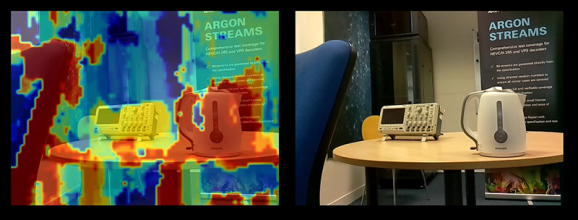
The Raspberry Pi has a port for a camera connector, allowing it to capture 1080p video and stream it to a network without having to deal with the craziness of webcams and the improbability of capturing 1080p video over USB. The Raspberry Pi compute module is a little more advanced; it breaks out two camera connectors, theoretically giving the Raspberry Pi stereo vision and depth mapping. [David Barker] put a compute module and two cameras together making this build a reality.
The use of stereo vision for computer vision and robotics research has been around much longer than other methods of depth mapping like a repurposed Kinect, but so far the hardware to do this has been a little hard to come by. You need two cameras, obviously, but the software techniques are well understood in the relevant literature.
[David] connected two cameras to a Pi compute module and implemented three different versions of the software techniques: one in Python and NumPy, running on an 3GHz x86 box, a version in C, running on x86 and the Pi’s ARM core, and another in assembler for the VideoCore on the Pi. Assembly is the way to go here – on the x86 platform, Python could do the parallax computations in 63 seconds, and C could manage it in 56 milliseconds. On the Pi, C took 1 second, and the VideoCore took 90 milliseconds. This translates to a frame rate of about 12FPS on the Pi, more than enough for some very, very interesting robotics work.
There are some better pictures of what this setup can do over on the Raspi blog. We couldn’t find a link to the software that made this possible, so if anyone has a link, drop it in the comments.
The Raspberry Pi has a port for a camera connector, allowing it to capture 1080p video and stream it to a network without having to deal with the craziness of webcams and the improbability of capturing 1080p video over USB. The Raspberry Pi compute module is a little more advanced; it breaks out two camera connectors, theoretically giving the Raspberry Pi stereo vision and depth mapping. [David Barker] put a compute module and two cameras together making this build a reality.
The use of stereo vision for computer vision and robotics research has been around much longer than other methods of depth mapping like a repurposed Kinect, but so far the hardware to do this has been a little hard to come by. You need two cameras, obviously, but the software techniques are well understood in the relevant literature.
[David] connected two cameras to a Pi compute module and implemented three different versions of the software techniques: one in Python and NumPy, running on an 3GHz x86 box, a version in C, running on x86 and the Pi’s ARM core, and another in assembler for the VideoCore on the Pi. Assembly is the way to go here – on the x86 platform, Python could do the parallax computations in 63 seconds, and C could manage it in 56 milliseconds. On the Pi, C took 1 second, and the VideoCore took 90 milliseconds. This translates to a frame rate of about 12FPS on the Pi, more than enough for some very, very interesting robotics work.
There are some better pictures of what this setup can do over on the Raspi blog. We couldn’t find a link to the software that made this possible, so if anyone has a link, drop it in the comments.
Lytro Hits Up The Enterprise With The Introduction Of The Lytro Platform And Dev Kit
https://www.lytro.com/files/LDK_Data_Sheet.pdf
https://www.lytro.com/platform/
From: http://techcrunch.com/2014/11/06/lytro-pivots-to-hit-up-the-enterprise-with-the-introduction-of-the-lytro-platform-and-dev-kit/
Lytro has been working for three years to build a brand new type of camera with light field technology, and while the tech itself is quite incredible, transforming that into a viable business has proven difficult.
Until now, the company has been selling special cameras, the original Lytro and the newer,photographer-friendly Illum. It’s a difficult business that is in fast flux, given that so many entry-level photographers now have a camera in their smartphone and more intensive photographers want a proper DSLR.
And so, Lytro is adding a new revenue stream to its business with the launch of the Lytro Development Kit. For now, it’s a software development kit that comes with an API for integrating light field technology into applications in a number of imaging fields, including holography, microscopy, architecture, and security.
Lytro’s light field sensor takes into account the direction that light is traveling relative to the shot, rather than capture light on a single plane. This, paired with Lytro’s software, allows for image refocusing post-shot, among other dimension-based features. With the LDK, Lytro is looking to open up that functionality to other field and businesses, with a revenue stream coming from the enterprise side.
Alongside access to the API and the Lytro processing engine, the company will also be working alongside partners to develop custom devices and photography hardware to accomplish their specific, industry-based goals.
With the launch, Lytro has announced four major partnerships with organizations already on the platform, including NASA’s Jet Propulsion Laboratory, a medical devices startup called General Sensing, the Army Night Vision and Electronic Sensors Directorate, and an unnamed “industrial partner” applying the tech to work with nuclear reactors.
Pricing starts at $20,000 for access to the platform. You can learn more here.
How a Real 3D Display Works
From: http://hackaday.com/2014/11/06/how-a-real-3d-display-works/
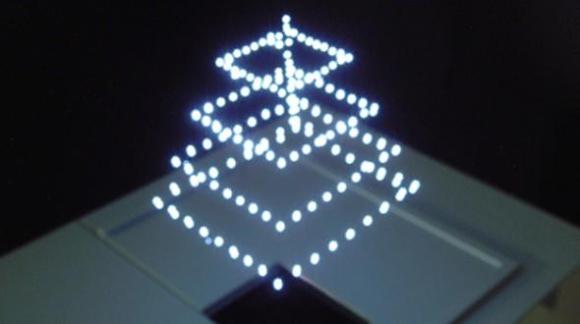
There’s a new display technique that’s making the blog rounds, and like anything that seems like its torn from [George Lucas]‘ cutting room floor, it’s getting a lot of attention. It’s a device that can display voxels in midair, forming low-resolution three-dimensional patterns without any screen, any fog machine, or any reflective medium. It’s really the closest thing to the projectors in a holodeck we’ve seen yet, leading a few people to ask how it’s done.
This isn’t the first time we’ve seen something like this. A few years ago. a similar 3D display technology was demonstrated that used a green laser to display tens of thousands of voxels in a display medium. The same company used this technology to draw white voxels in air, without a smoke machine or anything else for the laser beam to reflect off of. We couldn’t grasp how this worked at the time, but with a little bit of research we can find the relevant documentation.
A system like this was first published in 2006, built upon earlier work that only displayed pixels on a 2D plane. The device worked by taking an infrared Nd:YAG laser, and focusing the beam to an extremely small point. At that point, the atmosphere heats up enough to turn into plasma and turns into a bright, if temporary, point of light. With the laser pulsing several hundred times a second, a picture can be built up with these small plasma bursts.
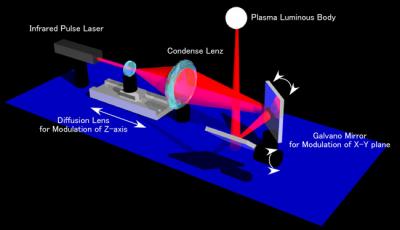
Moving a ball of plasma around in 2D space is rather easy; all you need are a few mirrors. To get a third dimension to projected 3D images, a lens mounted on a linear rail moves back and forth changing the focal length of the optics setup. It’s an extremely impressive optical setup, but simple enough to get the jist of.
Having a device that projects images with balls of plasma leads to another question: how safe is this thing? There’s no mention of how powerful the laser used in this device is, but in every picture of this projector, people are wearing goggles. In the videos – one is available below – there is something that is obviously missing once you notice it: sound. This projector is creating tiny balls of expanding air hundreds of times per second. We don’t know what it sounds like – or if you can hear it at all – but a constant buzz would limit its application as an advertising medium.
As with any state-of-the-art project where we kinda know how it works, there’s a good chance someone with experience in optics could put something like this together. A normal green laser pointer in a water medium would be much safer than an IR YAG laser, but other than that the door is wide open for a replication of this project.
Omnivision Automotive Image Sensor Demo
LowLightVideos publishes a video demo of Omnivision OV10640 OmniBSI 4.2um pixel sensor for automotive applications. The notable points in the video:
0:10 Driving down the road there are clouds in the night sky that can be seen, yet oncoming headlights are not blinding.
0:18 Driving in the underground during the day provides a fairly good image, though the trees outdoors are a bit washed out.
0:55 Driving into the Sun does not oversaturate the Sensor. Next, a turn into a dark underground which quickly and smoothly brightens up as we enter.
1:40 All those Headlights create a tiny bit of glare, but the clouds look pretty good in the night sky. Very little noise visible.
4:00 At night the Streetlights never get too bright and the glare is never too great, yet the sky has visible clouds and very little noise.
Peter Thiel Invests in PixelPlus
Korea Economic Daily reports that Peter Thiel, one of the legendary Silicon Valley investors and a former PayPal CEO, has acquired 3% stake in Korean image sensor maker PixelPlus. Reportedly, he paid 10 billion won (about $9.3M) , putting the company valuation at about 330 billion won, or $310M. Analysts expect the company value to jump to 500 billion won next year when it is to make IPO on the KOSDAQ. Pixelplus founder and president Lee Seo-gyu is said to own 24.4% stake in the company.
Pixelplus posted 149.4 billion won in sales revenue and 46.5 billion won in operating profit last year.
This Chinese Company Wants to Be the Next Oculus Rift
http://gadgets.ndtv.com/laptops/news/this-chinese-company-wants-to-be-the-next-oculus-rift-528008
As a part of our weekly series on Kickstarter and other crowdfunding websites, we try and find the most exciting new projects online. The Oculus Rift and the Pebble Smartwatch proved that the most interesting and innovative new products don't have to emerge from giant companies anymore, and we're watching out for the next big thing.
A Chinese company called ANTVR believes that will be its ANTVR Kit, a Virtual Reality kit, which they say is even better than the OculusRift. What's more, ANTVR claims its headset is compatible with different gaming platforms, and not just the PC, unlike the Rift. To bring the ANTVR Kit to production, the company has taken to Kickstarter.
Normally, when a company makes claims like that, you should start to feel skeptical, but the Kickstarter video includes testimony from people like Jan Goetgeluk, CEO at Virtuix, whose Omni treadmill is designed to work with the Oculus Rift. ANTVR also quotes David Helgason, the CEO and founder of Unity Technologies, as saying that "it's a really really great experience."
With some experts having tried out prototypes, this Kickstarter starts to sound like something which is real and exciting. At the time of writing, ANTVR has raised $171,991 out of a total target of $200,000, with 33 days left to go.
The headset looks similar to Oculus Rift, but we were initially sceptical about the idea that it could be used across platforms. However, the company claims it can do that by using the headset as just a head-mounted display, and not for VR. They note on the Kickstarter page that if the game is only 2D, then you can wear the headset to play as a 2D game on a large virtual screen. This means you can hook it up with consoles that have not been developed with its use in mind. Sony already has a somewhat similar product in the market, the Sony HMZ-T3Q.
But what's most interesting about the ANTVR might be the controller peripheral that the company has developed. This is pretty unique, and while it's shaped like a gun for use in shooter games, you can unfold it to reveal a full controller, or a steering wheel as well, which is pretty interesting. Since the HDMI cable to your computer will run from the front of this controller though, it might lead for some risky wire tangles, as the wire would be waved about as you play. There is a $200 wireless accessory available, though given how big a problem latency is already supposed to be, that sounds like a really bad idea.
The project is also pricing things similarly to the Oculus Rift Kickstarter, with a headset and controller coming for a $300 pledge. Until the commercial release of the Oculus Rift or Sony's Project Morpheus, this seems to be the standard benchmark for VR devices, though that will probably change once those other devices are widely available.
For now though, you can check out this video of the ANTVR in action below:
Oculus VR Headset's Consumer Version Is 'Very Close': CEO
http://gadgets.ndtv.com/wearables/news/oculus-vr-headsets-consumer-version-is-very-close-ceo-616607
Oculus VR, which is anticipated to launch the consumer version of the Oculus Rift, could launch the device soon, as it is "months, not years away", according to CEO, Brendan Iribe.
Oculus VR, which is anticipated to launch the consumer version of the Oculus Rift, could launch the device soon, as it is "months, not years away", according to CEO, Brendan Iribe.
Speaking at Web Summit 2014 in Dublin, Brendan Iribe, said (via The Next Web), "We're all hungry for it to happen. We're getting very close. It's months, not years away, but many months."
According to Iribe, the company has grown after the acquisition by Facebook in March, and now with a separate R&D division, the number of employees has increased from 75 to over 200.
Iribe also said that company's latest Crescent Bay prototype is "largely finalized for a consumer product", which was announced in September. Crescent Bay is an upgraded prototype of the Oculus Rift virtual reality headset that has higher resolution and built-in audio.
While the exact timing of the launch of the consumer version of the Rift virtual reality headset was not shared by Iribe, one thing we know from previous coverage is its approximate price.
In September, Oculus VR Founder, Palmer Luckey, in an interview said that the price range of the consumer version of the Rift could be between $200 and $400, which will depend on a number of factors.
(Also see: Five Essential Oculus Rift Gaming Experiences)
"We want to stay in that $200-$400 price range, [...] That could slide in either direction depending on scale, pre-orders, the components we end up using, business negotiations," said in an interview to Eurogamer.
Friday, October 17, 2014
Yet another flying camera that follows you around.

This was from the Stanford Berkeley robotics symposium today.
Thursday, October 16, 2014
Fwd: video brochure with ring binder-Ching


---------- Forwarded message ----------
From: Shenzhen Masrui Technology <masrui.deng@gmail.com>
Date: Thursday, October 16, 2014
Subject: video brochure with ring binder-Ching
To: Shenzhen Masrui Technology <masrui.deng@gmail.com>
Dear friend
How are you?

You may interested in this new model,check picture below:
samples are available

Masrui Specialized in Video Brochure 5 years ago ,have 2000㎡ factory now,we are cooperating with IBM ,BMW ,Samsung,Audi ... Also we have many Real Estate,Medical,Health Care,Sports,Health,Beauty... Customers .
Warmly welcome you to visit our factory if you come to Shenzhen ,China.
 | Ching Deng/manager partner | |
| Shenzhen Masrui Technology Co., Ltd. | ||
| T: 86 0755 29955866 | M: 86-13652367942 | ||
| Skype:masrui99 | MSN:masrui99@hotmail.com | ||
| W: http://www.masrui.com |
Wednesday, October 15, 2014

Saturday, October 11, 2014
Monday, September 22, 2014
Friday, September 19, 2014
Thursday, September 18, 2014

Monday, September 15, 2014
Saturday, September 13, 2014
Zambilight: The colorful update for your television
|


Fwd: FW: An HD helicopter camera that fits in your pocket!
|


Thursday, September 04, 2014
Subscribe to:
Posts (Atom)
