Showing posts with label spectrum. Show all posts

Thursday, September 30, 2021

USING A LASER TO BLAST AWAY A BAYER ARRAY


A Bayer array, or Bayer filter, is what lets a digital camera take color photos. It’s an array of tiny color filters that sit on top of a camera’s CCD. The filter makes it so that each sub-pixel in the image sensor only sees red, green, or blue light. The Bayer filter is an elegant tool that gives us color digital photos, but what would you do if you wanted to remove one?

[Les Wright] has devised a way to remove the Bayer filter from the Raspberry Pi Camera. Along with filtering red, green, and blue light for their respective sensors, Bayer filters also greatly reduce the amount of UV and IR light that make it to the CCD sensor. [Les] uses the Raspberry Pi camera in his Pi-based Spectrometer, and he wants to remove the Bayer filter to improve and expand its sensitivity.

Of course, [Les] isn’t the first one to want to do this. Some have succeeded in physically scratching the filter off of the CCD, but because the Pi Camera has vital circuitry around the outside of the sensor, scratching the filter off would likely destroy the circuitry. Others have stripped it off using chemical means, so [Les] gave this a go and destroyed no small number of cameras in his attempt to strip the filter off with solvents like DMSO, brake fluid, and industrial paint stripper.

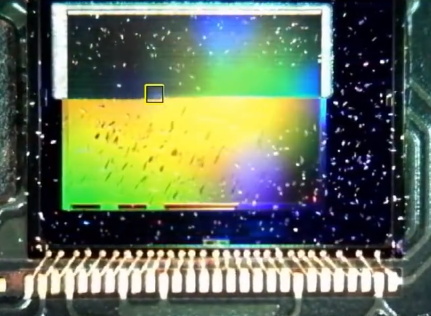
A look at the CCD, halfway through the process.

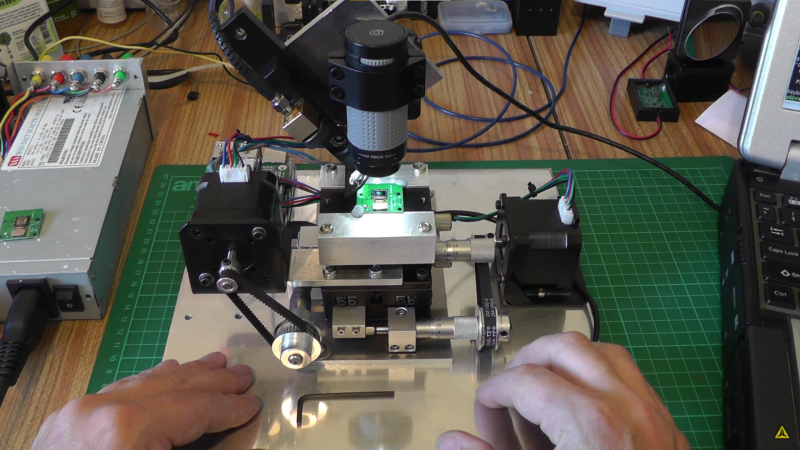
Inspired by techniques used in industry, [Les] eventually tried to use a several-kW nitrogen laser to burn off the filter (which seems appropriate given his experience with lasers). He built a rig that raster scans the laser across the sensor using stepper motors to drive micrometer bases. A USB microscope was included to allow progress to be monitored, and you can see a change in the sensor’s appearance as the filter is removed.

After blasting off the Bayer filter, [Les] plugged his improved camera into his home-built spectrometer and pointed it outside. The new camera gives the spectrometer much more uniform sensitivity and allows [Les] to see further into the IR and UV bands. The spectrometer can even detect the Fraunhofer lines—subtle dips in the sun’s spectrum from absorption by molecules in the atmosphere.

This is incredible for a DIY setup and instrument, and we can’t wait to see what [Les] does next to improve his measurements. If your spectrometry needs are more mass than visual, take a look at this home-built mass spectrometer. Home spectrometers aren’t just for examining light spectra—they can also be used to judge the ripeness of fruit!


 https://hackaday.com/2021/08/09/using-a-laser-to-blast-away-a-bayer-array/

Friday, June 08, 2012

Dinosaur Broadcasters Turn to Congress to Mandate Their Relevance

My Droid X has an FM radio.  It's sucks, it only works with the headphones plugged in and it doesn't work very well.  Add to that FM radio is really a low quality analog service when compared to MP3 and Internet based services like Pandora and iHeart Radio.

Even in my card I can listen to the station on AM or FM then switch to the iHeart Radio version and the sound quality is remarkable better it's immune to fading, assuming my Verizon Data Service doesn't cut out.

If they wish to push some emergency services for cell phone they would be far better off using something like my proposed Mobile Device Behavior Protocol. 


Click her to view a transcript of Gary Shapiro's testimony Wednesday, June 6.

FROM: Forbes,  Gary Shapiro,  May 30


Dinosaur Broadcasters Turn to Congress to Mandate Their Relevance


The technology of the audio industry is booming, leading to wonderful competition to generate new products. In this survival-of-the-fittest game, innovative products become more readily available while unpopular products disappear – except when the companies that make the outdated devices appeal to Congress to mandate old technology on new products – thus stifling innovation. One of these proposals was the topic of a House Committee on Energy and Commerce hearing today, where I testified on behalf of the companies who innovate. Specifically, broadcasters want to require that analog receivers be installed in a host of digital devices – a cell phone with an FM antenna.
At a time, where most agree that government is over reaching and when the economic bright spots are our innovation sectors, it seems incredible that this inane proposal choking a fast-developing new technology with an old technology would not pass the hee-haw test. But broadcasters still carry political weight, and many members of Congress fear them, so I found myself on the witness list this morning addressing why this idea makes as much sense as requiring every car be led by a horse.
We live in an amazing time, where wireless and the Internet have meshed to create a golden age of content creation. People can get news, music, video and other entertainment in many different ways. Also testifying today was the head of Pandora, whose service is sweeping America. Consumers can now buy music by the song, or all they can hear, or use any of several market offerings to sample, search and personalize. While some of the big distribution companies may see their market shrink, entrepreneurs and new creators rapidly jump in and create new services, products and groundbreaking content.
Broadcast radio now faces unprecedented competition, and despite already having the advantage of a free license for public spectrum and being the only media not to pay performers, it is stagnating. Broadcasters have lost their historic monopoly on music transmission, and they now exist in a more competitive environment. Indeed, digital audio advertising giant TargetSpot found nearly half of 18- to 24-year-olds (47 percent) spend less time listening to broadcast radio than they did a year ago. Not surprisingly, the steepest decline in broadcast radio listenership was among these “digital natives.”
At today’s hearing, Members of Congress on the House Energy and Commerce Committee also heard why the broadcasters’ plea to mandate an FM radio chip in each smartphone, ostensibly for emergency reasons, is a bad idea.
First, at least two dozen phones equipped with FM tuners are already in the marketplace for consumers who desire that feature. Most consumers surveyed say they don’t want Congress to mandate the FM chip, and their marketplace refusal to buy phones that have these FM chips speaks volumes.
Second, the delivery method is outdated and the extra hardware, including a special antenna, and design requirements increase production costs for little return in value.
Third, the role of radio in emergencies is diminishing rapidly. Many if not most radio stations are no longer manned 24-hours a day. People with cell phones can actually use the phone and a new system to send emergency text messages just recently mandated by Congress.
The correct answer for broadcasters is not to seek new laws or studies from Congress to protect their business model. Instead, broadcasters must do what other industries do when faced with new market entrants – learn to compete smarter and harder.
Wasting taxpayer funds on studying an unnecessary restriction on innovation is the kind of special interest expenditure that frustrates average Americans. You don’t have to be a member of the Tea Party to hate waste and special interest market intervention.
Innovation is driving our economy, and nowhere is this truer than the audio industry. Hardware manufacturers, online innovators and artists are all taking advantage of extraordinary new business opportunities. As always during times of disruptive innovation, incumbent industries are coming to Congress and requesting special protections. Congress should ignore these self-interested pleas, and continue to promote a vibrant and dynamic free market economy that creates investment and jobs.
Gary Shapiro is president and CEO of the Consumer Electronics Association (CEA)®, the U.S. trade association representing more than 2,000 consumer electronics companies, and author of The New York Times bestselling book, The Comeback: How Innovation Will Restore the American Dream.

Sunday, December 25, 2011

Television White Space Spectrum Approved For Use By FCC - Slashdot

http://mobile.slashdot.org/story/11/12/25/0319201/television-white-space-spectrum-approved-for-use-by-fcc
"The unused spectrum now assigned to television broadcast has been made available for public use by the FCC. This is going to be used for wireless applications (PDF) with implications that it will generate as much investment as the previous Wi-Fi spectrum. It also happens to be the last available spectrum to be exploited."

Friday, December 02, 2011

Comcast & Time Warner have agreed to sell their wireless licenses

From USA Today:


NEW YORK – Cable companies Comcast, Time Warner Cable and Bright House Networks are giving up on their dreams of creating their own wireless network, opting instead to resell Verizon Wireless service.

The companies said Friday that they have agreed to sell their wireless licenses — which they haven't been using — to Verizon Wireless for $3.6 billion.
The deal "amounts to a partnership between formerly mortal enemies," said analyst Craig Moffett at Sanford Bernstein. The cable companies compete with Verizon Communications Inc., Verizon Wireless' parent company, for phone and cable-TV customers. Now, Verizon Wireless stores will be selling cable service.
Cable companies have long had ambitions to open a second front against AT&T and Verizon by setting up their own wireless networks. In the meantime, some of them have partnered with Sprint Nextel and Clearwire to offer wireless service.
Lately, there had been speculation that the cable companies would try for a deeper beachhead in wireless by investing in ailing No. 3 and 4 carriers Sprint or T-Mobile USA. That talk had gained currency as it's become clear that AT&T's deal to buy T-Mobile USA is firmly opposed by regulators.
The link-up with No. 1 carrier Verizon Wireless and the sale of the spectrum appears to preclude a deal between a cable consortium and one of the weaker players in wireless. Instead, the biggest cellphone company will strengthen its hand, if the spectrum sale is approved by regulators.
"Pity poor T-Mobile. Verizon just ran off with the last pretty girl in the bar," Moffett said.
U.S.-listed shares of Deutsche Telekom AG, the parent of T-Mobile USA, were down 53 cents, or 4.2%, at $12.25 in midday trading. Sprint shares were down 3 cents, or 1.1%, at $2.67.
"It's really hard for a cable company to expect to compete in a highly competitive wireless market," said Time Warner Cable spokesman Alex Dudley. He pointed to Cox Communications, another cable company, which this year shut down its plans to build out a wireless network.
"We got a good price for the spectrum," Dudley said. "An arrangement like this makes a lot of sense."
The cable companies paid $2.2 billion for the spectrum in 2006, so they're getting a 64% gain on a five-year investment. The spectrum covers about 85% of the country's population, and would have been sufficient to start up an independent wireless network.
Shares of Philadelphia-based Comcast rose 97 cents, or 4.3%, to $23.53. New York-based Time Warner Cable shares rose $1.90, or 3.1%, to $62.82. Orlando, Fla.-basedBright House Networks is privately held.
Time Warner Cable currently resells access to Clearwire's wireless data network as "4G" service. Dudley said it could continue to provide service to existing subscribers, but the arrangement with Verizon Wireless is exclusive, so it will stop selling to new subscribers.
Neil Smit, the head of Comcast's cable operations, said its Clearwire service, marketed as "Xfinity 2Go," will be shut down within six months. It has about 30,000 customers.
Clearwire shares were unchanged at $2.03.
Comcast, the country's largest cable company, owned the majority of the spectrum holding company, and will get $2.3 billion from the sale. Time Warner Cable, the second-largest cable company, will get $1.1 billion. Bright House, the sixth-largest, will get $189 million.
Verizon Wireless CEO Dan Mead said the company will combine the spectrum with some of its own unused holdings and launch service using the latest wireless data technology, dubbed LTE for Long-Term Evolution. The acquisition roughly doubles the number of airwaves Verizon Wireless would have available for LTE.
Mead said he expected the deal to close in the middle of next year, but didn't say when the spectrum would be put to use.
Moffett, the analyst, said the Federal Communications Commission would probably rather see the spectrum go to T-Mobile USA. One of the reasons its German parent company wants to sell it to AT&T is that T-Mobile USA doesn't have a lot of room on the airwaves, and can't keep up with Verizon and AT&T when it comes to expanding wireless data capacity.
But Deutsche Telekom is unwilling to plow more money into the U.S., so an outright purchase of the cable-company spectrum has not been in the cards.
The sale to Verizon does solve one problem for the FCC, Moffett said: that the cable spectrum holdings have not been put to use yet.
Under the agreement, the cable companies and Verizon Wireless will market each others' services. Billing will be separate, but the cable companies have the option to start selling Verizon Wireless service under their own brand in four years. Cox had a similar arrangement with Sprint, but gave it up last month, saying it was too small to compete with the big cellphone companies.
Verizon Communications, the New York-based phone company that owns 55% of Verizon Wireless, runs its own, competing cable-TV service called FiOS in some areas. In the rest of its local-phone territory, it resells satellite TV service from DirecTV Group Inc. based in El Segundo, Calif.

Tuesday, September 20, 2011

Spectrophotometer Analysis of Crayons

I have always wanted to do this for a number of materials.

Beautiful work.

http://www.photo-mark.com/notes/2011/sep/20/crayon-colors/
http://www.photo-mark.com/webpix/note_examples/crayons/Crayons_24.pdf

Click to see full size image.


From Slashdot:

"Like many as a child, the photographer Mark Meyer wondered what the difference between Yellow-Green and Green-Yellow was in that Crayola box of crayons. Using a monitor calibration tool and the Argyll 3rd party software he evaluated a box of 24 color box of Crayola crayons, and plotted them out with sRGB values. He even included a nice printable poster size version of the chart in his blog post. For the geek or curious this was a pretty interesting plot."

Thursday, August 11, 2011

Uganda's analogue signal at risk.

Uganda risks losing her analogue signal if we haven't switched to digital TV broadcasting by 2015.

Uganda Communications Commission executive director Godfrey Mutabazi says Uganda is behind schedule because the appointed signal distributor UBC has moved slowly.

He says if neighboring countries migrate to digital broadcasting before Uganda, our analogue signal will be severely affected.

http://www.newvision.co.ug/detail.php?newsCategoryId=12&newsId=762386


September 24th 2015  is the set date by the Dominican...Telecommunications (Indotel) to make the definitive transition to digital television, a process already in motion in several countries such as Argentina

http://globalvoicesonline.org/2010/10/05/dominican-republic-digital-tv-in-2015/

It's going to be very interesting to live this transition that in the US was not easy or accessible to everybody, because last year, there were so many people with analogical TV (big ones!) that the logistic to supply the digital converter to the users was somewhat traumatic. The government should encourage the acquisition of digital televisions during this 5 year period; because if the current rate of adoption continues, by august 2015 we'll have too many Dominicans with old televisions.

Monday, August 08, 2011

FCC authorizes Microsoft as white space database administrator


The Federal Communications Commission has authorized Microsoft to serve as a white space database administrator, joining Google and eight other entities in overseeing the databases, where unlicensed mobile devices will be required to check in to make sure they are not interfering with television broadcasting. Broadcasting & Cable

 The FCC had already approved nine other entities, including Google Spectrum Bridge and Neustar, to oversee the databases, which unlicensed devices will have to check in with periodically to insure they are not using frequencies that will interfere with TV stations operating in the same frequency band. Why so many administrators? The FCC decided to let "marketplace" forces shape the development of the database service, which will ultimately be overseen by the FCC's Office of Engineering and Technology [OET]."

Tuesday, July 26, 2011

CEA questions NAB ideas on spectrum transfer

 CEA and the CTIA-The Wireless Association responded sharply in separate statements to a broadcaster trade group's attack on the Federal Communications Commission's plan to pay broadcasters who voluntarily allow the transfer of 120MHz of bandwidth for mobile use. The National Association of Broadcasters asserted that the proposal could shut down up to 200 stations. In a statement, CEA said, "Our nation faces a crisis as demand for wireless spectrum will soon outstrip supply. ... Incentive auctions would be a financial windfall for broadcasters, free up the spectrum necessary for the next generation of American innovation to move forward and bring in $33 billion to the U.S. Treasury.

 
From Twice : CEA, CTIA React To NAB Spectrum Study
By TWICE Staff -- TWICE, 7/25/2011
New York - The Consumer Electronics Association (CEA) and CTIA - The Wireless Association each released statements regarding the National Association of Broadcaster's study on spectrum incentive auctions.

From the CEA: "The NAB study sets up and knocks down a purely fictional straw man. The study presumes an unrealistic scenario in which every single existing TV station continues to operate over-the-air. However in the event of incentive spectrum auctions, it is highly likely numerous stations will capitalize on their spectrum assets by exiting the business or sharing resources. 

"More, the NAB study implies that many broadcasters will be forced to auction their spectrum. However, current congressional legislation includes only voluntary incentive auctions and reimbursement expenses for relocation costs.

"Our nation faces a crisis as demand for wireless spectrum will soon outstrip supply. Meanwhile, the number of Americans relying purely on over-the-air TV is less than 10 percent, according to both CEA and Nielsen market research. Incentive auctions would be a financial windfall for broadcasters, free up the spectrum necessary for the next generation of American innovation to move forward and bring in $33 billion to the U.S. Treasury.

"Spectrum auctions would be a win-win-win for the United States. CEA, CTIA - the Wireless Association, the Federal Communications Commission (FCC), the Obama Administration and numerous members of Congress support spectrum incentive auctions. NAB stands alone and is simply trying to protect its business interests."

Chris Guttman-McCabe, VP of CTIA - The Wireless Association, said, "Contrary to the scare tactics that NAB is presenting to consumers and policymakers, reallocating underutilized spectrum will not remove free over-the-air broadcast television. We also want to remind broadcasters of two key points in all of the incentive auction discussions, as well as in each of the legislative discussion drafts. First, participation in the auction is voluntary. Second, repacking costs will be reimbursed. NAB's study confirms that even under their analysis, spectrum can be moved voluntarily to its highest and best use, billions can be raised for the United States Treasury and free over-the-air broadcast services continue.

"Even though we are the most efficient users of spectrum, driving high-speed mobile broadband to 300 million Americans, the U.S. wireless industry needs the ability to purchase more spectrum in order to continue to provide their customers with the best products and services in the world. Since spectrum is a finite resource, it is vital that the U.S. government ensures the highest and best of use. Economists estimate that for every dollar invested in mobile Internet, it will create an additional $7 to $10 for the GDP. This is in addition to the tens of billions of dollars that will be raised at auction. Our members want to help boost our country's economy, but they must have access to more spectrum. This can, and should, be a win-win-win."


Wednesday, July 20, 2011

How Congress’ spectrum bills hurt the tech community

I'd like to thank Alex Lightman for sharing this.

http://gigaom.com/broadband/how-congress-spectrum-bills-screw-the-tech-community/


How Congress’ spectrum bills hurt the tech community

This week both Republicans and Democrats proposed drafts of mobile spectrum bills that would incent television broadcasters to give up some of their spectrum to be used for mobile broadband. Essentially, Congress wants to replace PBS or local broadcast affiliates with downloading Facebook on iPhones.

But things aren’t so simple when it comes to spectrum or Washington politics. The Republican version of the spectrum bill poses a threat to unlicensed wireless, which is where technologies such as Wi-Fi and Bluetooth operate. Your Wi-Fi and Bluetooth technologies are safe, but the future of the proposed White Spaces broadband also known as Super Wi-Fi, and new unlicensed spectrum is in doubt under the draft bill. And hiding in those unlicensed airwaves could be the next Wi-Fi.

Such spectrum is free for anyone to use as long as devices operate under interference rules set by the FCC. These bands are where baby monitors, Bluetooth, Wi-Fi, walkie-talkies and other radios work — even toys. But in the Republican draft bill, getting ahold of more unlicensed spectrum looks about as easy as getting Om to cheer for the Red Sox.

The draft bill says that in order for unlicensed spectrum to win out over a licensed bidder, an entity or a group of people would have to collectively bid more than a licensed bidder would. This would be akin to having a group of people who want more unlicensed airwaves going up against Verizon or AT&T. As a reminder Verizon spent $9.63 billion on spectrum licenses in the last auction while AT&T spent $6.64 billion. The legislators may have envisioned Google playing a heroic role here and thus enabling the government to make some extra money in a spectrum auction as opposed to just letting such potentially lucrative spectrum become a public radio panacea regulated by the FCC.

There’s another wacky issue with unlicensed spectrum — all of the airwaves would be auctioned off in geographic blocks which means that there would be no nationwide unlicensed spectrum block created. So even if local communities or corporate entities interested in promoting unlicensed spectrum bought out the airwaves, they’d only have access to the ones in their local areas. This is how wireless providers buy their spectrum, and it can lead to some operators having a hard time covering certain markets. And while a local municipality might want to buy unlicensed spectrum to offer its citizens Super Wi-Fi or another service over those airwaves, getting low-cost devices for only one area would be a challenge. Device makers can’t provide cheap electronics for smaller markets.

If the Republicans who control the House manage to get their bill through with those unlicensed provisions, it creates challenges for white spaces broadband, which was originally supposed to operated in the bands between the digital TV spectrum the FCC is trying to convince broadcasters to give up. It also creates challenges for anyone hoping for more airwaves where tech firms and entrepreneurs could create the next generation of Wi-Fi or other wireless data transfer protocol.

With the debate over the debt ceiling, the fate of the spectrum legislation is in flux, but tech firms should keep an eye on this proposal if it moves through the House. I’m willing to sacrifice my TV for more spectrum, but only it’s put to efficient and effective use. As it’s written, the rules don’t favor that for any unlicensed bands.

Monday, July 11, 2011

First tweets over white space spectrum achieved

From EE Times: First tweets over white space spectrum achieved
Cambridge Consultants has successful trialled a wireless network using the unused spectrum between TV channels, or White Space. The demonstration used the social media tools Twitter, YouTube and Skype video to illustrate the potential of White Space as a genuine solution to the problems of rural broadband provision, and increasingly spectrum hungry devices.
White Space frequency is viewed as a cost effective solution for rural broadband. Built to deliver wireless broadband over local White Space TV frequencies to the village of Cottenham, Cambridgeshire, the completion of a working White Space network marks another step forward in the adoption of this technology.
The network was tested using a range of social media tools, marking the first time White Space spectrum has been used in this way. The village of Cottenham was chosen due to its lack of wireless provision, and availability of spectrum. Transmitting from an antenna positioned at the top of Cambridge Consultants' headquarters, the signal was able to reach the village approximately 6 kilometres away.
A challenge when using this new White Space spectrum is avoiding interference with residents' TV signals and professional radio microphones. To address this, Cambridge Consultants worked closely with the licensing authority, and also developed a database engine which accurately pinpoints unused frequencies that are available to use in each locality. This was augmented using a low-cost 'spectral sensing' cognitive radio technology platform that can enable White Space radios to search the spectrum for channels that have interference, potentially from other non-TV and non-microphone users.
Called InCognito, this White Space sensing capability is based on novel cognitive radio hardware and software algorithms allowing it to quickly and accurately find the best spectrum to use. Richard Traherne, head of wireless at Cambridge Consultants, commented: "We believe that White Space, as a pioneering cognitive radio wireless technology, has the potential to change the way that people communicate, especially in rural areas. It has a wide range of applications, from healthcare to home working, and we expect to see these and other exciting applications emerge in the near future."

Related Articles:

Tuesday, May 17, 2011

Last mile WiFi over TV white space

Last mile WiFi over TV white space


What do you do when you can’t afford broadband and no-cost WiFi is just out of reach?
That was the problem Rice University grad student [Ryan Guerra] was tasked with solving. A local Houston resident could barely tap into the free service offered in her area, so [Ryan] set out to extend the signal’s range using white space previously occupied by TV signals.
Using channel 29 which operates at 563MHz, his “Super WiFi” project utilizes standard WiFi protocols and can extend the signal’s reach up to a mile. The WiFi signals at the closest tower are piped through a prototype frequency translator, shifting the signal from 2.4GHz down to 563MHz, which is far better suited for long(er)-haul transmissions. The system does not use channel bonding just yet, so it is limited to using about 25% of WiFi’s maximum bandwidth, which is far better than no signal at all.
While the widespread practical use of TV white space will take some time to come to fruition, this is definitely a step in the right direction.


Friday, April 22, 2011

A Clash Over the Airwaves

Overcrowded cellphone spectrum and wireless broadband networks have put the United States on the verge of a “spectrum crisis“ that, unaddressed, will threaten the nation’s technological leadership and economic growth. The 120 megahertz of spectrum being sought from the broadcasters would increase the amount available for cellphones and other wireless devices by about 22 percent, to 667 megahertz.

Good article on New York Times:  A Clash Over the Airwaves


The Federal Communications Commission has a solution: reclaim airwaves from “inefficient“ users — specifically, television broadcasters — and auction them off to the highest bidder, sharing some of the proceeds with television stations that volunteer to give up airwaves, known in the trade as spectrum. 

Broadcasters, however, are furious with the plan, setting the stage for an old media vs. new media lobbying battle with cellphone companies and the government.
“We’re in full battle mode to protect broadcasters from being forced to give up spectrum,“ said Gordon H. Smith, president of the National Association of Broadcasters and a former United States senator, addressing his members at their meeting here last week. The CTIA, the lobbying group for the wireless industry, quickly fired back, accusing broadcasters of “desperate and inaccurate stall tactics,” said Steve Largent, the group’s president, who is a former Oklahoma congressman and member of the Pro Football Hall of Fame.
Broadcasters have long been under siege, their audiences slipping away to cable television, their advertisers defecting to the Internet. Although giving up spectrum would go unnoticed by most viewers, the fight to hold onto a chunk of the airwaves could be the industry’s biggest battle in years.
“We are not going to volunteer,“ said Leslie Moonves, the CBS chief executive. “Spectrum is our lifeblood.“ CBS owns and operates 14 stations in the large markets that the F.C.C. is considering for spectrum sell-offs.
Some lawmakers on Capitol Hill, in whose hallways the battle is likely to be fought over the next year, have already challenged the assertion that the auctions would be completely voluntary.
“Sounds kind of like a bank holdup to me,“ Representative John D. Dingell, a prominent Michigan Democrat, told Julius Genachowski, the F.C.C. chairman, at a hearing in February. “You hold a gun at the teller’s head and say, ‘We know that you are going to voluntarily give me this money. If you don’t, I’m going to shoot you.’ “
To the government, the overcrowded cellphone spectrum and wireless broadband networks have put the United States on the verge of a “spectrum crisis“ that, unaddressed, will threaten the nation’s technological leadership and economic growth. The 120 megahertz of spectrum being sought from the broadcasters would increase the amount available for cellphones and other wireless devices by about 22 percent, to 667 megahertz. On top of that, the Obama administration has said it wants to free an additional 380 megahertz for wireless Internet use.
“This growing demand is not going away,“ Mr. Genachowski told broadcasters last week. “The only thing that can address the growing overall demand for mobile is increasing the overall supply of spectrum and the efficiency of its use.“
From the days of analog signals, television bands leave broad spaces between stations to prevent interference — hence, their inefficiency. For cable TV or satellite viewers, airwave changes make no difference in reception. But for the 11 million households that still use an antenna to receive over-the-air signals (and thus do not subscribe to cable or satellite) there could be some interference between stations as the F.C.C. tries to press TV signals into a tighter spectrum bands.
Government officials deny this, but as the conversion to digital broadcasting showed, there can be unexpected consequences when you mess with the physics of broadcasting.
Mr. Genachowski has garnered support for the idea of reclaiming spectrum from some broadcasters. Also, a group of 112 economists who specialize in telecommunications, competition policy and auction design sent a letter to President Obama urging him to push Congress to approve incentive auctions. Three bills have been introduced in Congress supporting the idea.
But some members of Congress have opposed the plan, and the broadcasters’ group is a formidable foe. The group spent nearly $14 million on lobbying last year and made another $886,000 in campaign contributions toward the 2010 elections, according to the Center for Responsive Politics, in Washington. 


In Mr. Genachowski’s favor are estimates that incentive auctions will generate $24 billion or more for the Treasury. He argues that the reallocation of spectrum to wireless broadband “will generate benefits to our economy and society an order of magnitude 10 times that amount.“

But there has been little public discussion about how much of the proceeds broadcasters would receive, an omission that has left station owners wary.
There is plenty of evidence of growing demand for wireless broadband. Just one year ago, the commission projected that mobile data traffic would increase 35-fold over the next five years — an estimate that was quickly rendered obsolete with the introduction of the iPad.
That a new technology could become so popular so quickly demonstrates the need for additional spectrum, Mr. Genachowski says, because those technologies can spur new ways to address “major national challenges like education, health care, energy, transportation and public safety.“ The F.C.C. could, of course, simply move to take spectrum back from broadcasters when their licenses expire, but that would probably result in lengthy court battles. The F.C.C. wants broadcasting spectrum because those wavelengths are particularly hearty — they travel well through buildings, an advantage for mobile smartphones.
But Mr. Genachowski says the F.C.C. feels that it cannot simply grab spectrum and believes that buyers would pay more for uninterrupted airwaves. So it is asking broadcasters to either turn over their spectrum for cash and go out of business, or voluntarily move to another frequency, freeing chunks of space. For technical reasons, the move would not necessarily force stations to change their familiar channel number.
“No broadcaster will be forced to offer up spectrum for auction,“ Mr. Genachowski said. But “voluntary can’t mean undermining the potential effectiveness of an auction by giving every broadcaster a new and unprecedented right to keep their exact channel location.“
Translation: The F.C.C. might forcibly move some stations if it does not get enough volunteers. It also has proposed assessing “spectrum fees” on broadcasters, which in most cases now receive their licenses for free.
Broadcasters say they are being shortchanged, because broadcasting’s model of transmitting from one station to millions of viewers is more efficient than one-to-one wireless communication. “We understand broadband is important, but we think broadcasting is important, too,“ said Alan Frank, president of Post-Newsweek Stations, a division of the Washington Post Company that owns six stations.
Other owners are more blunt. “I’ve never heard so much nonsense in my life,“ said Charles Glover, chairman and chief executive of Telos Digital Television Networks, which owns the Fox station in Portland, Me.
“This is an actual cash grab from all of these people who have dedicated our lives to build these systems.” By taking spectrum, Mr. Glover said, “you are about to start a train wreck that we will not be able to come back from.”