Streamroot: Powering robust, scalable video delivery for the World Cup Streamroot uses Google Kubernetes Engine and Google Cloud Load Balancing to handle peaks in traffic for its global peer-accelerated content delivery solution that powers over 20 million video sessions a day with zero downtime. https://cloud.google.com/customers/streamroot
This module simply initializes socket.io and configures it in a way that single broadcast can be relayed over unlimited users without any bandwidth/CPU usage issues. Everything happens peer-to-peer!
RTCMultiConnection v3 and Scalable Broadcast
RTCMultiConnection v3 now naively supports scalable-broadcast:
host means the browser that is used to forward remote-stream.
Host
Streams
Receivers
Issues
Chrome
Audio+Video
Chrome,Firefox
Remote audio tracks are skipped.
Chrome
Audio
None
Chrome can NOT forward remote-audio
Chrome
Video
Chrome,Firefox
No issues
Chrome
Screen
Chrome,Firefox
No issues
Firefox
Audio+Video
Chrome,Firefox
No issues
Firefox
Audio+Screen
Chrome,Firefox
No issues
Firefox
Audio
Chrome,Firefox
No issues
Firefox
Video
Chrome,Firefox
No issues
Firefox
Screen
Chrome,Firefox
No issues
First column shows browser name
Second column shows type of remote-stream forwarded
Third column shows browsers that can receive the remote forwarded stream
Fourth column shows sender's i.e. host's issues
Chrome-to-Firefox interoperability also works!
Android devices are NOT tested yet. Opera is also NOT tested yet (though Opera uses same chromium code-base).
Currently you can't share audio in Chrome out of this big. In case of audio+video stream, chrome will skip remote-audio tracks forwarding. However chrome will keep receiving remote-audio from Firefox!
Streams captured or generated by AudioContext i.e. WebAudio API
Is stream keeps quality?
Obviously "nope". It will have minor side-effects (e.g. latency in milliseconds/etc.).
If you'll be testing across tabs on the same system, then you'll obviously notice quality lost; however it will NOT happen if you test across different systems.
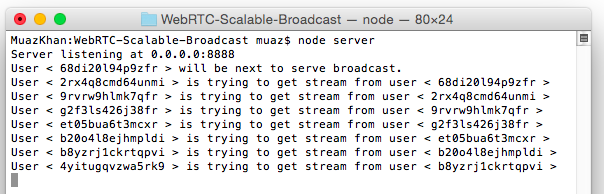
In the image, you can see that each NEW-peer is getting stream from most-recent peer instead of getting stream directly from the moderator.
npm install webrtc-scalable-broadcast
Now, goto node_modules>webrtc-scalable-broadcast:
cd node_modules
cd webrtc-scalable-broadcast

# and run the server.js file
node server.js
Or:
cd ./node_modules/webrtc-scalable-broadcast/
node ./server.js
Or install using WGet:
mkdir webrtc-scalable-broadcast &&cd webrtc-scalable-broadcast
wget http://dl.webrtc-experiment.com/webrtc-scalable-broadcast.tar.gz
tar -zxvf webrtc-scalable-broadcast.tar.gz
ls -a
node server.js
IPFS allows users to host and receive content in a manner similar to BitTorrent. As opposed to a centrally located server, IPFS is built around a decentralized system[5] of user-operators who hold a portion of the overall data, creating a resilient system of file storage and sharing.
"The founders of The Pirate Bay, possibly the best-known BitTorrent tracking service in existence, are going legit with a new file-sharing site which they claim will adhere to all copyright rules and takedown requests. BayFiles, as the new service is named, isn't BitTorrent powered. Instead, the site borrows its method of operation from the likes of Megaupload and RapidShare: a user selects a file and uploads it to the site via their web browser, after which it becomes available for anyone to download, assuming they have the link."
"One researcher has decided he wants to make Skype open source by reverse engineering the protocol the service uses. In fact, he claims to have already achieved that feat on a new skype-open-source blog. The source code has been posted for versions 1.x/3.x/4.x of Skype as well as details of the rc4 layer arithmetic encoding the service uses. While his intention may be to recreate Skype as an open source platform, it is doubtful he will get very far without facing an army of Microsoft lawyers. Skype is not an open platform, and Microsoft will want to keep it that way."
It's been almost a year since the producers of The Hurt Locker filed a lawsuit against 5,000 alleged pirates suspected of distributing the film via BitTorrent. Now Voltage Pictures has updated its complaint, adding almost 20,000 IP addresses to the list of defendants. That makes it the largest file-sharing lawsuit of all time -- a crown previously held by the company behind The Expendables, according to Wired. The plaintiff has already reached agreements with Charter and Verizon to identify individual users, but no such deal with Comcast, who owns nearly half the supposedly infringing addresses. Linking those addresses with user accounts would let Voltage manage individual settlements -- probably somewhere between $1,000-$2,000 -- rather than continue legal action. All of this eerily echoes the Oscar-winning film's plot, about an adrenaline junkie who couldn't resist downloading just one more movie. Or defusing one more bomb. We're a little fuzzy on the details, but venture into TorrentFreak to scan for familiar IP addresses.
Microsoft has received a patent for a 'digital rights management scheme for an on-demand distributed streaming system,' or using a P2P network to distribute commercial media content. The patent, #7,639,805, covers a method of individually encrypting each packet with a separate key and allowing users to decrypt differing levels of quality depending on the license that has been purchased.
"In an in depth discussion on the codec industry, CoreCodec CEO and Matroska Foundation board member Dan Marlin shares his thoughts on the growing popularity of the MKV container, confusion in the marketplace between X.264/MKV and DivXHD and weighs in on a controversial decision by Microsoft to block third party filter support in future versions of Windows media player. His interview offers a behind the scenes look at an important piece of technology that is helping to power the P2P movement. It also raises the prickly question of whether or not Microsoft is abusing their OS monopoly, in order to rein in competition within the codec industry."
Joshua: Hey John! Sent at 3:47 PM on Tuesday me: hi Sent at 3:54 PM on Tuesday Joshua: you going to go revolutionize the video streaming business and get rich? :) Sent at 4:01 PM on Tuesday me: It's a nice thought, but since flash and youtube are now doing almost everything that I had in 1996 there is probably little chance of that. I am working on a Head Mounted display Something like http://www.lumusvision.com/ Joshua: nice! me: Not sure how far it will get, still in research phase I also had an incredible idea for super caps as in the end of battery technology as we know it Joshua: dang! Sent at 4:05 PM on Tuesday Joshua: That would be amazing too. I still think you can improve on the CDN side of video streaming though. Sent at 4:06 PM on Tuesday me: I am sure I can by using P2P or cooperation from the prodiders I had a live p2p streaming system at one point up for demo's a long long time ago. Sent at 4:09 PM on Tuesday Joshua: could a site like youtube use something like that? Sent at 4:12 PM on Tuesday me: They are limited to what Adobe's macromedia flash platform can operate with I was thinking of selling a flash server since adobe want's $4000 for one that only works on windows server but for recorded video a web server is fine Joshua: what can a flash server do that a normal one can't? me: So this would be for live flash video streaming encode and stream at the same time it's like web server, but the file never ends. so a normal web server can't do it the livecam server can already do this. Sent at 4:17 PM on Tuesday Joshua: whats the difference between your server and the livecam one? me: Mine is the livecam one I wrote it Joshua: lol. thats really cool. me: Sorry I thought you knew this. Joshua: nope. it's really impressive though. me: we made a web server version of it called afterburner, it's on sourceforge Joshua: would it be able to save a company like google money? Sent at 4:21 PM on Tuesday me: Well they are already using litehttp similar to afterburner from what I can tell, haven't read the source code yet. and no one is doing live flash streaming but 2 small web sites Joshua: you said that most content is recorded though. me: ustream.tv and justin.tv but any web server will work for recorded because it just serving up large files some throttling would help them not waste bandwidth by not serving more of the file then the viewer is going to need right now someone on a fast connection will download the who video as fast as they can even if they will just flip to another video and not watch , so there is a lot of data sent that it just tossed out later and never used. Increasing bandwidth costs. Sent at 4:26 PM on Tuesday Joshua: Great point. Hey John, I gotta jet. It's always good talking to you and I'll catch up with you later. Have a great one! Sent at 4:29 PM on Tuesday me: ok l8r Sent at 4:31 PM on Tuesday
Source SlashDot - CNN Uses P2P Video & Adds Terrible EULA
"CNN's use of software called Octoshape presents an incredibly abusive EULA. If you agree to the EULA, you agree that CNN can use your bandwidth, and that you will pay any costs. Also, you lose the right to monitor your own network traffic. You can't even use information collected by your own firewall. Quoting the EULA: 'You may not collect any information about communication in the network of computers that are operating the Software or about the other users of the Software by monitoring, interdicting or intercepting any process of the Software. Octoshape recognizes that firewalls and anti-virus applications can collect such information, in which case you not are allowed to use or distribute such information.' "
I have the rights to make a movie based on a famous SciFi writer short story who just passed.
After 3 years of rejections from Hollywood, I was thinking that maybe we can fund the movie with donations and grants and release the movie freely (GPL style) over Bit Torrent and BlueRay and then see what it will take to get it played in theaters. I really think it would be so cool and set a whole new model for film production, copyleft movies. Am I a nut job or is this just crazy enough to work?
If you have any thoughts on that please leave a comment.
Or you can mail me at http://www.videotechnology.com/contact.html
South Park is coming online, free and legal. My brief research has not indicated if it will use DRM, require some silly Windows-only software or be otherwise substandard. According to a Wired blog article, 'Parker and Stone said they were inspired to start the site when they got 'really sick of having to download our own show illegally all the time. So we gave ourselves a legal alternative.'" In this regard South Park joins fellow Comedy Central notable The Daily Show with Jon Stewart, whose archive was made freely available online late last year.





"CNN's use of software called Octoshape presents an incredibly abusive EULA. If you agree to the EULA, you agree that CNN can use your bandwidth, and that you will pay any costs. Also, you lose the right to monitor your own network traffic. You can't even use information collected by your own firewall. Quoting the EULA: 'You may not collect any information about communication in the network of computers that are operating the Software or about the other users of the Software by monitoring, interdicting or intercepting any process of the Software. Octoshape recognizes that firewalls and anti-virus applications can collect such information, in which case you not are allowed to use or distribute such information.' "
CNN's P2P Live Video Player Sucks Your Bandwidth Dry