Saturday, April 25, 2020

Fwd: [Newsletter] The final week of Bitmovin LIVE is upon us - learn about Live Low Latency Streaming and Data-Driven Workflows


---------- Forwarded message ---------
From: The Bitmovin Team <marketing@bitmovin.com>

bitmovin-live-data-driven-video-workflows-NL

Virtual NAB - Data Driven Workflows Webinar

The age of data and information may have reached peak attention in the early 2010s, but that doesn't mean that it's lost any steam in the past 10 years. OTT, VoD, and Broadcast services must rely on data to optimize their business for risk mitigation and ROI. Join us on Monday, Apr 27th @ 8am PT (11 am ET | 3 pm UTC), as we outline the type of workflows that depend on data to succeed and how you can use data to improve your workflows. Register below:

Sign up today

Blog - live-low-latency-streaming-NL (2)

Blogs

Video Tech Deep Dive: Live Low Latency Pt 1

According to our Video Developer Report 2019 - Low Latency streaming was the top challenge that developers are facing when building out their apps or services. This challenge multiplies when considering low latency for live streaming. Take a moment to learn about Live Low Latency, how it differs from "standard" low latency, and why it's important for the future of your business in our latest blog post:
View blog post
 

Bitmovin...A Great Place to Work!

Writer's message: As employees, we know that Bitmovin is a great place to work, especially given recent circumstances. All of our managers, directors, and executives have stressed the importance of staying safe, healthy, and maintaining a balanced work-life schedule in these trying times - so it was a great vindication to hear that earned the #2 spot in this year's "Great Places to Work" in all of Austria. Check out our blog post to learn a little more about what this means and how you can join our international team!


View blog post

bitmovin-live-nab-2020-edition (1)

bitmovin live: NAB edition

Event schedule: Week 3 (Apr 27th - 30th)


Tech Talk Follow the Data: Data-Driven Workflows Apr 27th Reserve spot
Tech Talk Achieving D2C Streaming Success Apr 27th Reserve spot
Tech Talk Low Latency Streaming Apr 28th Reserve spot
Tech Talk Encoding in AWS Cloud Environments ft Amazon Web Services Apr 28th Reserve spot
Partner Presentation Beenius: OTT as a Strategy Apr 29th Reserve spot
Learning Lab Advanced Player Course Apr 29th Reserve spot
Tech Talk State of Compression - The Video Codec Landscape 2020 Apr 30th Reserve spot


Job Openings

Open roles

Today, we're seeking a curious, inventive, and flexible individuals to support our US and Austrian teams. Check out the links below for more information:

  • Solutions Architect (Denver) - A Solutions Architect's responsibility is to foster our customers' technical success and overall happiness. Join our team if you have experience in software engineering/web development and interest in online video.
  • Engineering Team Lead (Klagenfurt) - As an engineering team lead your responsibility will be to run our Web Player team. The Player team works on our industry-leading adaptive streaming player that runs everywhere, from desktop browsers to mobile apps to OTT devices such as SmartTVs or gaming consoles.

San Francisco  •  Chicago  •  Denver  •  Seattle  •  New York  •  Klagenfurt  •  Vienna  •  London  •  Hong Kong  •  Sao Paulo

© Bitmovin, Inc. - 41 Drumm Street, San Francisco, CA, 94111, USA


Sunday, April 12, 2020

Multistream to 30+ Platforms Simultaneously | Restream

Next generation solar cells perform better when there's a camera around

Quantum camera snaps objects it cannot 'see'


A normal digital camera can take snaps of objects not directly visible to its lens, US researchers have shown. The “ghost imaging” technique could help satellites take snapshots through clouds or smoke.
Physicists have known for more than a decade that ghost imaging is possible. But, until now, experiments had only imaged the holes in stencil-like masks, which limited its potential applications.
Now Yanhua Shih of the University of Maryland, Baltimore, and colleagues at the US Army Research Laboratory, also in Maryland, have now taken the first ghost images of an opaque object – a toy soldier (see image, top right).

Quantum camera

Ghost imaging works a bit like taking a flash-lit photo of an object using a normal camera. There the image forms from photons that come out of the flash, bounce off an object and into the lens.
The new technique also uses a light source to illuminate an object. However, the image is not formed from light that hits the object and bounces back. Instead, the camera collects photons that do not hit the object, but are paired through a quantum effect with others that did.
In Shih’s experiments a toy soldier was placed 45 centimetres away from a light source, which was split into two beams. One was pointed at the toy and the other at a digital camera. A photon detector was placed near the soldier, able only to record when a photon bounced off.

Connected pairs

Photons from the light source constantly travel down both paths made by the splitter, either towards the soldier and the photon detector, or towards the camera. The detector and camera record a constant stream of those photons, and occasionally record a photon at exactly the same time.
When this happens, there is a direct relationship between where one of the photons hit the soldier, and where the other one hits the camera’s sensor, says Shih, because of a quantum effect called “two-photon interference”.
“If the first photon stops at one point on the object plane, the second photon can only be observed at the corresponding point on the image plane,” he says.
So when the camera records only pixels from photons that hit simultaneously with one reaching the detector, a “ghost image” of the object builds up. The soldier’s image appeared after around 1000 coincidental photons were recorded.

Sunny snaps

“It is clear that the experimental set-up can be directly applied to sensing applications,” Shih told New Scientist.
The same method could one day be employed to produce satellite images of objects hidden behind clouds or smoke, using the sun’s radiation as the photon source, says Shih. Doing that may require a photon counter beneath the clouds, but could allow a top-down view not possible using conventional methods.
Not everyone agrees that quantum effects are at work in ghost imaging, though. Baris Erkmen and Jeffrey Shapiro of the Massachusetts Institute of Technology, Cambridge, US, point out in a recent paper that classical physics says light sources produce numbers of uncoordinated photons that are not correlated as Shih suggests.
They suspect ghost images might be produced without a quantum link between photon pairs, purely because some photons are just similar.
Quantum World – Learn more about a weird world in our comprehensive special report.


https://www.newscientist.com/article/dn13825-quantum-camera-snaps-objects-it-cannot-see/


Tuesday, February 04, 2020

Neural networks upscaling of 1896


Denis Shiryaev upscaled 60 fps 4k version of 1896 movie "Arrival of a Train at La Ciotat" with several neural networks


https://www.youtube.com/watch?v=3RYNThid23g


https://www.reddit.com/r/videos/comments/eyoxfb/oc_i_have_made_60_fps_4k_version_of_1896_movie/

Upscaled and resounded version of a classic B&W movie: Arrival of a Train at La Ciotat, The Lumière Brothers, 1896

Source used to upscale: https://youtu.be/MT-70ni4Ddo

Algorithms that were used:
 ››› To upscale to 4k – Gigapixel AI – Topaz Labs https://topazlabs.com/gigapixel-ai/
 ››› To add FPS – Dain, https://sites.google.com/view/wenbobao/dain 

This is the interesting Bit:
Depth-Aware Video Frame Interpolation
Wenbo Bao*, Wei-Sheng Lai#, Chao Ma*, Xiaoyun Zhang*, Zhiyong Gao*, Ming-Hsuan Yang#&

*Shanghai Jiao Tong University,     #University of California, Merced,   &Google

Abstract
Video frame interpolation aims to synthesize non-existent frames in-between the original frames. While significant advances have been made from the deep convolutional neural networks, the quality of interpolation is often reduced due to large object motion or occlusion. In this work, we propose to explicitly detect the occlusion by exploring the depth cue in frame interpolation. Specifically, we develop a depth-aware flow projection layer to synthesize intermediate flows that preferably sample closer objects than farther ones. In addition, we learn hierarchical features as the contextual  information. The proposed model then warps the input frames, depth maps, and contextual features based on the optical flow and local interpolation kernels for synthesizing the output frame. Our model is compact, efficient, and fully differentiable to optimize all the components. We conduct extensive experiments to analyze the effect of the depth-aware flow projection layer and hierarchical contextual features. Quantitative and qualitative results demonstrate that the proposed model performs favorably against state-of-the-art frame interpolation methods on a wide variety of datasets. 


 Update: Colorized by DeOldify Neural Network version of this video: https://youtu.be/EqbOhqXHL7E


This is an upscaled version of the gorgeous video by Bard Canning of curiosity descent uploaded on Sep 13, 2012,
 source: https://youtu.be/Esj5juUzhpU

 The video was upscaled with Gigapixel AI software to 4K, frame by frame, 60 FPS was achieved with After Effect frame blending. I made this video for fun, to spread the love of space traveling. Here is my telegram channel: http://t.me/denissexy Here is comparison: https://gfycat.com/diligentgianteaste... Here is a tutorial how to upscale things in Russian language: https://vc.ru/76580 x


Friday, November 01, 2019

OmniVision announces world record for smallest image sensor


OmniVision, a developer of advanced digital imaging solutions, has announced that it has won a place in the Guinness Book of World Records with the development of its OV6948 image sensor—it now holds the record for the smallest image sensor in the world. Along with the sensor, the company also announced the development of a camera module based on the sensor called the CameraCubeChip.

https://techxplore.com/news/2019-10-omnivision-world-smallest-image-sensor.html

Thursday, October 10, 2019

NeTV2 - overlapping content on encrypted video signals. DMCA Lawsuit Progress

NeTV2 by Alphamax
An open video development board in a PCI express form factor that supports overlaying content on encrypted video signals. Let's bring open video to the digital age!

https://www.crowdsupply.com/alphamax/netv2

Bugfix and DMCA Lawsuit Progress


by Andrew H


Dear backers,
Things have been progressing quietly behind the scenes on NeTV2. Here’s two major developments that you might find particularly relevant.
First, the lawsuit challenging the constitutionality of the anti-circumvention provisions of section 1201 of the DMCA with respect to the NeTV2 is finally moving forward again. After a 2.5 year hiatus sitting on the judge’s bench, a ruling was made which is allowing the case to move forward toward a preliminary injunction that could enable much-requested features such as alpha blending and automatic colorspace selection, as well as finally opening the door for image processing and ML applications.
... Removed...
Finally, if you have any ideas or applications for NeTV2 that rely upon the right to access to plaintext video, please add them to
Thanks to everyone who has logged an issue here – the US government has made an argument that the 1201 exemptions sought around the NeTV2 would only benefit a very limited audience. This public list of ideas helps refute this argument, as well as the argument that non-infringing applications of the NeTV2 hardware are just “hypothetical uses”. This list helps to explain to regulators why the features that would be enabled by access to the plaintext video streams rise above the level of a “mere inconvenience.”
Happy hacking,
-b.

https://www.crowdsupply.com/alphamax/netv2/updates/bugfix-and-dmca-lawsuit-progress


Sunday, May 12, 2019

new A.I. camera that can spot you from 28 miles away


A new camera can photograph you from 45 kilometers away
Developed in China, the lidar-based system can cut through city smog to resolve human-sized features at vast distances.
by Emerging Technology from the arXiv
May 3, 2019

Long-distance photography on Earth is a tricky challenge. Capturing enough light from a subject at great distances is not easy. And even then, the atmosphere introduces distortions that can ruin the image; so does pollution, which is a particular problem in cities. That makes it hard to get any kind of image beyond a distance of a few kilometers or so (assuming the camera is mounted high enough off the ground to cope with Earth’s curvature).

But in recent years, researchers have begun to exploit sensitive photodetectors to do much better. These detectors are so sensitive they can pick up single photons and use them to piece together images of subjects up to 10 kilometers (six miles) away.

Nevertheless, physicists would love to improve even more. And today, Zheng-Ping Li and colleagues from the University of Science and Technology of China in Shanghai show how to photograph subjects up to 45 km (28 miles) away in a smog-plagued urban environment. Their technique uses single-photon detectors combined with a unique computational imaging algorithm that achieves super-high-resolution images by knitting together the sparsest of data points.

The new technique is relatively straightforward in principle. It is based on laser ranging and detection, or lidar—illuminating the subject with laser light and then creating an image from reflected light.

The big advantage of this kind of active imaging is that the photons reflected from the subject return to the detector within a specific time window that depends on the distance. So any photons that arrive outside this window can be ignored.

This “gating” dramatically reduces the noise created by unwanted photons from elsewhere in the environment. And it allows lidar systems to be highly sensitive and distance specific.

To make the new system even better in urban environments, Zheng-Ping and co use an infrared laser with a wavelength of 1550 nanometers, a repetition rate of 100 kilohertz,  and a modest power of 120 milliwatts. This wavelength makes the system eye-safe and allows the team to filter out solar photons that would otherwise overwhelm the detector.

The researchers send and receive these photons through the same optical apparatus—an ordinary astronomical telescope with an aperture of 280 mm. The reflected photons are then detected by a commercial single-photon detector. To create an image, the researchers scan the field of view using a piezo-controlled mirror that can tilt up, down, and side to side.

In this way, they can create two-dimensional images. But by changing the gating timings, they can pick up photons reflected from different distances to build a 3D image.

The final advance the team has made is to develop an algorithm that knits an image together using the single-photon data. This kind of computational imaging has advanced in leaps and bounds in recent years, allowing researchers to create images from relatively small sets of data.

The results speak for themselves. The team set up the new camera on the 20th floor of a building on Chongming Island in Shanghai and pointed it at the Pudong Civil Aviation Building across the river, some 45 km away.

single pixel resolution imaging

Conventional images taken through the telescope show nothing other than noise. But the new technique produces images with a spatial resolution of about 60 cm, which resolves building windows. “This result demonstrates the superior capability of the near-infrared single-photon LiDAR system to resolve targets through smog,” say the team.

That’s also significantly better than the conventional diffraction limit of 1 meter at 45 km, and certainly better than other recently developed algorithms. The image here shows the potential of the technique in images taken in daylight from a distance of 21 km. ”Our results open a new venue for high-resolution, fast, low-power 3D optical imaging over ultralong ranges,” say Zheng-Ping and co.

That’s interesting work that has a wide range of applications. The team mention remote sensing, airborne surveillance, and target recognition and identification. Indeed, the entire device is about the size of a large shoebox and so is relatively portable.

And Zheng-Ping and co say it can be significantly improved. “Our system is feasible for imaging at a few hundreds of kilometers by refining the setup, and thus represents a significant milestone towards rapid, low-power, and high-resolution LiDAR over extra-long ranges,” they say.

So keep smiling—they may be watching.

Ref: arxiv.org/abs/1904.10341 : Single-Photon Computational 3D Imaging at 45 km

Friday, September 28, 2018

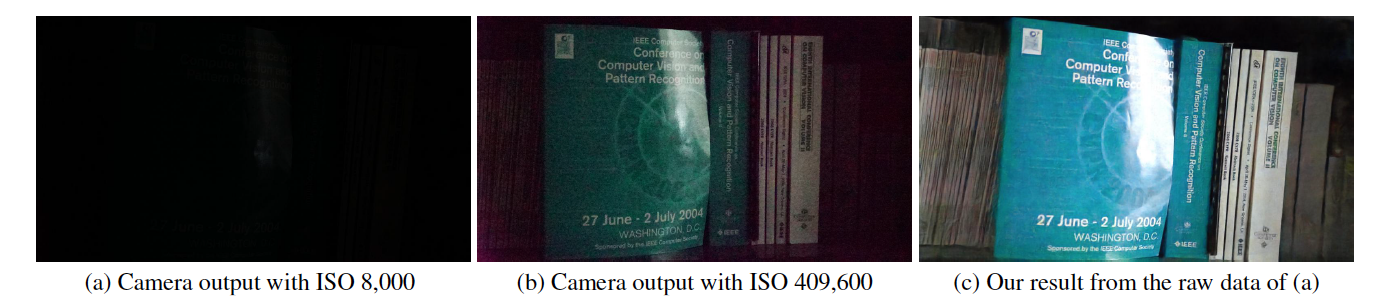
This AI Learned To See In The Dark


The paper "Learning to See in the Dark" and its source code is available here:


Thermal polarimetric imaging.


Researchers demonstrate an example of human identification using conventional and polarimetric thermal cameras. The thermal polarimetric image allows for fine facial details to emerge, researchers said. (U.S. Army Photo)


"Researchers have known for about 30 years that man-made objects emit thermal radiation that is partially polarized, for example, trucks, aircraft, buildings, vehicles, etc., and that natural objects like grass, soil, trees and bushes tend to emit thermal radiation that exhibits very little polarization," Gurton said. "We have been developing, with the help of the private sector, a special type of thermal camera that can record imagery that is based solely on the polarization state of the light rather than the intensity. This additional polarimetric information will allow Soldiers to see hidden objects that were previously not visible when using conventional thermal cameras."

"Prior to our research at ARL, the only way to view humans at night was to use conventional thermal imaging," Gurton said. "Unfortunately, such imagery is plagued by a "ghosting" effect in which detailed facial features required for human identification are lost. However, when polarization information is included in the thermal image, i.e., a thermal polarimetric image, fine facial details emerge, which allows facial recognition algorithms to be applied."

https://www.arl.army.mil/www/default.cfm?article=3292


Monday, September 17, 2018

Fwd: OpenMV News

---------- Forwarded message ----------
From: "OpenMV" <openmv@openmv.io>
Date: Sep 17, 2018 8:41 AM
Subject: OpenMV News
To: "John" <john.sokol@gmail.com>
Cc:

OpenMV Home - https://openmv.io/
View this email in your browser

OpenMV Cam H7 Kickstarter Launched

SEP 17, 2018 POSTED BY: KWABENA AGYEMAN

Hi everyone,

The wait is over! The OpenMV Cam H7 Kickstarter has launched!

OpenMV Cam H7 Kickstarter

Help OpenMV make the OpenMV Cam H7 a reality by backing us on Kickstarter!

Copyright © 2018 OpenMV, LLC, All rights reserved.
You are receiving this email because you provided your email address to OpenMV at some point in time. Please opt out if you do not want to receive communications from OpenMV.

Our mailing address is:
OpenMV, LLC
PO Box 1577 #22900
Atlanta, GA 30301

Add us to your address book


Want to change how you receive these emails?
You can update your preferences or unsubscribe from this list

Email Marketing Powered by MailChimp

Saturday, August 11, 2018

Machine vision camera

http://jevois.org/


About JeVois

Open-source machine vision finally ready for prime-time in all your projects!
JeVois = video sensor + quad-core CPU + USB video + serial port, all in a tiny, self-contained package (28 cc or 1.7 cubic inches, 17 grams or 0.6 oz). Insert a microSD card loaded with the provided open-source computer vision algorithms (including OpenCV 3.4.2, TensorFlow, Caffe, Darknet, and many others), connect to your desktop, laptop, and/or Arduino, and give your projects the sense of sight immediately.


Monday, July 30, 2018

1950 HOW TELEVISION BENEFITS YOUR CHILDREN


Television Newspaper & Intramural Television - Scoops magazine UK (1934/1935)

Television Newspaper:  Can it be Done? syndicated comic, Scoops magazine UK (1934/1935)


Sunday, July 29, 2018

My Notes on TV from 2011, Evolution of Television. Future TV.


The Price of a Television has remained relatively constant


Even High End Televisions are oddly unchanged over a 70 year span!


We have added new capabilities, 3D, 4K, vast improvements in color and image quality


But where are we going ?


Of all the screens we have, we can tolerate much longer viewing times on a TV than any other device.


Below are some thoughts on the Content Ecosystem.


John Sokol shared “Lambert Castle Museum, Passaic County Historical Society Library, Video Related items” with you


Lambert Castle Museum, Passaic County Historical Society Library, Video Related items
4
View album