Showing posts with label 3D Display. Show all posts

Thursday, September 30, 2021

Looking Glass Portrait - 3D holographic display


They are now $300 with very expensive high end 4K and 8K versions now available. 

Monday, January 04, 2021

My LED Cube


Cubic Display

Monday, August 10, 2020

Facebook’s new 3D photos


https://techcrunch.com/2018/06/07/how-facebooks-new-3d-photos-work/

Johannes Kopf, a research scientist at Facebook’s Seattle office, where its Camera and computational photography departments are based. Kopf is co-author (with University College London’s Peter Hedman) of the paper describing the methods by which the depth-enhanced imagery is created; they will present it at SIGGRAPH in August.
http://visual.cs.ucl.ac.uk/pubs/instant3d/


http://stereo.jpn.org/eng/stphmkr/makedm/

How to make Facebook 3D Photo from Stereo pair

Download the latest StereoPhoto Maker(ver5.29b or later)

I use DMAG(Depth Map Automatic Generator)64bit software to create the Depth map from stereo pair.
Grate thanks to Ugo Capeto 3D who made DMAG software!
Attention : DMAG works on 64bit Windows only!

Extracting Depth Map Photos for the Looking Glass

https://blog.lookingglassfactory.com/process/extracting-depth-map-photos-for-the-looking-glass/

If your unaware of what Looking Glass is, it's truly amazing.
a life like 3D volumetric display.  Done using some sort of holographic or lenticular layers in front of a 2D display. It has a solid 2 inch thick Acrylic Brick that hold the optics together in a super solid fashion. Anyhow the end result is amazing.


RGB and depth map images


Article goes in to how to extract and manipulate a depth map using exiftool. 

https://exiftool.org/

ExifTool by Phil Harvey

Read, Write and Edit Meta Information!


Seems there is a magic undocumented command that might only run on MacOS?
-MPImage2


StereoPhoto Maker’s Looking Glass Web Tools site.


http://stereo.jpn.org/lkg/depth/depthe.html  
This is cool, seems the web page can detect and render directly to the Looking Glass.


Monday, November 21, 2016

Monday, February 08, 2016

LEIA 3D - Light field display - Holographic display module

https://www.leia3d.com/


“There has been very little innovation in the basic physics for making 3-D images since early in the 20th century. This new display is transforming a technology that’s been around for 100 years.” – MIT Tech Review


They have developed an holographic technology that makes it possible to deliver collaborative 3D experiences through an interactive display with no eye wear required.

Every standard LCD display has a component called a backlight. A backlight is comprised of an LED light source and light guide, which directs light toward the display’s pixels. Once light passes through them images appear on the display as the LCD selectively blocks varying amounts of light at each pixel.

LEIA 3D’s technology replaces the standard light guide with a much more sophisticated one that has nanoscale gratings. Our new light guide delivers more control over the direction that light travels before it reaches the pixel array, and can direct a single ray of light to a single given pixel on the display.
leia3d-technology


This diffractive “multiview backlight” allows the projection of different images in different directions of space with smooth, gradual transitions between views. The result is content that looks 3D from any viewpoint, by any number of viewers, with a seamless sense of parallax—without the breaks, ghost images, or “bad spots” that are commonly experienced in lenticular displays. The visual experience is remarkable and provides a much wider field of view with the ability to update content at video rate.


PRODUCT SPECS:

  • 64 views (8×8) full-parallax, field of view (FOV) of 60deg
  • 200×200 pixels per view, total LCD resolution 1600×1600
  • 8bit monochrome output (color can be adjusted, default is white)
  • HDMI video input at 60fps, tiled or swizzled view supported.
  • powered directly via USB cable, no battery needed
  • Capacitive “Hover-Touch” panel, senses your fingers in proximity to the display and lets you interact with holograms without touching the screen (Haptics not available with this model.)
  • Gyro / Accelerometer


Thursday, November 06, 2014

How a Real 3D Display Works


From: http://hackaday.com/2014/11/06/how-a-real-3d-display-works/


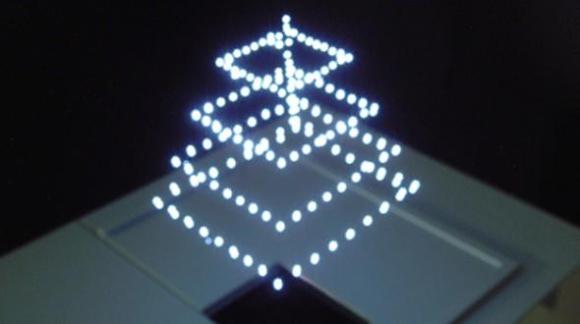
There’s a new display technique that’s making the blog rounds, and like anything that seems like its torn from [George Lucas]‘ cutting room floor, it’s getting a lot of attention. It’s a device that can display voxels in midair, forming low-resolution three-dimensional patterns without any screen, any fog machine, or any reflective medium. It’s really the closest thing to the projectors in a holodeck we’ve seen yet, leading a few people to ask how it’s done.

This isn’t the first time we’ve seen something like this. A few years ago. a similar 3D display technology was demonstrated that used a green laser to display tens of thousands of voxels in a display medium. The same company used this technology to draw white voxels in air, without a smoke machine or anything else for the laser beam to reflect off of. We couldn’t grasp how this worked at the time, but with a little bit of research we can find the relevant documentation.

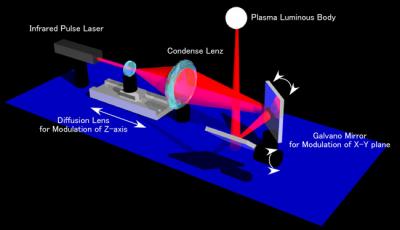
A system like this was first published in 2006, built upon earlier work that only displayed pixels on a 2D plane. The device worked by taking an infrared Nd:YAG laser, and focusing the beam to an extremely small point. At that point, the atmosphere heats up enough to turn into plasma and turns into a bright, if temporary, point of light. With the laser pulsing several hundred times a second, a picture can be built up with these small plasma bursts.


Moving a ball of plasma around in 2D space is rather easy; all you need are a few mirrors. To get a third dimension to projected 3D images, a lens mounted on a linear rail moves back and forth changing the focal length of the optics setup. It’s an extremely impressive optical setup, but simple enough to get the jist of.

Having a device that projects images with balls of plasma leads to another question: how safe is this thing? There’s no mention of how powerful the laser used in this device is, but in every picture of this projector, people are wearing goggles. In the videos – one is available below – there is something that is obviously missing once you notice it: sound. This projector is creating tiny balls of expanding air hundreds of times per second. We don’t know what it sounds like – or if you can hear it at all – but a constant buzz would limit its application as an advertising medium.

As with any state-of-the-art project where we kinda know how it works, there’s a good chance someone with experience in optics could put something like this together. A normal green laser pointer in a water medium would be much safer than an IR YAG laser, but other than that the door is wide open for a replication of this project.


Friday, October 11, 2013

Avegant’s new Virtual Retinal Display


Avegant unveiled a prototype virtual retinal display (VRD) delivers insanely sharp definition and a realistic image even with low-resolution sources by projecting directly into each eye

"Note that this also puts the field of view of the virtual image entering the eye somewhere between a 24.3° diameter circle and a 24.3° by 43.2° rounded rectangle."

It projects images that appear as 80-inch panels viewed from eight feet away similar to a Vuzix's Wrap glasses, MyVu, Sony's HMZ-T1 and not the Oculus Rift which had head tracking and a wider field of view.

Rather than relying on a set of high-resolution LCD displays placed close to your eyes it actually projects images directly onto your retinas from a micromirror array, which gives it a number of advantages over LCD-based headsets.

The HMD, which can handle 240Hz content (and beyond) , two separate WXGA (1,280×768-pixel resolution) images at each eye, which is essentially double the effective resolution of currently-available Oculus Rift developer kits. Additionally, since these images are being generated with reflected rather than emitted light, they more accurately mimic the way we see in the real world. Pixels blend together more naturally this way, and, since there’s no screen anywhere, the wearer won’t experience the dreaded “screen door effect” that generally occurs when LCD’s or OLEDs are placed close to the eye.

Avegant
210 E. Huron, Suite H 
Ann Arbor, MI 48104

Friday, April 27, 2012

Fwd: Is glasses-free 3D the next big tablet feature?

---------- Forwarded message ----------
From: "MasterImage 3D" <display@masterimage3d.com>
Date: Apr 27, 2012 10:40 AM
Subject: Is glasses-free 3D the next big tablet feature?
To: <sokol@videotechnology.com>


Is 3D the next big tablet feature?

From James Cameron talking up 3D tablets, to a close-up look at our 10.1" display in the Los Angeles Times, there's been a lot of buzz about autostereoscopic tablets in recent weeks. 

Here are just a few articles we thought would interest you:


This message was sent to sokol@videotechnology.com from:
MasterImage 3D | 5358 Melrose Ave. | Los Angeles, CA 90038
Master Image 3D
Unsubscribe

Saturday, April 07, 2012

Sony RayModeler 360 Autusteroscopic Display Prototype

Autostereoscopic Display
The RayModeler 3D display 

 LED light sources allow you to see an image from all angles, 360 degrees. Objects like faces and people appear realistic giving viewers a sense of depth because the left and right eyes are seeing different images. I saw a demo of the display recently at the Sony offices and looking at moving 3D holographic images was almost like looking into a crystal ball! You’ll notice in the video the images even react and move when prompted by the wave of a hand. Though the device can’t let you see into the future, it is the future of how we will display objects, game or even see advertisements or displays at stores.


http://blog.sony.com/sony-prototype-360%C2%B0-3d-display
http://blog.sony.com/raymodeler-3d-prototype-will-be-showcased-at-siggraph
http://www.youtube.com/watch?v=6BFKC-NKRFw

http://en.wikipedia.org/wiki/Volumetric_display

Monday, January 23, 2012

3D Camera and 3D TV, from Aigo

3D Camera and 3D TV, from Aigo a consumer electronics Giant that we've never heard of but may soon all become a household name. It's the Chinese equivalent of a Sony or Samsung.


Aigo Brochure  From CES 1/12/2012

http://aigoamerica.com/  US web site.

North American Distributor
1201 N. Orange St.  Suite 7175
Wilmington DE, 19801
201-645-5888

Make sure you tell them you heard about it on VideoTechnology.com

http://en.aigo.com/  Main Web Site.

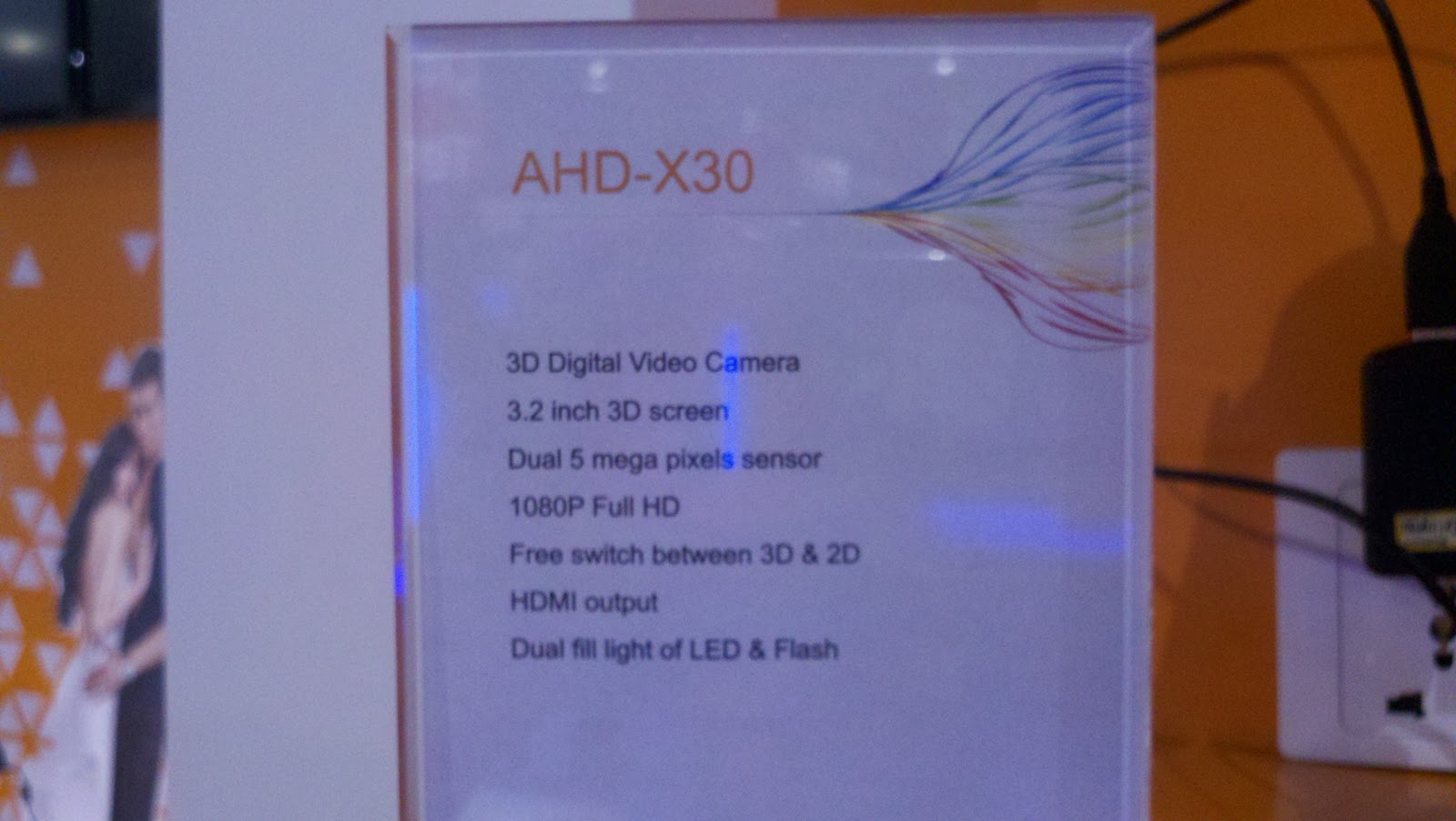
AHD-X30 3D Video Camcorder
Glasses Free 3D  PMP663-3D

More Glasses Free 3D  PMP887-3D

Saturday, December 31, 2011

LG Unveils a Monstrous 84 Inch 4K Resolution 3D Television

LG Unveils a Monstrous 84 Inch 4K Resolution 3D Television

As most of our avid readers know, Videomaker has faithfully scoured the CES floor to find the world’s most interesting products to write home to you all about. This year will be no exception. In an odd twist of the norm, LG just unveiled what might be the world’s largest 4K 3D television at a whopping 84 inches. It’s hard to imagine that there would be some other television revealed at CES this year that could match the specs and size of this television but be assured that if there is, we’ll be one of the first to report it right here on our blog next week.
As of right now, there are few details about what this television can do, but we can guess that the price for such a bohemoth will likely cost more than the average person makes in an entire years worth of salary.  What we do know is that this television will feature LG’s Smart TV functionality which includes access to various 3D movies and over 1,200 apps.
Lest you get confused about what 4K exactly means, LG has already told us that their television will display images at 3840×2160 pixels. Not exactly a true 4K picture but still double what we usually get on our 1080 televisions. Of course you may be asking how much 4K really improves the television viewing experience. I can tell you as someone who’s personally seen a 4K television and a 1080 television side to side that the extra pixels are definitely worth it.
Even so, there is no infrastructure currently in place for television stations to broadcast television at 4K resolutions. That will likely be a long time coming especially since most stations have just completed their move to HD content and will probably be resistant to changing things all over again. Also, you’ll be hard pressed to find any set-top players that can output resolutions this high without completely choking. Nonetheless, it seems like 4K is going to be just as big at CES as 3D televisions were last year. RED has already announced it’s plans for 4K disc players, many camcorders can already record at 4K resolutions, and even YouTube allows users to upload 4K content. These are all strong indications that 4K television is coming – and sooner than we think. I just hope computers and graphics cards will be able to keep up.

From: http://www.videomaker.com/community/videonews/2011/12/12278-lg-unveils-a-monstrous-84-inch-4k-resolution-3d-television/

Wednesday, December 28, 2011

3D WITHOUT GLASSES

12/21/2011 STREAM TV NETWORKS, INC. PREPARES TO LAUNCH GROUNDBREAKING 3D WITHOUT GLASSES PRODUCT LINE AT CES 2012

posted Dec 27, 2011 9:25 AM by Esther Koo   [ updated Dec 27, 2011 9:29 AM ]

STREAM TV NETWORKS, INC. PREPARES TO LAUNCH 
GROUNDBREAKING 3D WITHOUT GLASSES PRODUCT LINE AT CES 2012

Proprietary Ultra-DTM technology surpasses all available 3D viewing experiences

December 21, 2011 (Philadelphia, PA) – Stream TV Networks, Inc. announced today that it will unveil its new Ultra-DTM technology at CES 2012.   Ultra-D is a next generation 3D without glasses display technology that surpasses all 3D viewing experiences offered to date.

Developed by Stream TV Networks, Inc., the producer of the eLocity brand of mobile tablets launched first in 2010, the Ultra-D technology is strictly proprietary and leverages custom hardware, middleware techniques and software algorithms to create unprecedentedautostereoscopic 3D imagery. This technology will provide consumers with access tounlimited 3D content by enabling real-time conversion of:

·        2D content into 3D autostereoscopic (without glasses)
·        3D stereoscopic content (with glasses) to 3D autostereoscopic (without glasses)

The Ultra-D technology thus supports the immediate adoption of 3D consumer hardware despite limited availability of 3D content. Real-time conversion of 2D to 3D and 3D with glasses to 3D without glasses works seamlessly with various content formats including Blu-ray, DVD, PC gaming, Internet, cable and satellite content.

Another key differentiator of the Ultra-D technology enables customization of the 3D effect to address individual differences in spatial perception and the varying impact of 3D rendering on viewer comfort. The technology allows users to increase or decrease the real-time 3D rendering effect, adjusting for variance in content quality and source as well as personal preference so that consumers can use all Ultra-D products to achieve the optimal 3D picture every time.

“We are extremely proud of what we have been able to accomplish with our Ultra-D technology. It is capable of creating a significant shift in the way people view media, comparable to the transition from black and white to color TV,” said Mathu Rajan, CEO of Stream TV Networks, Inc. “Our ultimate goal was to create a solution that addresses existing concerns impeding the adoption of 3D—consumer aversion to expensive glasses, viewer discomfort, variance in individual vision and preference and the slow creation of 3D content. It seemed we were aiming for the impossible but we’ve made it possible and will be sharing these hard-won achievements with consumers in 2012. Ultra-D is the next generation 3D technology designed to replace 3D with glasses and win preference over 2D devices.”

The Ultra-D brand includes 3D-enabling products in the following categories:

·        TVs
·        Converter Boxes
·        Tablets
·        Desktop All-in-One PCs
·        Gaming
·        Laptops
·        Digital Signage
·        Mobile Phones
·        Digital Picture Frames

More information on the Ultra-D product line will become available for the first time to members of the press at the Ultra-D Launch Press Conference at 8:30 am on January 9, 2012 at CES 2012. Additional demos can be scheduled by appointment at Stream TV Networks, Inc.’s CES booth #14815 in the Central Hall of LVCC during the tradeshow.

Stream TV’s mission is to bring to market innovative products featuring state-of-the-art technology designed to enhance consumer experience and simplify their digital lifestyle. Its line of consumer products stands to take the media viewing experience to new levels through high end displays and graphics technologies.

Please direct all sales and general inquiries to contact@streamtvnetworks.com. Press inquiries should be directed to esther@southardinc.com or janina@southardinc.com.

ABOUT STREAM TV NETWORKS, INC:
Stream TV Networks, Inc. is a Philadelphia-based new media company founded in 2009 to serve a consumer market seeking enhanced entertainment and communications experiences through superior quality devices with unlimited accessibility.  Through its brands, Stream TV Networks, Inc. intends to reshape the current media landscape by releasing computer-enabled devices that create an environment where on-demand access to content is available anytime and anywhere, where interactive user feedback is standard, and where creative participation and community formation around media content is nurtured.  The company’s mission is to redefine “new media” so that it reaches its true dynamic potential and real-time interactive relationship with the media consumer.

Wednesday, December 21, 2011

Fwd: Online 3D Streaming from the Cloud

---------- Forwarded message ----------
From: David Abboud


Fordela Interview Request

Hi John,                                                                             Follow us Follow Us on Facebook Follow Us on Linkedin Follow Us on Twitter

Global box office revenue from 3D screens recorded over $6.1Billion in 2010, and 2011 will be another record breaking year with blockbuster hits like Transformers 3D, The Smurfs in 3D, Lion King and most recently, Martin Scorsese's Hugo.

Now with Fordela's 3D platfom, companies of any size can securely stream 3D video online with ease. 
Fordela provides a cloud-based platform that enables you to securely manage and stream your content online today.

  • No technical skills required
  • Designed for business and marketing users
  • Secure 3D online streaming
  • Analytics of who watched what, when
  • No software to download
  • No hardware/servers needed
Have a look at our 1 minute Sizzle Video
Stream 3D Video Today
John, I'd love to schedule an online web demo and interview with the founder of Fordela. We have some big announcements coming up at CES and we'd like to offer you a sneak peak. Would Tues (12/27) at 1:00pm PST work for you? Or would Thurs (12/28) at 11:00am PDT be better? Regards, David Abboud | Director of Sales | Fordela Corporation 900 Kearny St | 5th Floor | San Francisco | California | 94133 Direct: (415) 678-5295 | Skype: daveabboud7 dabboud@fordela.com | Linkedin

3D Customer Showcase

NVIDIA NVIDIA® relies on the Fordela® Media Management Platform™ to power 3DVisionLive.com, the first and only dedicated, high definition 3D streaming video portal. "Working with Fordela to integrate their platform into 3DVisionLive.com has created the world's best place to watch 3D videos on the web. Fordela makes it possible for us to quickly and easily manage and deliver high-quality, premium 3D content to all of our 3D Vision users around the world." -Jon Barad, Senior Business Development Manager at NVIDIA NVIDIA


Click to view this email in a browser

Wednesday, November 30, 2011

A 3D Display You Can Touch

From Slashdot:A 3D Display You Can Touch

"Are we getting closer to really effective volumetric 3D display technology? A new display, designed in Russia, uses cold fog and a laser projector to create a volumetric 3D image that you can touch. A tracking device (no, it's not a Kinect) is used to detect the user's hand and moves the virtual objects in response. There have been cold fog 3D displays before, but this one has a reasonable resolution and looks near to being a finished product that could be on sale soon. Estimated price? Between $4000 and $30,000."


Monday, November 07, 2011

Apple 3D Display is Groundbreaking According to Insider


Los Angeles industry analyst Paul Mueller
Nov 3rd. 
“Consumers—in general—still believe 3D is a gimmick. Right now, Apple is the only company that can convince them it isn’t.”


August 3rd
Paul Mueller told people that once Apple embraces 3D (which they may do on the iPad 3), people will stop talking about the technology as a gimmick and see it as more mainstream. “After all, Apple can take the concept of using tablets as toilet paper and people will latch on no matter how disgusting the concept is.”  


Who is Paul Mueller,  I did some Googling and couldn't find this guy. 

UPDATE:
Thanks Oliver from 3DCinecast.

http://www.linkedin.com/profile/view?id=13283247&authType=name&authToken=OcXN&locale=en_US&pvs=pp&trk=ppro_viewmore

Paul Mueller-Bruehl :  Design Lead, Mobile Platform Experience at Apple Inc.

Humm, maybe not such an Independent  industry analyst after all.


FROM: http://www.examiner.com/gadgets-in-los-angeles/apple-3d-display-is-groundbreaking-according-to-insider & http://3dcinecast.blogspot.com/2011/11/apple-3d-display-is-groundbreaking.html
November 3, 2011 

Apple is working on a glasses-free 3D display that—according to an insider—will reinvent the way consumers perceive 3D. This was already discussed in Steve Jobs’ biography. Our Apple insider tells us that this display may not be limited to just television sets.

“We have prototypes of many different sized 3D displays—all the way from 3.5 inches to 32 inches. These displays are nothing like the glasses-free 3D displays that have a very narrow sweet spot for viewing. I can’t even describe how amazing they are. You’ll hear more about this by the middle of the year.”
Los Angeles industry analyst Paul Mueller believes that Apple could help the crawling 3D market really take off. “Consumers—in general—still believe 3D is a gimmick. Right now, Apple is the only company that can convince them it isn’t.”

FROM: http://www.examiner.com/gadgets-in-los-angeles/industry-analyst-apple-needs-to-embrace-3d
August 3, 2011 

Los Angeles industry analyst Paul Mueller told a small crowd at yesterday’s 3D conference in Santa Monica that the only way 3D technology will truly take off is if Apple embraces it.
“3D is an absolutely amazing technology if it is filmed and displayed correctly. However, it has a lot of critics and although devices such as the HTC EVO 3D are selling well, people are buying them more because of their excellent 2D features.”
The people at the conference acted like they were tired of hearing about 3D technology. However, once Mr. Mueller had me play Avatar 3D on my HTC EVO and pass the device around, the mood changed. I cannot explain how many times I heard people shout “Cool!”
Paul Mueller told people that once Apple embraces 3D (which they may do on the iPad 3), people will stop talking about the technology as a gimmick and see it as more mainstream. “After all, Apple can take the concept of using tablets as toilet paper and people will latch on no matter how disgusting the concept is.”  

Mixed-Reality 3D Volumetric Projector - Slashdot

http://hardware.slashdot.org/story/11/11/06/2137257/mixed-reality-3d-volumetric-projector

"We are describing and demonstrating a 3D Volumetric Projector (YouTube video); in short words: a device that enables mixed reality. The 3D projector has very poor quality, we just have 10 rotational voxels (as we are using only 10 regular LCD projectors), but is proof of concept for developing a commercial solution."


http://volumetricprojection.blogspot.com/

Wednesday, October 26, 2011

"Holographic" Desk Allows Interaction With Virtual Objects

From Slashdot:


"The Sensors and Devices group at Microsoft Research has developed a new system called HoloDesk that allows users to pick up, move and even shoot virtual 3D objects. It's about the size of a filing cabinet and is made up of an overhead screen that projects a 2D image through a half-silvered beam splitter into a viewing area beneath. A Kinect camera keeps tabs on a user's hand position within the 3D virtual environment, a webcam tracks the user's face to help with placement accuracy, and custom algorithms bring everything together in (something very close to) real time."

Tuesday, October 18, 2011

3D hologram table

From Slashdot: Real 3D Display; 3 Years Out?

"Fortune magazine is reporting that the company Zebra Imaging is producing a 3D hologram table that will project a 360 degree 3D image that doesn't require glasses. Funding for this project is being provided by DARPA for battle planning. The company expects it will take at least another three years for the table to be ready for commercial applications."