Showing posts with label Facebook. Show all posts

Wednesday, September 23, 2020

Facebook: Video@Scale 2020

https://videoscale2020.splashthat.com/

OCTOBER 22, 2020

10:00AM – 1:00PM

REGISTER NOW

YOU'RE INVITED TO VIDEO @SCALE REMOTE EDITION


BUILDING DISTRIBUTED VIDEO SYSTEMS


Video @Scale is an invitation-only technical conference for engineers that develop or manage large-scale video systems serving millions of people. The development of large-scale video systems includes complex, unprecedented engineering challenges. The @Scale community focuses on bringing people together to discuss these challenges and collaborate on the development of new solutions.


This year, we will be hosting our Video @Scale event virtually. 


AGENDA


SESSION #1


VIDEO QUALITY


10:00 AM - 11:00 AM PST


KEYNOTE


    Rajeev Rajan


VIDEO CODING STANDARDIZATION


     Ioannis Katsavounidis


VIDEO ENCODING PARAMETER SELECTION WITH HYBRID SOFTWARE/HARDWARE APPROACH


     Nick Wu


VMAF


     Zhi Li | Netflix


SESSION #2


SCALABILITY & RELIABILITY


11:00 AM - 12:00 PM PST


YET ANOTHER LIVE VIDEO DELIVERY ARCHITECTURE


     Kirill Pugin


SCALING I/O TO MILLIONS OF VIDEOS


     David Zhang


PROVIDING BETTER VIDEO EXPERIENCE FOR THE NEXT BILLION USERS


     Denise Noyes


BYTES RANGE ADDRESSING WITH LL-HLS


     Will Law | Akamai


SESSION #3 


PANEL + Q&A 


12:00 PM - 1:00 PM PST


VIDEO TRENDS DURING COVID-19


     Jaron Schaeffer | Google


     Connie Goshgarian | AT&T


     Li-Tal Mashiach | Facebook 


     Tremain Wheatley | Facebook (Moderator)


Monday, August 10, 2020

Facebook’s new 3D photos


https://techcrunch.com/2018/06/07/how-facebooks-new-3d-photos-work/

Johannes Kopf, a research scientist at Facebook’s Seattle office, where its Camera and computational photography departments are based. Kopf is co-author (with University College London’s Peter Hedman) of the paper describing the methods by which the depth-enhanced imagery is created; they will present it at SIGGRAPH in August.
http://visual.cs.ucl.ac.uk/pubs/instant3d/


http://stereo.jpn.org/eng/stphmkr/makedm/

How to make Facebook 3D Photo from Stereo pair

Download the latest StereoPhoto Maker(ver5.29b or later)

I use DMAG(Depth Map Automatic Generator)64bit software to create the Depth map from stereo pair.
Grate thanks to Ugo Capeto 3D who made DMAG software!
Attention : DMAG works on 64bit Windows only!

Thursday, July 30, 2020

Seurat : system for image-based scene simplification for VR

https://developers.google.com/vr/discover/seurat


Seurat

Seurat is a scene simplification technology designed to process very complex 3D scenes into a representation that renders efficiently on mobile 6DoF VR systems.
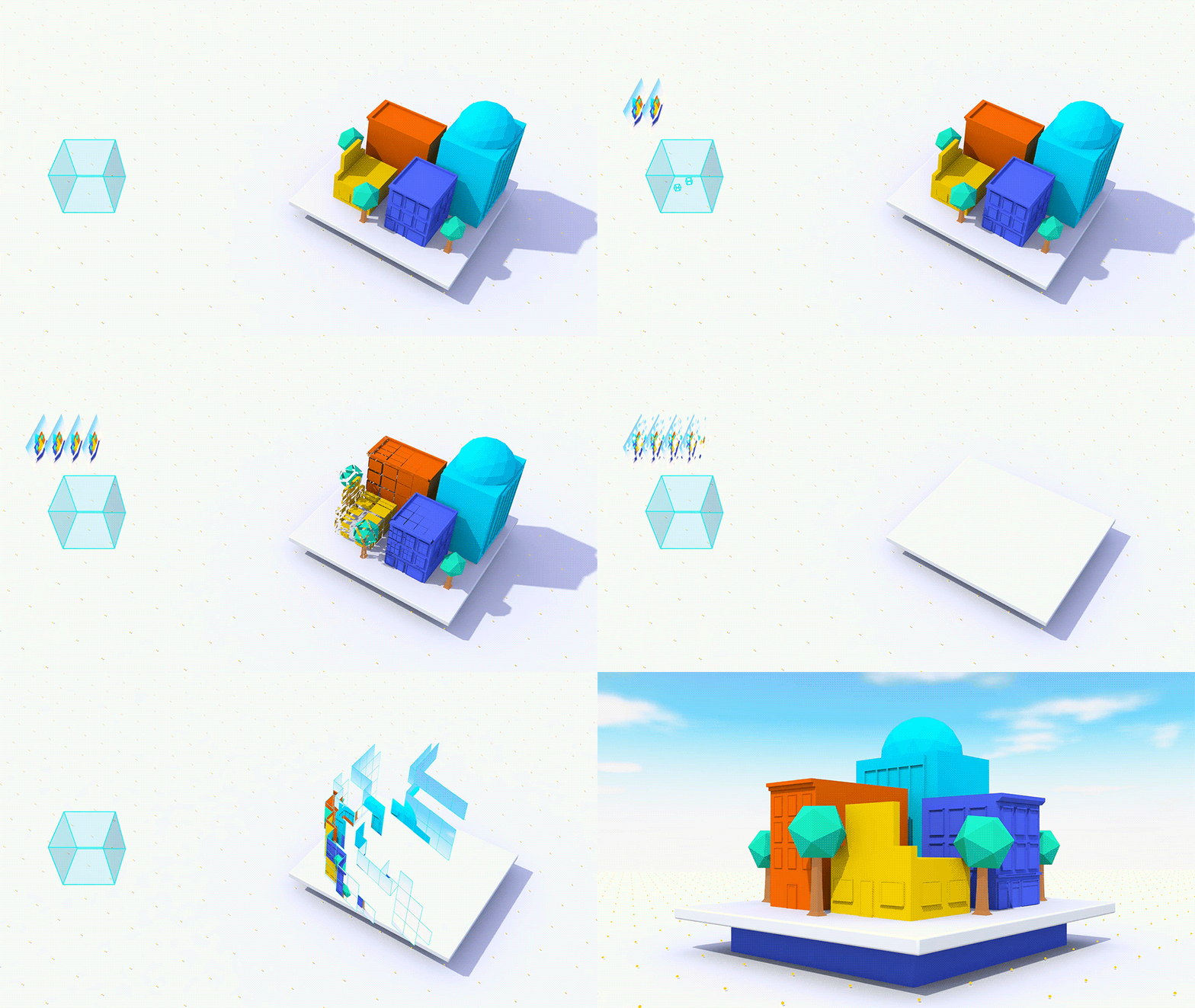
Seurat works by taking advantage of the fact that VR scenes are typically viewed from within a limited viewing region (the box on the left below), and leverages this to optimize the geometry and textures in your scene.
It takes RGBD images (color and depth) as input and generates a textured mesh, targeting a configurable number of triangles, texture size, and fill rate, to simplify scenes beyond what traditional methods can achieve.
Seurat is available as an open source project on GitHub, and includes plugin support for generating depth images for scenes in both Unity and Unreal.

Seurat - Documentation

What is Seurat?

Seurat is a system for image-based scene simplification for VR. It converts complex 3D scenes with millions of triangles, including complex lighting and shading effects, into just tens of thousands of triangles that can be rendered very efficiently on 6DOF devices with little loss in visual quality. It delivers high fidelity graphics on mobile VR devices. (One way to think of it is as a serving the same role as stereo panoramas on 3DoF VR devices, on 6DoF devices.)
The processing pipeline for static environments generates data for a single headbox (e.g. 1 m³ of space). Input data can be generated with any rendering system, e.g. a real-time game engine or an offline ray tracer. We have plugins for Unity, Unreal and Maya. Seurat outputs a mesh with an RGBA texture atlas, which can be rendered in any real-time engine. Dynamic content can be composited on top of the static Seurat environments.


Optimizing for 6DOF mobile VR with Google's Seurat


I lifted this from a 3D photo off facebook.  Still trying to make sense of it...
You can see this image have been broken in to subimages, I suspect these are mapped on to various planes with different Z buffer levels, something that renders quickly in webgl.


----


Tuesday, March 25, 2014

Facebook Buys Oculus Rift For $2 Billion

http://www.oculusvr.com/

http://kotaku.com/facebook-buys-oculus-rift-for-2-billion-1551487939

http://www.theguardian.com/commentisfree/2014/mar/27/oculus-rift-facebook-buy-out-kickstarter


Mark Zuckerberg  (FACEBOOK STATUS MESSAGE) 
I'm excited to announce that we've agreed to acquire Oculus VR, the leader in virtual reality technology.
Our mission is to make the world more open and connected. For the past few years, this has mostly meant building mobile apps that help you share with the people you care about. We have a lot more to do on mobile, but at this point we feel we're in a position where we can start focusing on what platforms will come next to enable even more useful, entertaining and personal experiences.
This is where Oculus comes in. They build virtual reality technology, like the Oculus Rift headset. When you put it on, you enter a completely immersive computer-generated environment, like a game or a movie scene or a place far away. The incredible thing about the technology is that you feel like you're actually present in another place with other people. People who try it say it's different from anything they've ever experienced in their lives.
Oculus's mission is to enable you to experience the impossible. Their technology opens up the possibility of completely new kinds of experiences.
Immersive gaming will be the first, and Oculus already has big plans here that won't be changing and we hope to accelerate. The Rift is highly anticipated by the gaming community, and there's a lot of interest from developers in building for this platform. We're going to focus on helping Oculus build out their product and develop partnerships to support more games. Oculus will continue operating independently within Facebook to achieve this.
But this is just the start. After games, we're going to make Oculus a platform for many other experiences. Imagine enjoying a court side seat at a game, studying in a classroom of students and teachers all over the world or consulting with a doctor face-to-face -- just by putting on goggles in your home.
This is really a new communication platform. By feeling truly present, you can share unbounded spaces and experiences with the people in your life. Imagine sharing not just moments with your friends online, but entire experiences and adventures.
These are just some of the potential uses. By working with developers and partners across the industry, together we can build many more. One day, we believe this kind of immersive, augmented reality will become a part of daily life for billions of people.
Virtual reality was once the dream of science fiction. But the internet was also once a dream, and so were computers and smartphones. The future is coming and we have a chance to build it together. I can't wait to start working with the whole team at Oculus to bring this future to the world, and to unlock new worlds for all of us.

Friday, November 18, 2011

Exclusive Interview with Facebook Leadership: Mark Zuckerberg, CEO/Co-Founder & Sheryl Sandberg, COO

Exclusive Interview with Facebook Leadership: Mark Zuckerberg, CEO/Co-Founder & Sheryl Sandberg, COO

From http://www.charlierose.com/view/interview/11981

Mark mentions facebooks place in TV.