Showing posts with label RealD. Show all posts
Showing posts with label RealD. Show all posts
Friday, November 18, 2011


Tuesday, December 21, 2010
Who is Lenny Lipton?
Lipton wrote the lyrics to the song Puff the Magic Dragon in 1959.
He is also the most prolific inventor in the field of 3D video and film with at least 31 patents and another 40 pending applications in the area of stereoscopic displays. Lipton almost single-handedly created the electronic stereoscopic display industry.
Starting in 1980 he founded StereoGraphics Corporation and in 1981 was granted a patent the first flicker-free electronic stereoscopic display (U.S. Patent No. 4,523,226)
In 1996 he received an award from the Smithsonian Institution for this invention of CrystalEyes, the first practical electronic stereoscopic product for computer graphics and video applications. StereoGraphics was acquired by Real-D Cinema in 2005.

In July of 2007 Lipton was the featured physicist in Physics World magazine because of his contributions to stereoscopic displays.
Lipton served as Chief technical officer of RealD through 2008 and has The RealD 3D system now showing in theaters uses technology he invented. It is based on the push-pull electro-optical modulator called the ZScreen. More recently, he left RealD to start a new venture, Oculus3D, that has developed a low-cost 3D theatrical format that works with the installed base of 35mm movie projectors.
LennyLipton.com
Wikipedia: Lenny Lipton
Oculus3d™ Announces 3D Projection Solution for Existing 35 Millimeter Film Projectors
Oculus3d™ Announces 3D Projection Solution for Existing 35 Millimeter Film Projectors
Oculus3D vies to be the greener solution in disposable 3D shades
The Stereoscopic Cinema:From Film to Digital Projection
He is also the most prolific inventor in the field of 3D video and film with at least 31 patents and another 40 pending applications in the area of stereoscopic displays. Lipton almost single-handedly created the electronic stereoscopic display industry.
Starting in 1980 he founded StereoGraphics Corporation and in 1981 was granted a patent the first flicker-free electronic stereoscopic display (U.S. Patent No. 4,523,226)
In 1996 he received an award from the Smithsonian Institution for this invention of CrystalEyes, the first practical electronic stereoscopic product for computer graphics and video applications. StereoGraphics was acquired by Real-D Cinema in 2005.

In July of 2007 Lipton was the featured physicist in Physics World magazine because of his contributions to stereoscopic displays.
Lipton served as Chief technical officer of RealD through 2008 and has The RealD 3D system now showing in theaters uses technology he invented. It is based on the push-pull electro-optical modulator called the ZScreen. More recently, he left RealD to start a new venture, Oculus3D, that has developed a low-cost 3D theatrical format that works with the installed base of 35mm movie projectors.
LennyLipton.com
Wikipedia: Lenny Lipton
Oculus3d™ Announces 3D Projection Solution for Existing 35 Millimeter Film Projectors
Oculus3d™ Announces 3D Projection Solution for Existing 35 Millimeter Film Projectors
Oculus3D vies to be the greener solution in disposable 3D shades
The Stereoscopic Cinema:From Film to Digital Projection
Wednesday, December 15, 2010
Dolby Digital 3D vs Real D / Master image systems.
It's interesting to watch this evolutionary battle play out.


Dolby's 3D is clearly superior, I mean just breathtaking 3D, but in the end it's the costs and not just the image quality that may end up determining the winners in this game.
Glasses
I am told the Dolby glasses are $38 a pair, which is an amazing deal for 2 precision interference filters.
The Real D / Masterimage system using inexpensive plastic polarizers. This make them almost disposable. But this lower cost in glasses comes at a cost.
 American Paper Optics Even make disposable paper glasses for 3D movies that I am sure the theaters really have consider deeply. I think they went for the recyclable plastic just because the paper seemed too cheap.
I wonder if they ask their customers, "Would you like that in paper or plastic?"
There is also a shutter goggle system that nearly identical to what they are now pushing with 3D HDTV's. These are my least favorite as they require batteries, and are bulky and don't work 1/2 the time. I have not seen these use in a normal theater setting ever, only in amusement parts, older IMAX system and trade show demos.
It's getting push with HDTV's only because it required no changed to existing TV designs and they can charge more. Just the addition of an IR LED to provide a sync signal to the glasses and a sticker and double the price. I will discuss shutter goggle technology in more depth in a later article.
Screen
3D projection using polarization requires non-depolarizing screens. What this means in that the screen must be coated with a special polarization preserving material, usually silver or aluminum metals in paint.
Regular white matte theater screens cost normally around $6000 for an ordinary screen which the Dolby system and shutter glasses can use.
But not just any screen will work with polarized light it cost $13000 or more for an old fashion silver screen or specialized 3D Polarization preserving screen.
Da-Lite 3D Silver Matte or Virtual Grey front projection material
Silver screen in general don't give as good of an image as the high reflectivity white matte plastic screens. You can see an almost metallic luster and they have more of a Grey appearance.
Maintenance
But there is a hidden cost with the Dolby system, with the increased cost of the glasses this brings about several other problems.
The need to keep to employees by the theater doors when the film ends to collect the glasses even with the anti-theft RF tag.
Also the cost of washing and sterilizing the glasses and the manpower needed to do this.
When they recycle the polarizing glasses the issues are the same they can order many pair of glasses and eat the cost of the ones that aren't returned.
The glasses can be sterilized in one of two ways.
1.) UV sterilization system but most UV sterilizers are only small capacity and usually used for laboratory safety goggles.
2.) A commercial washer that uses a special disinfectant detergent.
Both take about 1 hour and some man power to load and unload the glasses.

Projectors & Filter Wheels.
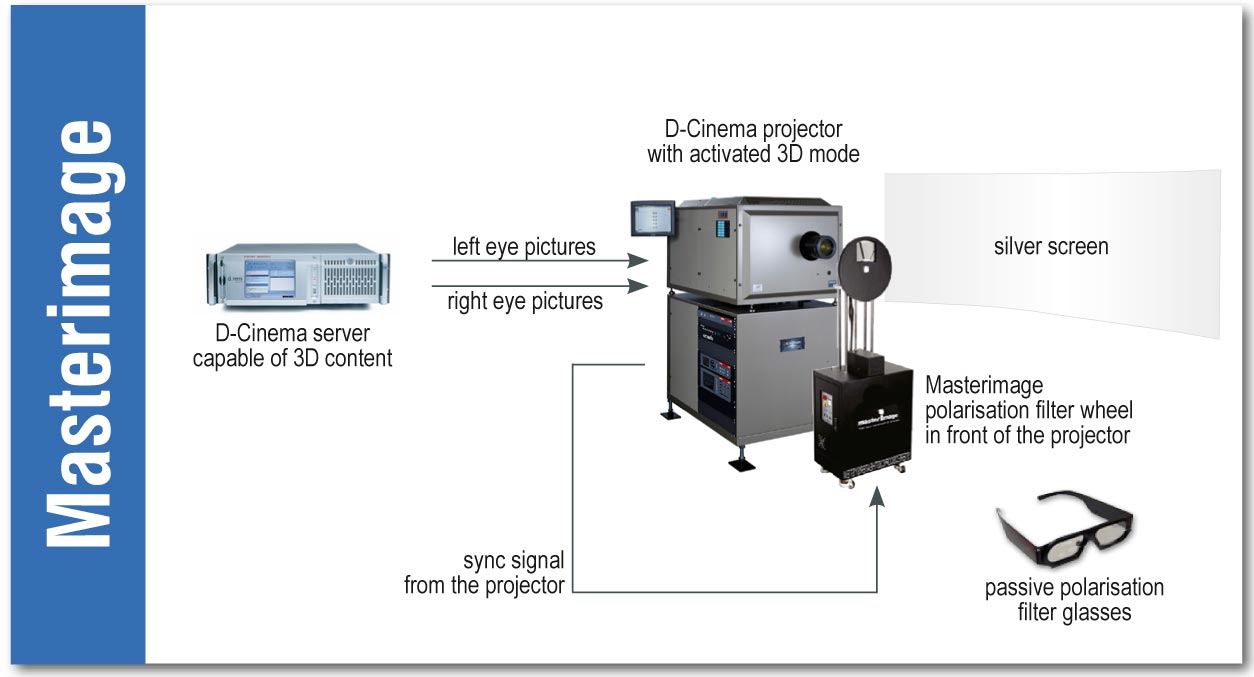
Both systems use synchronized wheels in front of a digital projector.
In the Dolby system they provide now is a sealed Barco SUPERKONTRAST projector system with the filter wheel inside. The Theater operators can not open it and if they do an Alarm system prevents the projector from running till a technician comes out and resets it.


 Master Image also has a rotating wheel system, with alternating Clockwise and Counterclockwise circular polarizers.
I see is both of these as some sort of throwback to the film days with all the the clockwork and moving parts.
The Real D system uses "Z Screen" basically an electronic polarizing filter but for the most part is 100% compatible with the Master Image system.

Summary

$38 Glasses, expensive to clean
Uses existing screens
Special Projector, cost unknown.
Needs special digital cinema server.

Glasses almost disposable. They are recycled, meaning washed and repackaged.
Needs special screen at 2x the cost.
Can use any standard projector and digital cinema server.

Glasses almost disposable. They are recycled, meaning washed and repackaged.
Needs special screen at 2x the cost.
Can use any standard projector and digital cinema server.

$50+ Glasses, expensive & difficult to clean, (can't get electronics wet),
The glasses are also prone to malfunction, with batteries dying, contact failing etc.
Uses existing screens
Can use any standard projector and digital cinema server.
OPINION
It's my opinion that even though the Dolby system is superior, the circular polarized systems will win, the glasses are lighter, cheaper and disposable. (really important with small kids)
I think in the end they will also win the battle on the HDTV front also for this very same reason.
More Reading:
I explain in some depth how the Dolby system work here.
Dolby 3D Digital Cinema
MasterImage site
Chinese source for Circular Polarized glasses
Eye Wear
Through the 3D looking glass
http://www.avsforum.com/avs-vb/showthread.php?t=953978&page=5
http://www.reald.com/
3D projection in cinemas
Digital 3D-Systems
American Paper Optics
Dolby 3D Glasses Training Video
Dolby 3D Digital Cinema / INFITEC Glasses
VS.
Real-D / Master Image Circular Polarized Glasses
Dolby's 3D is clearly superior, I mean just breathtaking 3D, but in the end it's the costs and not just the image quality that may end up determining the winners in this game.
Glasses
I am told the Dolby glasses are $38 a pair, which is an amazing deal for 2 precision interference filters.
The Real D / Masterimage system using inexpensive plastic polarizers. This make them almost disposable. But this lower cost in glasses comes at a cost.
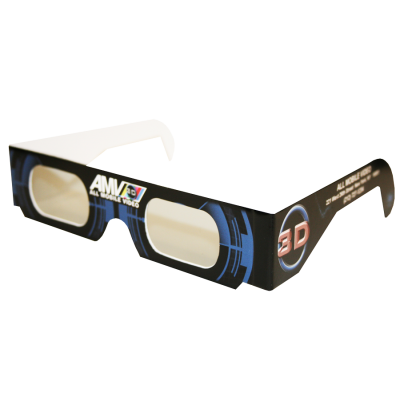
I wonder if they ask their customers, "Would you like that in paper or plastic?"
There is also a shutter goggle system that nearly identical to what they are now pushing with 3D HDTV's. These are my least favorite as they require batteries, and are bulky and don't work 1/2 the time. I have not seen these use in a normal theater setting ever, only in amusement parts, older IMAX system and trade show demos.
It's getting push with HDTV's only because it required no changed to existing TV designs and they can charge more. Just the addition of an IR LED to provide a sync signal to the glasses and a sticker and double the price. I will discuss shutter goggle technology in more depth in a later article.
Screen
3D projection using polarization requires non-depolarizing screens. What this means in that the screen must be coated with a special polarization preserving material, usually silver or aluminum metals in paint.
Regular white matte theater screens cost normally around $6000 for an ordinary screen which the Dolby system and shutter glasses can use.
But not just any screen will work with polarized light it cost $13000 or more for an old fashion silver screen or specialized 3D Polarization preserving screen.
Da-Lite 3D Silver Matte or Virtual Grey front projection material
Silver screen in general don't give as good of an image as the high reflectivity white matte plastic screens. You can see an almost metallic luster and they have more of a Grey appearance.
Maintenance
But there is a hidden cost with the Dolby system, with the increased cost of the glasses this brings about several other problems.
The need to keep to employees by the theater doors when the film ends to collect the glasses even with the anti-theft RF tag.
Also the cost of washing and sterilizing the glasses and the manpower needed to do this.
When they recycle the polarizing glasses the issues are the same they can order many pair of glasses and eat the cost of the ones that aren't returned.
The glasses can be sterilized in one of two ways.
1.) UV sterilization system but most UV sterilizers are only small capacity and usually used for laboratory safety goggles.
2.) A commercial washer that uses a special disinfectant detergent.
Both take about 1 hour and some man power to load and unload the glasses.
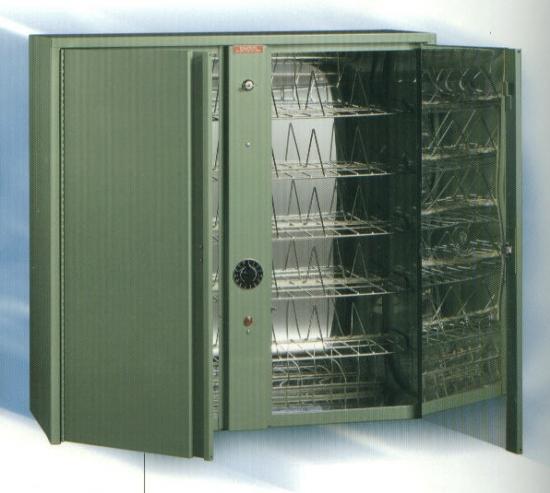
UV sterilizer
Projectors & Filter Wheels.
Both systems use synchronized wheels in front of a digital projector.
In the Dolby system they provide now is a sealed Barco SUPERKONTRAST projector system with the filter wheel inside. The Theater operators can not open it and if they do an Alarm system prevents the projector from running till a technician comes out and resets it.

Dolby 3D filter wheel

I see is both of these as some sort of throwback to the film days with all the the clockwork and moving parts.
The Real D system uses "Z Screen" basically an electronic polarizing filter but for the most part is 100% compatible with the Master Image system.

Summary

$38 Glasses, expensive to clean
Uses existing screens
Special Projector, cost unknown.
Needs special digital cinema server.
Glasses almost disposable. They are recycled, meaning washed and repackaged.
Needs special screen at 2x the cost.
Can use any standard projector and digital cinema server.

Glasses almost disposable. They are recycled, meaning washed and repackaged.
Needs special screen at 2x the cost.
Can use any standard projector and digital cinema server.

$50+ Glasses, expensive & difficult to clean, (can't get electronics wet),
The glasses are also prone to malfunction, with batteries dying, contact failing etc.
Uses existing screens
Can use any standard projector and digital cinema server.
OPINION
It's my opinion that even though the Dolby system is superior, the circular polarized systems will win, the glasses are lighter, cheaper and disposable. (really important with small kids)
I think in the end they will also win the battle on the HDTV front also for this very same reason.
More Reading:
I explain in some depth how the Dolby system work here.
Dolby 3D Digital Cinema
MasterImage site
Chinese source for Circular Polarized glasses
Eye Wear
Through the 3D looking glass
http://www.avsforum.com/avs-vb/showthread.php?t=953978&page=5
http://www.reald.com/
3D projection in cinemas
Digital 3D-Systems
American Paper Optics
Dolby 3D Glasses Training Video
Monday, January 11, 2010
For some, 3D movies a pain in the head
From Reuters: For some, 3D movies a pain in the head

Movie buffs and sports fans looking to 3D televisions for the ultimate home theater experience may want to get their eyes checked first -- or risk a 3D headache, U.S. eye experts said
The growing popularity of three-dimensional movies such as James Cameron's "Avatar" -- now a $1 billion box office hit -- has inspired a crop of 3D TV sets, unveiled CES 2010
And while new digital 3D technology has made the experience more comfortable for many, for some people with eye problems, a prolonged 3D session may result in an aching head, they said. "There are a lot of people walking around with very minor eye problems, for example a minor muscle imbalance, which under normal circumstances, the brain deals with naturally," said Dr Michael Rosenberg, an ophthalmology professor at Northwestern University Feinberg School of Medicine in Chicago.
He said in a 3D movie, these people are confronted with an entirely new sensory experience. "That translates into greater mental effort, making it easier to get a headache," Rosenberg said in a telephone interview.
In normal vision, each eye sees things at a slightly different angle. "When that gets processed in the brain, that creates the perception of depth," Dr Deborah Friedman, a professor of ophthalmology and neurology at the University of Rochester Medical Center in New York. "The illusions that you see in three dimensions in the movies is not exactly calibrated the same way that your eyes and your brain are. If your eyes are a little off to begin with, then it's really throwing a whole degree of effort that your brain now needs to exert. "This disparity for some people will give them a headache," she said.
DIGITAL 3D TECHNOLOGY
Dr John Hagan, ophthalmologist in Kansas City, Missouri, and a fellow with the American Academy of Ophthalmology, said some people who do not have normal depth perception cannot see in 3D at all.
He said people with eye muscle problems, in which the eyes are not pointed at the same object, have trouble processing 3D images.
Experts say there are no studies tracking how common it is to get a headache after watching a 3D movie, but Rick Heineman, a spokesman for RealD, a provider of 3D equipment to theaters, said headaches and nausea were the chief reasons 3D technology never took off.
The company, which provides 3D equipment to 90 percent of U.S. movie theaters with 3D capability and has cut deals with Sony Corp, Panasonic, JVC, Toshiba Corp and with Direct TV, said its newer digital technology addresses many of the problems that typically caused 3D moviegoers discomfort.
Heineman said older 3D technology involved the use of two film projectors, one that projected a left eye image and one that projected a right eye image. Three-D glasses would allow viewers to see a different image in each eye.
"People often complained of headaches and it was really because the projectors weren't lined up," Heineman said.
Heineman's company uses a single digital projector, which switches between the left and the right eye image 144 times a second, to help overcome some of the old problems.
"By going to a single digital projector, those issues were solved," he said.
Friedman said she thinks most people will do fine with 3D movies and with 3D TVs, but Rosenberg said people may quickly tire of the novelty.
"I think it will be a gimmick. I suspect there will be a lot of people who say it's sort of neat, but it's not really comfortable," he said.

The growing popularity of three-dimensional movies such as James Cameron's "Avatar" -- now a $1 billion box office hit -- has inspired a crop of 3D TV sets, unveiled CES 2010
And while new digital 3D technology has made the experience more comfortable for many, for some people with eye problems, a prolonged 3D session may result in an aching head, they said. "There are a lot of people walking around with very minor eye problems, for example a minor muscle imbalance, which under normal circumstances, the brain deals with naturally," said Dr Michael Rosenberg, an ophthalmology professor at Northwestern University Feinberg School of Medicine in Chicago.
He said in a 3D movie, these people are confronted with an entirely new sensory experience. "That translates into greater mental effort, making it easier to get a headache," Rosenberg said in a telephone interview.
In normal vision, each eye sees things at a slightly different angle. "When that gets processed in the brain, that creates the perception of depth," Dr Deborah Friedman, a professor of ophthalmology and neurology at the University of Rochester Medical Center in New York. "The illusions that you see in three dimensions in the movies is not exactly calibrated the same way that your eyes and your brain are. If your eyes are a little off to begin with, then it's really throwing a whole degree of effort that your brain now needs to exert. "This disparity for some people will give them a headache," she said.
DIGITAL 3D TECHNOLOGY
Dr John Hagan, ophthalmologist in Kansas City, Missouri, and a fellow with the American Academy of Ophthalmology, said some people who do not have normal depth perception cannot see in 3D at all.
He said people with eye muscle problems, in which the eyes are not pointed at the same object, have trouble processing 3D images.
Experts say there are no studies tracking how common it is to get a headache after watching a 3D movie, but Rick Heineman, a spokesman for RealD, a provider of 3D equipment to theaters, said headaches and nausea were the chief reasons 3D technology never took off.
The company, which provides 3D equipment to 90 percent of U.S. movie theaters with 3D capability and has cut deals with Sony Corp, Panasonic, JVC, Toshiba Corp and with Direct TV, said its newer digital technology addresses many of the problems that typically caused 3D moviegoers discomfort.
Heineman said older 3D technology involved the use of two film projectors, one that projected a left eye image and one that projected a right eye image. Three-D glasses would allow viewers to see a different image in each eye.
"People often complained of headaches and it was really because the projectors weren't lined up," Heineman said.
Heineman's company uses a single digital projector, which switches between the left and the right eye image 144 times a second, to help overcome some of the old problems.
"By going to a single digital projector, those issues were solved," he said.
Friedman said she thinks most people will do fine with 3D movies and with 3D TVs, but Rosenberg said people may quickly tire of the novelty.
"I think it will be a gimmick. I suspect there will be a lot of people who say it's sort of neat, but it's not really comfortable," he said.
Subscribe to:
Posts (Atom)
