Showing posts with label projectors. Show all posts

Saturday, August 08, 2020

lightform - Video Projection Mapping.

https://lightform.com/


Lightform is a San Francisco, California. company developing AR hardware and software founded by Brett Jones, Raj Sodhi and Kevin Karsch in 2014


Lightform has two main products: the hardware, LF1, and the software, Lightform Creator. LF1 is a 3D scanner and media player that provides AR effects when it is paired with an image projector. LF1 performs this function by capturing the object that would be enhanced through AR application with its camera. After calibrating the image data according to the projector lens, the images are sent to the user’s laptop. Using the Lightform Creator, users can then apply AR effects based on their needs.


https://en.wikipedia.org/wiki/Projection_mapping

Projection mapping, similar to video mapping and spatial augmented reality, is a projection technique[1][2] used to turn objects, often irregularly shaped, into a display surface for video projection. These objects may be complex industrial landscapes, such as buildings, small indoor objects or theatrical stages. By using specialized software, a two- or three-dimensional object is spatially mapped on the virtual program which mimics the real environment it is to be projected on. The software can interact with a projector to fit any desired image onto the surface of that object.[3] This technique is used by artists and advertisers alike who can add extra dimensions, optical illusions, and notions of movement onto previously static objects. The video is commonly combined with, or triggered by, audio to create an audio-visual narrative. In recent years this technique has also been widely used in the context of cultural heritage as it has proved to be an excellent edutainment[4] tool thanks to the combined use of a digital dramaturgy.


Friday, July 31, 2020

Projection Tool - poor mans laser cutter.

PolyProjector

This is a tool for projecting the individual shapes of a 3d model onto sheets of cardboard to create physical models. It's kind of like a poor mans laser cutter. Its build on top of the game engine Unity.


Source code:  https://github.com/greengiant83/PolyProjector

You can download a precompiled version of the app here: Windows 10: https://github.com/greengiant83/PolyProjector/raw/master/App%20Builds/PolyProjector%20-%20Windows.zip


After calibrating the screen. Press L on your keyboard to load the 3d model. Use < and > (command and period) to cycle through the faces of your model. Mouse wheel can be used to rotated the polygon for easier working. Some more information can be found in this video:
https://www.youtube.com/watch?v=iDshWkUkbXk


The cool think here is it was made by Matt Bell, a Virtual Reality expert who wanted to make physical objects,
Sort of the reverse of my path of having the digital manufacturing down but wanting to put things in to VR now.


Tuesday, March 15, 2016

RETROTECHTACULAR: EIDOPHOR, AN UNKNOWN WIDELY USED PROJECTOR

http://hackaday.com/2016/03/15/retrotechtacular-eidophor-an-unknown-widely-used-projector/

If you own a video projector, be it a module small enough to fit in a mobile phone or one designed for a cinema screen, the chances are it will have a DLP at its heart. An array of microscopic mirrors on an integrated circuit, the current state of the art in video projection technology.
Perhaps you own an older video projector, or maybe a cheaper new one. If so the chances are it’ll have a small LCD screen doing its work, taking the place of the Kodachrome in something very similar to your grandparents’ slide projector or their grandparents’ magic lantern.
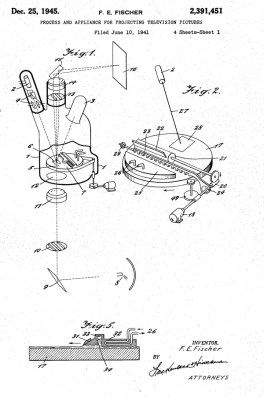
eidophore-patent-image-600pxLCD technology was invented in the 1970s, while DLP was invented at the end of the 1980s. So how did the video projectors that were such a staple of televised spectaculars in the preceding decades work? For that matter, how did NASA project their status displays on the huge screen at Mission Control? Certainly not with CRT technology, even the brightest CRT projectors weren’t up to filling a cinema-sized screen.
The answer came from the Eidophor (Greek: ‘eido’ and ‘phor’, ‘image’ and ‘bearer’), a device invented in the years before World War II by the Swiss physicist Dr. Fritz Fischer and granted a US patent in 1945. It featured a complex vacuum device in which an electron gun painted the video frames as a raster on an oil-covered mirror in the light path of a fairly conventional projector. High-voltage electric charges have the effect of deforming the surface of mineral oils, and it was this effect that was exploited to vary the effectiveness of the mirror as the raster was drawn. An unfortunate side-effect of tracing an oil surface with an electron beam is that a charge will build up on the oil surface, so the entire oil-covered mirror assembly had to rotate within its vacuum enclosure and pass under an electrode which removed any charge build-up.
Eidophor-wikipedia
Eidophor [by Topquark2 CC-BY-SA 3.0]
The resulting machine as seen in this 1952 issue of Popular Science was very large, complex, and expensive to run, but delivered by far the brightest and sharpest projected video available. In a literal sense they painted the backdrop to our culture, as they found a home not only in NASA’s control room but in television studios and at large televised events. This Shirley Bassey performance from the 1960s for example, or the spectacular video light show on this rather poor quality VHS YouTube clip from Seville Expo 1992.
You will probably be unaware of the exact date you last saw an eidophor performance. Quince Imaging tell us their last one was used at the TWA Dome in St Louis in July 2000. Eidophores may have become more compact over the decades but they remained costly to run, and through the 1990s they were suplanted by DLP devices that did substantially the same job with a lot less fuss.
It is not often that a search in the Hackaday archives for a technology returns no results, but the eidophor is one of those cases. Perhaps that is a fitting epitaph for a device that created its own show but never starred in it, that it is only its spectacular performances that live on.

Monday, February 15, 2016

Ink Mapping: Video Mapping Projection on Tattoos, by Oskar & Gaspar

https://vimeo.com/143296099

Ink Mapping: Video Mapping Projection on Tattoos, by Oskar & Gaspar from Oskar & Gaspar on Vimeo.

Warping Fisheye Images for Spherical Mirror Projection

http://www.luniere.com/2013/03/14/warping-fisheye-images-for-spherical-mirror-projection/


This post doesn’t go into any of the complex mathematics involved with spherical mirror projection. For that information I recommend using the invaluable resources at http://paulbourke.net . This post explains a practical solution for projecting onto complex geometry using spherical mirrors, 3ds Max and 123D Catch.


Saturday, June 07, 2014

Bot & Dolly - Video Mapping


Box by Bot & Dolly - Video Mapping

Box explores the synthesis of real and digital space through projection-mapping on moving surfaces. The short film documents a live performance, captured entirely in camera. 

Bot & Dolly produced this work to serve as both an artistic statement and technical demonstration. It is the culmination of multiple technologies, including large scale robotics, projection mapping, and software engineering. We believe this methodology has tremendous potential to radically transform theatrical presentations, and define new genres of expression.

Find out exactly how "Box" was created in our exclusive behind the scenes video: 
http://www.youtube.com/watch?list=PL6...

http://www.botndolly.com/box


Box by Bot & Dolly | Behind the Scenes


Published on Oct 1, 2013 A behind the scenes look at Box, Bot & Dolly's wildly popular latest live performance film which documents a first-ever live synchronized performance using 3D projection mapping, robots, and actors.D projection mapping, robots, and actors.

Monday, August 05, 2013

Hendy’s Law (pixels per dollar)


Pixels per dollar. Similarly, Barry Hendy of Kodak Australia has plotted the "pixels per dollar" as a basic measure of value for a digital camera, demonstrating the historical linearity (on a log scale) of this market and the opportunity to predict the future trend of digital camera price, LCD and LED screens and resolution.


Thursday, January 26, 2012

Babycastles is Turning the Hayden Planetarium into a Giant Videogame

http://motherboard.vice.com/2012/1/24/babycastles-is-turning-the-hayden-planetarium-into-a-giant-videogame

Spacecruiser_large


Remember your first visit to the planetarium? Neil DeGrasse Tyson does — it was what inspired him to become an astrophysicist in the first place. That same planetarium, now under Tyson’s direction, is currently undergoing a transformation the likes of which Neil’s young self couldn’t have possibly imagined: It’s becoming a giant videogame.
Space Cruiser is the most ambitious project yet from NYC developer Ivan Safrin and DIYgames collective Babycastles: An interactive installation designed for 100-200 participants that turns the Hayden Planetarium dome into a giant virtual spacecraft. Together, players will collaborate to navigate a virtual ship through asteroid belts and other dangers — kind of like a massively-multiplayer version of Carl Sagan’s imaginary space vessel from Cosmos.
“Space Cruiser is using Ivan Safrin’s creative coding platform ‘Polycode’ to render his game on a 6-projector 4500×4500 pixel screen. Each projector is hooked up to a separate PC running an instance of Polycode and rendering part of the screen,” says Babycastles impresario Syed Salahuddin of the enormous installation, which premieres for one night only this Thursday at the Museum of Natural History in New York.
Some other space-related indie games will also be reporting for duty: Osmos, a surreal space simulator from Hemisphere Games, Kerbal Space Program, a build-your-own spaceship game, and Bit Pilot, the previously-exhibited minimalist shooter by Zach Gage. If you’ve ever wondered what it’s like to be on an unscripted episode of Star Trek with 200 other people, you can get tickets (use code ‘BEYOND’ for half off) at the museum’s website.

Android Kinect Projector Interface

From Slashdot:


Android Kinect Projector Interface


"A guy who goes by the online handle DDRBoxman decided it would be fun to blow up his Samsung Galaxy Nexus display onto the wall by connecting his phone to a projector. He then connected the whole thing to a PC and, thanks to Microsoft's open-source Kinect platform for Windows, he was able to create a custom ROM that mapped out the phone interface to the Kinect sensors. Pretty neat!"

Tuesday, October 04, 2011

Lockheed Martin Debuts the Holowall

Stand in front of Lockheed Martin's Hollowall, and it will project your hologram over a giant map of an ersatz Afghan battlefield.


http://bcove.me/9tzrun54

Tuesday, August 23, 2011

Elite Screens' Lunette Shows Benefits of Curved Screen


Elite Screens' Lunette A1080P2 curved frame projection screen features a number of innovations that enhance the viewing experience.

The curve design eliminates common projection issues like the "pincushion effect" by bringing the sides of the screen forward. It also gives the viewer the sensation of being drawn into the film.

The Lunette's acoustically transparent material, is a 1.0 gain projection surface that has .25mm perforations that allow optimal sound penetration, so in-wall speakers behind the screen can give excellent performance. It is also black backed to eliminate bounce back distortion.

"It wraps the viewer in a vivid image with excellent direct and off-axis luminescence along with stunning color uniformity." Said Dave Rodgers, Marketing Manager for Elite Screens USA. "Sound breathes through the material with a minimal amount of acoustical insertion loss or dispersion. The design gives a superb performance free of visual artifacts so that viewers can sit, enjoy and be wrapped in a full cinematic experience."

Thursday, August 11, 2011

Runco adds LightStyle DLP projector

Runco has introduced the LS-1, a single-chip 1080p projector based on the Digital Light Processing chip from Texas Instruments. The LS-1 carries a suggested retail price of $3,995.

ElectronicHouse.com

http://www.runco.com/

Monday, August 01, 2011

Panasonic unveils 3D home theater projector

Panasonic unveiled the PT-AE7000 3D home theater projector. The product features 480 Hz transparent LCD panels, an infrared transmitter for syncing the 3D glasses and picture adjustments for viewing distances. The PT-AE7000 will hit the market in September with a suggested retail price of $3,499.

Read article on Engadget:

Panasonic's PT-AE7000 is its first 3D home theater projector, arrives in September for $3,499

Friday, July 29, 2011

Fwd: Something about Buckaroo Awards for Projectors

Is it just me or is the s/n on this press release really low.


---------- Forwarded message ----------
From: "Bill Coggshall" <coggshall@pacificmediaassociates.com>
Date: Jul 28, 2011 10:41 PM
Subject:
To:


FOR IMMEDIATE RELEASE

FOR MORE INFORMATION, CONTACT:
Linda Norton, +1 949-493-4601, LNorton@pacificmediaassociates.com

William Coggshall, +1 650-561-9020, coggshall@pacificmediaassociates.com

Pacific Media Names Buckaroo Awards for 2011 InfoComm Projectors
Exciting new technologies in maturing projector business

Menlo Park, California, USA – July 28, 2010.  Pacific Media Associates, the global market information experts on front projectors, has announced their Buckaroo winners for best-of-show products exhibited at InfoComm International 2011. The Buckaroo award is named for the pioneering cowboys of the Great Basin country of the American West, which includes portions of California, Nevada, Idaho, and Oregon. These cowboys were known for fancy gear that displayed lots of silver ornamentation, so the name is particularly fitting as a recognition of products that produce the best-looking pictures. The Buckaroo Awards recognize those products in the front projector category that lead the herd by enabling projection of attractive images in a broad range of situations.

Although data-capable front projectors using digital imager chip technology such as 3LCD, DLP, or LCOS date from 1994, the industry has made giant strides in technology, yielding giant improvements in brightness, resolution, color gamut, and a host of other features and performance measures. Industry growth has attracted numerous major brands, further spurring innovation and continued improvements in price-performance that have led to market expansion. But as is typical of maturing markets, competitive pressures have forced manufacturers to take measures such as expanding the boundary of the key measure of performance--in this case brightness--and specializing in narrower and narrower segments. The high-tech market information company Pacific Media Associates (PMA), founded in 1992, has expanded along with the industry, creating a worldwide team of projector experts to measure, analyze, and forecast the projector market. PMA currently divides our coverage of the market into three brightness ranges--New Era (sub-500 lumens), Mainstream (500-4999 lumens), and High-End (5000+ lumens)--each of which receives a significant fraction of our attention. In 2011 these three ranges turned out to be a handy way to look at the advances in technology, performance, and features of the products shown at this year's InfoComm International trade show, and we picked a Buckaroo award winner from each of the three.

New Era

Optoma ML500 - In early 2006 PMA identified the emerging New Era projector range, which at that time comprised a few, mostly quite dim, models using LED illumination, but with a likelihood of evolving to become models that had the brightness, resolution, and other specifications to make them attractive for volume sales. Most of the industry leaders have been in denial for years about this sub-500 lumen range, but their performance has now reached a stage where they can no longer be ignored. Although there have been numerous models, with varying resolutions, using either DLP or LCOS imagers, the recently-introduced and cost-effective WXGA DLP chipset, combined with bright LEDs, has garnered most of the design wins. At InfoComm the PMA team was most impressed with the 500-lumen Optoma ML500 model. While a few other manufacturers have achieved this brightness level using this combination of technology, Optoma did so in a package weighing under 2 1/2 lb. that contains the power supply, and is so thin it can be tucked into a laptop bag nestled against the laptop or even in a large purse. Its comprehensive set of inputs (including HDMI) and supported media, plus its built-in Personal Media Player and MS Office document viewer, enable it to display a wide range of signals or content types. It is compact and offers a low carry weight. A lot of technology for a $699 list price.

Mainstream

Casio Laser & LED Hybrid Light Engine Signature, Pro, and Short-Throw Family - Casio earns a Buckaroo award for catching the "greenness" wave, by taking a risk with new technology and staying the course through a few initial bumpy months. PMA gave them an award last year for innovation, but this year they deserve another one for recognizing the nature of their initial success and rapidly expanding into a much broader line. How frequently most UHP-type lamps need to be replaced continues to be a subject for debate, but environmental-sensitive educators loved the IDEA of a long-lived alternative, and Casio moved adroitly to capitalize on that idea. Educators can now choose from a pair of short-throw models based upon hybrid illumination, and other types of buyers can choose from Casio's expanded family of hybrid products aimed at the sweet spots of resolution and brightness (up to 3,500 lumens).

High-End

Sharp "SV" Series with AN-SV100T motorized swivel mount - Only time will tell how narrow the segment is for the new Sharp motorized docking station accessory that can accommodate either the 5000 lumen XGA model XG-SV200X or 4500 lumen WXGA XG-SV100W projector. This unique mount horizontally rotates the projector up to 360-degrees (180-degrees in each direction), and the motorized horizontal and vertical lens shift of the projectors enables a considerable range of screen sizes and positions to be used. Eight banks of memory-presets enable the projector to automatically swivel and project content. It seems to us that an ideal use would be in places like hotel ballrooms with movable partitions that have to serve a variety of group sizes in a relatively short period of time. But even if this product doesn't fly off the shelves, it generated a lot of booth traffic at InfoComm and should boost Sharp's image and mindshare in the longer term.

Congratulations to the winners of the InfoComm 2011 Buckaroo awards.

NOTE: This information may not be used for advertising or other promotional use without the express prior written consent of Pacific Media Associates.

About Pacific Media Associates

Pacific Media specializes in worldwide front projector market information, including New Era (sub-500 lumens), Mainstream (500-4999 lumens), and High-End (5000+ lumens) categories. Their Industry Service family of publications provides detailed worldwide quarterly updates (sell-in data and forecasts) on front projector markets, newsletters on new products and other key industry developments, and biennial Web surveys of North American dealers and end users (including organizations and individual consumers). Their Tracking Service family of monthly reports offers timely sell-through data and analysis on unit sales, true volume-weighted street prices, and inventories of front projectors sold by leading North American retailers, resellers, and distributors. Pacific Media Associates was established- by Dr. William Coggshall, who was a co-founder of Dataquest (now part of Gartner) and helped start the syndicated high-tech market information business. The company headquarters is at 1060 Siskiyou Drive, Menlo Park, CA 94025. Telephone +1 650-561-9020 www.pacificmediaassociates.com

Saturday, February 26, 2011

Tracking video projector.


Jon Howell came up system which projects his name his office door. The thing is, his office door slides on tracks so he made a projector that can follow the movement of that screen. He used a laser printer to make a black and white pattern that indexes the movement of the door using a quadrature encoder. When it senses door movement a servo motor rotates the projector to match the change in the door’s location. As you can see in the video after the break it works even if the door is moved quickly.

Wednesday, December 01, 2010

Virtual Fashion Show


www.demoslam.com | Some trendsetting Japanese girls try on clothes using nothing but a projector.

Now imagine adding 3D position data using something like the Microsoft Kinect , and you could do real time video mapping on to a live person.

By this I mean as the person in front of the projector moves, so could the virtual dress image with her. If she were to turn around the image of the dress could turn around with her giving a much more realistic image of her wearing a dress.

Tuesday, November 30, 2010

Inside the JAKKS Pacific Eyeclops Mini Projector

The EyeClops Mini Projector sells for around $100 as a toy.

It takes in composite video. The picture quality is so so, the color was inconsistent across the projected field due to misalignment of the LED light-source. But for a $100 toy who cares.

Somewhere I misplaced my notes, I had reverse engineered most of the Boards. If I find them I will update this page.

I was never able to track down the actual light valve. It's most likely a reflective LCOS, not DPL because of the price. Still I wish I knew who make it and where to get them for some other projects I am working on.

Click on an image to see full-size original. 


Multiple projector edge blending for increased resolution.

This was a cool demo where they used a canon digital camera to capture high res images of the projectors overlaps and then use that to correct the images to product one larger resolution projector image.

I have seen other systems that can edge blend projector images but they required more accurate placement of the projectors and the edge blends were predetermined.


http://www.zaxel.com

Read about Zaxtar