Showing posts with label CCD. Show all posts

Thursday, September 30, 2021

USING A LASER TO BLAST AWAY A BAYER ARRAY


A Bayer array, or Bayer filter, is what lets a digital camera take color photos. It’s an array of tiny color filters that sit on top of a camera’s CCD. The filter makes it so that each sub-pixel in the image sensor only sees red, green, or blue light. The Bayer filter is an elegant tool that gives us color digital photos, but what would you do if you wanted to remove one?

[Les Wright] has devised a way to remove the Bayer filter from the Raspberry Pi Camera. Along with filtering red, green, and blue light for their respective sensors, Bayer filters also greatly reduce the amount of UV and IR light that make it to the CCD sensor. [Les] uses the Raspberry Pi camera in his Pi-based Spectrometer, and he wants to remove the Bayer filter to improve and expand its sensitivity.

Of course, [Les] isn’t the first one to want to do this. Some have succeeded in physically scratching the filter off of the CCD, but because the Pi Camera has vital circuitry around the outside of the sensor, scratching the filter off would likely destroy the circuitry. Others have stripped it off using chemical means, so [Les] gave this a go and destroyed no small number of cameras in his attempt to strip the filter off with solvents like DMSO, brake fluid, and industrial paint stripper.
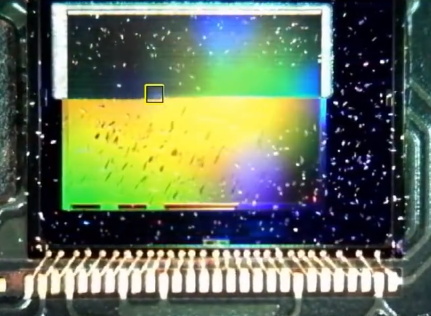
A look at the CCD, halfway through the process.

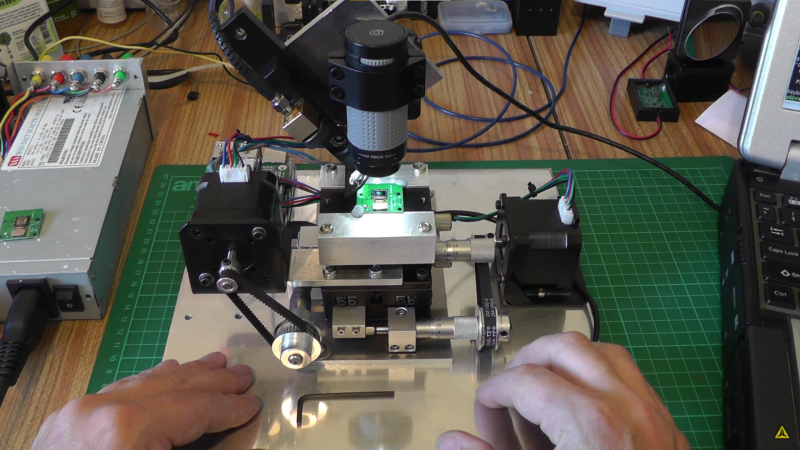
Inspired by techniques used in industry, [Les] eventually tried to use a several-kW nitrogen laser to burn off the filter (which seems appropriate given his experience with lasers). He built a rig that raster scans the laser across the sensor using stepper motors to drive micrometer bases. A USB microscope was included to allow progress to be monitored, and you can see a change in the sensor’s appearance as the filter is removed.

After blasting off the Bayer filter, [Les] plugged his improved camera into his home-built spectrometer and pointed it outside. The new camera gives the spectrometer much more uniform sensitivity and allows [Les] to see further into the IR and UV bands. The spectrometer can even detect the Fraunhofer lines—subtle dips in the sun’s spectrum from absorption by molecules in the atmosphere.

This is incredible for a DIY setup and instrument, and we can’t wait to see what [Les] does next to improve his measurements. If your spectrometry needs are more mass than visual, take a look at this home-built mass spectrometer. Home spectrometers aren’t just for examining light spectra—they can also be used to judge the ripeness of fruit!


 https://hackaday.com/2021/08/09/using-a-laser-to-blast-away-a-bayer-array/

Friday, June 13, 2014

Curved CCDs from Andanta


As Sony presents its curved CMOS sensors, one has to mention that Olching, Germany-based Andanta has first shown its commercially available curved CCDs in 2012. The 2013-dated document presents cylindrically curved FSI devices as standard products, while the spherical ones available on request: The company says: "*The curvature of the image sensor can be designed as a one-dimensional cylindrical curvature or as a two-dimensional spherical curvature (convex or concave). As part of a customized project, scientific front illuminated 4k x 4k (16 Mpixels) - image sensors with convex and ... more »


Wednesday, November 16, 2011

Color CMOS 8 Megapixel (3264 x 2448) Image Sensor

http://www.ovt.com/products/sensor.php?id=102


OV8830
Color CMOS 8 Megapixel (3264 x 2448) Image Sensor with OmniBSI-2 Technology
The OV8830 is OmniVision's first sensor built on the company's second generation OmniBSI-2™ backside illumination (BSI) pixel architecture. It delivers optimized power consumption and best-in-class pixel performance that enable enhanced image capture and high frame rate 1080p and 720p high-definition (HD) video recording. Manufactured combining a copper process on 300 mm wafers using 65 nm design rules, the 1/3.2-inch OV8830 is highly optimized for the next generation smart phone market.
Benefits of OmniBSI-2 technology found in the OV8830 include optimized die size, a bigger collection region in the photodiode enabled by custom design rules, a significant reduction in power consumption, and 1.2 V digital core. Key improvements over the first generation OmniBSI architecture include a 20 percent improvement in peak quantum efficiency in all color channels, 35 percent improvement in low-light sensitivity, and 45 percent increase in full well capacity. OmniBSI-2's custom pixel design rules also enable better pixel layout, better isolation, and significantly reduced crosstalk. Each of these advances represent additional performance improvements over the first generation OmniBSI technology resulting in better image quality, enhanced color reproduction, and improved overall camera performance.
In full 8-megapixel (3264 x 2448) resolution, the OV8830 operates at 24 frames per second (fps) in a 4:3 format and in 6-megapixel (3264 x 1836) resolution at 30 fps in a 16:9 format. These higher frame rates enable a number of key benefits, including: no image lag for shutter-less designs, continuous shooting, minimized rolling shutter effect, real-time image capture with no lag between resolutions, and full HD at 30 or 60 fps.
A RAW sensor, the OV8830 is designed for 2-chip solutions that involve the sensor working in conjunction with a baseband or an application processor with integrated image signal processing. Additional integrated features of the OV8830 include an integrated scaler, 2x2 binning, re-sampling filter, alternate row high dynamic range timing support, context switching, temperature sensing, 4 Kbits of one-time programmable memory, lens shading correction, and defect pixel correction. The OV8830 fits into the industry standard module size of 8.5 x 8.5 x 6 mm, and a high-speed, 4-lane mobile industry processor interface (MIPI) facilitates the required high data transfer rate.

Features

  • 1.4 µm OmniBSI-2 technology
  • 2/4-lane MIPI serial output interface
  • Support scalar, 2x2 binning, re-sampling filter
  • Supports alternate row HDR timing
  • Embedded 4K bits one-time programmable (OTP) memory
  • Context switching
  • Image quality controls: 2D-DPC and lens shading correction
  • Automatic black level calibration (ABLC)
  • Programmable controls for frame rate, mirror and flip, cropping, windowing, and scaling
  • Supports horizontal and vertical subsampling
  • Supports images sizes: 8 MP, 6 MP, EIS1080p, 1080p, EIS720p, EISQ 1080p, Q1080p, EISVGA, VGA, QVGA, etc.
  • Standard serial SCCB interface
  • Two on-chip phase lock loop (PLL)
  • Programmable I/O drive capability
  • Built-in 1.2V regulator for core
  • Built-in temperature sensor

Monday, March 22, 2010

Could quantum dots replace CCD and CMOS image sensors?

Quantum dots are tiny bits of semiconductor crystals with amazing optical properties that are determined not only by their material composition, but their size. Till now these have mostly been used for emitting light but can also receive light.

Silicon Valley startup InVisage has unveiled a potentially disruptive technology that might be a game changer for digital photography. Industry analysts are understandably intrigued by this quantum dot technology and its potential to displace the mighty CMOS image sensor in future cameras. Among other things, InVisage claims that quantum films offer four times the sensitivity as CMOS images sensor yet are less expensive to manufacture.

Quantum film threatens to replace CMOS image chips

Just as film was displaced by silicon chips, so now quantum film threatens to replace CMOS image chips by responding electrically to light instead of by changing its chemical composition.


See:

Monday, November 16, 2009

IR Water-proof Camera for sales at USD15.6/pc,UTP Video Balun at US$1.55/pair

I get this sort of stuff from China all the time, Anyone wanting to put together a group purchase let me know. 


John L. Sokol


---------------------------------


Dear Purchaser,
Good day.

The below are Hawell November Promotion items. Believe you will find the price is quite attractive, right?

25M IR Water-proof Camera,1/4 Sharp CCD,420TV lines, 24pcs IR leds


For sale: US$15.6/PC (MOQ:50PCS)


Economical UTP Video Balun,Smart design


For sale: US$1.55/Pair (MOQ:100 Pairs)

Wanna to get it? Pls just contact me now.

Kind regards,

Tarring tarring@cctvhowell.com
Shenzhen Hawell Advanced Technology Co.,Ltd

Website: http://www.cctvhw.com/english/
Tel:86 755 81706890
Fax:86 755 81706890
MSN: tarringhee@hotmail.com
Skype: tarringhee


Address: The 5th building of the 2nd Industrial Park of Yousong
The 1st Road of Donghuan, LongHua Town, Baoan District
Shenzhen City, Guangdong, China

Monday, January 26, 2009

Quantum Camera On a Silicon Chip

From: Slashdot

"Physicists in Switzerland and California have developed a new type of camera capable of imaging quantum correlations between pairs of photons. The details are presented in the current issue of the open-access publication New Journal of Physics. Unlike a conventional camera with a CCD imager, this camera is composed of Single Photon Avalanche Diode (SPAD) pixels implemented on a high-performance CMOS chip. One of the authors has provided more background for the non-physicist. Apparently, it could be used to verify the existence of Bose-Einstein condensates that are now starting to be produced in new ways."