Showing posts with label IR Cameras. Show all posts

Thursday, September 30, 2021

USING A LASER TO BLAST AWAY A BAYER ARRAY


A Bayer array, or Bayer filter, is what lets a digital camera take color photos. It’s an array of tiny color filters that sit on top of a camera’s CCD. The filter makes it so that each sub-pixel in the image sensor only sees red, green, or blue light. The Bayer filter is an elegant tool that gives us color digital photos, but what would you do if you wanted to remove one?

[Les Wright] has devised a way to remove the Bayer filter from the Raspberry Pi Camera. Along with filtering red, green, and blue light for their respective sensors, Bayer filters also greatly reduce the amount of UV and IR light that make it to the CCD sensor. [Les] uses the Raspberry Pi camera in his Pi-based Spectrometer, and he wants to remove the Bayer filter to improve and expand its sensitivity.

Of course, [Les] isn’t the first one to want to do this. Some have succeeded in physically scratching the filter off of the CCD, but because the Pi Camera has vital circuitry around the outside of the sensor, scratching the filter off would likely destroy the circuitry. Others have stripped it off using chemical means, so [Les] gave this a go and destroyed no small number of cameras in his attempt to strip the filter off with solvents like DMSO, brake fluid, and industrial paint stripper.
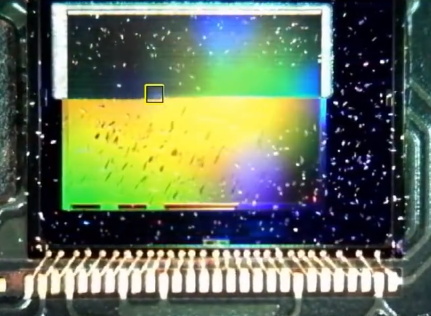
A look at the CCD, halfway through the process.

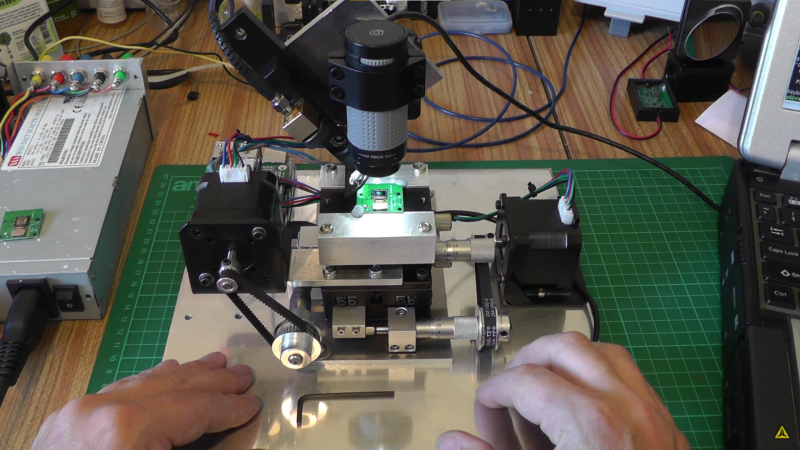
Inspired by techniques used in industry, [Les] eventually tried to use a several-kW nitrogen laser to burn off the filter (which seems appropriate given his experience with lasers). He built a rig that raster scans the laser across the sensor using stepper motors to drive micrometer bases. A USB microscope was included to allow progress to be monitored, and you can see a change in the sensor’s appearance as the filter is removed.

After blasting off the Bayer filter, [Les] plugged his improved camera into his home-built spectrometer and pointed it outside. The new camera gives the spectrometer much more uniform sensitivity and allows [Les] to see further into the IR and UV bands. The spectrometer can even detect the Fraunhofer lines—subtle dips in the sun’s spectrum from absorption by molecules in the atmosphere.

This is incredible for a DIY setup and instrument, and we can’t wait to see what [Les] does next to improve his measurements. If your spectrometry needs are more mass than visual, take a look at this home-built mass spectrometer. Home spectrometers aren’t just for examining light spectra—they can also be used to judge the ripeness of fruit!


 https://hackaday.com/2021/08/09/using-a-laser-to-blast-away-a-bayer-array/

Friday, October 20, 2017

Weatherproof TTL Serial JPEG Camera with NTSC Video and IR LEDs

https://www.adafruit.com/product/613


TECHNICAL DETAILS


  • Metal Housing size: 2" x 2" x 2.5"
  • Weight: 150 grams
  • Image sensor: CMOS 1/4 inch
  • CMOS Pixels: 30M
  • Pixel size: 5.6um*5.6um
  • Output format: Standard JPEG/M-JPEG
  • White balance: Automatic
  • Exposure: Automatic
  • Gain: Automatic
  • Shutter: Electronic rolling shutter
  • SNR: 45DB
  • Dynamic Range: 60DB
  • Max analog gain: 16DB
  • Frame speed: 640*480 30fps
  • Scan mode: Progressive scan
  • Viewing angle: 60 degrees
  • Monitoring distance: 10 meters, maximum 15meters (adjustable)
  • Image size: VGA(640*480), QVGA(320*240), QQVGA(160*120)
  • Baud rate: Default 38400, Maximum 115200
  • Current draw: 75mA without IR LEDs on. 250mA extra for IR LEDs
  • Operating voltage: DC +5V
  • Communication: 3.3V TTL (Three wire TX, RX, GND)

Thursday, December 11, 2014

FLIR Lepton minature Thermal Imager & Breakout Board


Flir Lepton Thermal Camera Breakout
https://www.tindie.com/products/PureEngineering/flir-lepton-thermal-camera-breakout-2/


FLIR Lepton Thermal Imager - Batch 4. Now with Breakout Board!
https://groupgets.com/campaigns/49-flir-lepton-thermal-imager-batch-4-now-with-breakout-board

The FLIR Lepton™ is the most compact longwave infrared (LWIR) camera core exclusively available here in small quantities for prototypers, makers, and hobbyists. It packs a resolution of 80 × 60 pixels into a camera body that is smaller than a dime. This Lepton is shutterless with a 51deg HFOV lens.


SystemPlus Publishes FLIR Lepton Reverse Engineering

http://image-sensors-world.blogspot.com/2014/12/systemplus-publishes-flir-lepton.html

Friday, November 28, 2014

Infrared thermal Imaging Hack-a-thon


FLIR ONE Hack-a-thon: 

Infrared thermal Imaging Camera for your Smartphone


At the HackerDojo
Start:   Friday, December 12 2014 at 1:00pm
End:    Sunday, December 14 2014 at 9:00am
Contact:
Carlos.Uranga@Hackerdojo.Com; Interim Assistance: Anil.Reddy@Hackerdojo.Com, Jaun.Alvarez@Hackerdojo.Com
Fee: Free for first 50 participants, $15 thereafter per person. Click on the link above to reserve your ticket now!

Details:
Join FLIR and HackerDojo in a 38-hour Hack-a-thon to develop cool and interesting iOS apps for the FLIR ONE!
Cash, products, and promotional prizes for best apps in four categories.

Event Agenda

Friday 12/12
4:00 p.m.- 6:00 p.m. - FLIR ONE Hack-A-Thon Event Kickoff and Keynotes

6:00 p.m.- 12:00 a.m. - FLIR ONE Hack-A-Thon with Hourly Prize Drawings*

*Must be present to win

Saturday 12/13
12:00 a.m.- 12:00 a.m. - FLIR ONE Hack-A-Thon Continues with Hourly Prize Drawings

Sunday 12/14
12:00 a.m.- 8:00 a.m. - FLIR ONE Hack-A-Thon Continues

8:00 a.m.- 12:00 p.m. - Developer Presentations and Demonstrations

12:00 p.m.- 1:00 p.m. - Catered Lunch and Judging

1:00 p.m. - Award Ceremony


Best New App Prizes

1st - $5000 +FLIR ONEs for the entire team + FLIR FX

2nd - $2000 + FLIR ONEs for the entire team + Flir FX

3rd - $1000 + FLIR ONEs for the entire team

4th - $500 + FLIR ONEs for the entire team

5th - FLIR ONEs for the entire team

Additional prizes: Best app in each category - $1000 + FLIR ONEs
App categories: Work, Home, Play, Games/Entertainment


Notes:
Ideally teams of 1-4, hacking the future!

Check back weekly for further updates.


Tuesday, August 19, 2014

Mantis Vision teardown


iFixit teardown shows that Mantis Vision structured light camera is responsible for Google Project Tango tablet 3D vision. The teardown team quotes Google: "The IR projector is from Mantis Vision, and designed specific to our specs for field of view and resolution. It is custom designed to work in partnership with the 4MP RGB-IR camera on the other side."


Friday, June 20, 2014

Amazon Fire Phone Uses 4 IR Cameras for 3D UI


This technology looks a lot like the Leap Motion but instead of two cameras, they are using three.


The Verge, Mashable:

Amazon Fire Phone uses four front-facing IR cameras to create a 3D user interface: "Perhaps the most useful application shown off so far is simply tilting the phone to scroll through a web page like The Washington Post or to page through a Kindle book. Of course, we've seen other tilting features before and they've a lot to be desired, but Amazon's demo seems to make these features seem far better than previous attempts. The question will be whether or not the extra processing power and potential battery life drain to run these multiple cameras will be worth it."