Showing posts with label Kinect. Show all posts

Friday, July 31, 2020

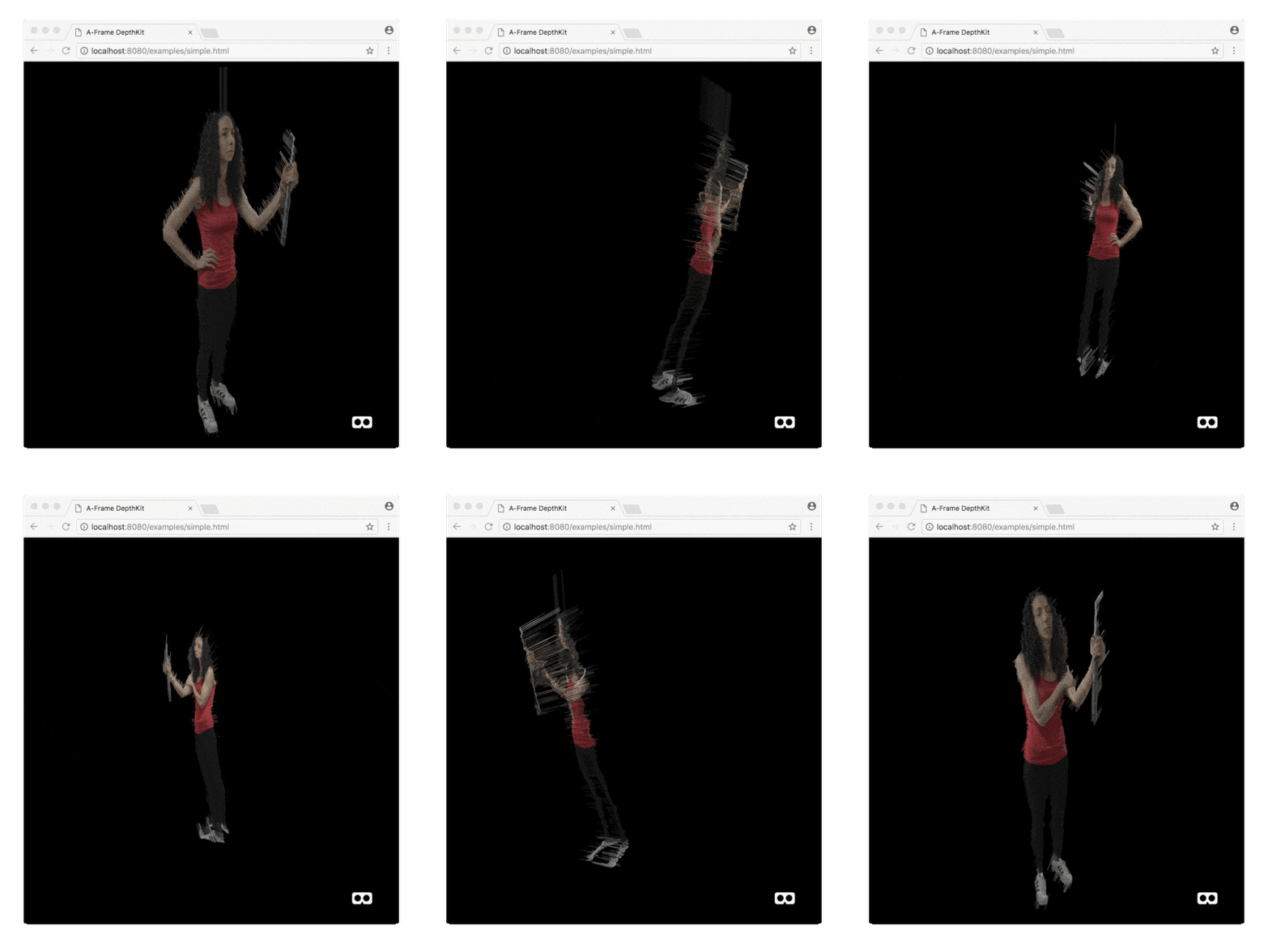
DepthKit - Depth Image Video - Free Viewpoint video. volumetric video


https://www.depthkit.tv/
DepthKit AFrame DepthKit for AFrame

An A-Frame component for rendering Volumetric videos captured using DepthKit (i.e Kinect + DSLR) in WebVR. The component wraps DepthKit.js which provides a similar interface for Three.js projects.


https://github.com/juniorxsound/DepthKit-A-Frame

https://orfleisher.com/aframe

https://github.com/juniorxsound/DepthKit-for-Max


DepthKit for Max/Msp/Jitter

A sample Max patch demonstrating a workflow for playing volumetric video in Max/Msp/Jitter using DepthKit combined-per-pixel exports. Supports rendering a mesh, wireframe and points.
DepthKit in Max


Saturday, June 09, 2012

XYZ Interactive

Super simple low cost gesture recognition.  3D spatial.  Uses LED's and Photo-diodes. 

They have an automotive computer demo. 

http://www.gesturesense.com/

Wednesday, May 16, 2012

Saturday, April 07, 2012

Using Kinect for eye tracking

"The technology works by figuring out where you’re sitting using a Microsoft Kinect camera, then guessing approximately where your right and left eyes are, and flashing images quickly on the screen targeted at each eye, which creates a 3D image in your brain."

Thursday, January 26, 2012

Android Kinect Projector Interface

From Slashdot:


Android Kinect Projector Interface


"A guy who goes by the online handle DDRBoxman decided it would be fun to blow up his Samsung Galaxy Nexus display onto the wall by connecting his phone to a projector. He then connected the whole thing to a PC and, thanks to Microsoft's open-source Kinect platform for Windows, he was able to create a custom ROM that mapped out the phone interface to the Kinect sensors. Pretty neat!"

Real-time depth smoothing for the Kinect

From Hack-A-Day:


[Karl] set out to improve the depth image that the Kinect camera is able to feed into a computer. He’s come up with a pre-processing package which smooths the depth data in real-time.
There are a few problems here, one is that the Kinect has a fairly low resolution, it is also depth limited to a range of about 8 meters from the device (an issue we hadn’t considered when looking at Kinect-based mapping solutions). But the drawbacks of those shortcomings can be mitigated by improving the data that it does collect. [Karl's] approach is twofold: pixel filtering, and averaging of movement.
The pixel filtering works with the depth data to help clarify the outlines of objects. Weighted moving average is used to help reduce the amount of flickering areas rendered from frame to frame. [Karl] included a nice GUI with the code which lets you tweak the filter settings until they’re just right. See a demo of that interface in the clip after the break and let us know what you might use this for by leaving a comment.


Sunday, November 06, 2011

Fast and easy 3D reconstruction

Very cool and inevitable use of the Kinect Technology. Once it's applied to robotics and transportation, literally the entire physical world will be represented in the virtual world.

Soon there may be little difference between the two.

This can also be done using simple stereo cameras, such as 2x $5 USB cameras. And you get a Stereo 3D image too. There are other motion clues in the video too.  I believe there are already systems that use regular mono video, it can even be prerecorded and later used to make 3D image maps just like shown in this video.

Microsoft Photosynth, Google and NASA also had some tech like that, it's a shame it hasn't been further perused and shared.  

I am sure in a few years every cell phone will be able to do this.  Say 2015, 2018 the latest.
Actually with embedded micro projectors, maybe as soon as 2013.

Augmented Reality system will just make these 3D maps as part of just doing there head tracking and synchronization.  Every inch of modern metropolitan society will be fully mapped within months of  Augmented Reality's market wide acceptance.


MatterPort is creating a low-cost handheld 3D scanner that allows anyone to quickly and easily produce a realistic 3D model of a room or object.

Their goal is to make 3D capture as easy, as cheap, and as pervasive as digital photography.

Learn more at http://matterport.com


Started by Matt Bell - Computer Vision expert. Founder of Reactrix. Working on MatterPort at Sunfire. CS degree from Stanford.
and
David Gausebeck - One of the original developers at PayPal; currently working at MatterPort. BS in CS from UIUC.

Bloomberg: Microsoft Kinect Lures Hackers

Monday, October 31, 2011

Upcoming Kinect Development Kit Could Change In-Store Shopping

http://www.wired.com/gadgetlab/2011/10/xbox-kinect-sdk-microsoft/


The Xbox Kinect is Microsoft’s big push into motion-controlled gaming. You don’t even need a controller to play. Just move your hands and feet with gestures that the Kinect understands, and — voilà! — you’re kicking footballs, competing in dance challenges, and shooting down bad guys.
But now, one year since its launch, the Kinect has gone way beyond video games. It could change our retail buying experiences, and reinvent the way we shop.
A commercial version of the Kinect software development kit will be made available in early 2012, Microsoft announced on Monday, opening the door for businesses to create new applications for the popular platform.
“With the Kinect for Windows commercial program, Microsoft hopes that visionaries all over the globe will continue to transform the way we do things with new Kinect-enabled tools,” a Microsoft spokesperson told Wired.com in a statement. Microsoft is currently running a pilot program with more than 200 businesses across more than 20 countries, including partners like Toyota, textbook publisher Houghton Mifflin Harcourt, and digital advertising agency Razorfish.
If all goes as planned, we could see Kinect-based interactions show up at retailers, banks, automotive dealers and other commercial environments. Razorfish, for example, is looking at building kiosks in which customers’ bodies would be scanned in order to try on digital outfits without needing to take off any clothes — so said Razorfish VP of emerging tech Jonathan Hull in an interview with Kotaku. Other applications could include simpler tasks, such as waving one’s hands to navigate an ATM’s menu screens.
Microsoft previously released a non-commercial version of its Kinect SDK in June, encouraging hackers and open software enthusiasts to create off-beat, innovative applications that take advantage of the platform’s motion-sensing capabilities. From gimmicky motion controls for banking software to NSF grant-backed medical research, the non-commercial SDK spurred creative uses of the platform beyond what Microsoft expected.
Kinect first debuted in November of 2010 to much fanfare. The system eschews the traditional button-and-joystick controller scheme, and instead lets users navigate and play games via hands-free motion capture. The system was an instant hit, setting a Guinness World Record for the fastest-selling consumer device ever in the first few days after its release. In March, Microsoft announced it had sold more than 10 million Kinect devices.
Though the hands-free controller has been a fun novelty for gaming enthusiasts, the Kinect’s utility for hardware-modding enthusiasts has been more compelling. The Xbox peripheral is packed with a bevy of sophisticated motion-capturing instruments, including an infrared light emitter to capture the surfaces of items in a room, and a depth camera that builds a 3D model of all the objects captured by infrared.
The Kinect’s relatively low $150 price tag has been even more attractive for budding DIY-ers. Willow Garage — the Silicon Valley robotics outfit known for its robot control operating system — now offers a $500 open-source robotics kit that incorporates the Kinect. The company’s previous version (also pre-Kinect) cost $280,000.
The initial forays into Kinect modification began with the homebrew modding community, spurring a wave of creative software hacks that ranged from Street Fighter games to the intricacies of “boob physics.” (Yes, really.)
Instead of taking action against the hackers or trying to bar hardware nerds from further Kinect mods, Microsoft encouraged development, promising to eventually release SDKs to new segments of would-be Kinect hackers. “Kinect represents the first incarnation of the next big thing in computing — a world where computing is becoming more natural and intuitive,” a Microsoft spokesperson told Bloomberg Businessweek in a statement.
Kinect’s natural progression is to move into the commercial realm. Much like app developers for Apple’s iOS and Google’s Android, the release of the commercial SDK allows third parties to use Microsoft’s technology in bolstering their own brands and services. Partners, however, would use Microsoft’s hardware to augment their own businesses — this rather than providing content to a centralized store. In return, Microsoft would open itself up to untold numbers of potential new hardware purchasing partners.
David Dennis, group program manager of Microsoft’s Xbox team, told Kotaku that Kinect devices could be sold in bulk numbers — the “tens of thousands” — to partner businesses.
Microsoft hasn’t released any hard details on the commercial SDK’s release date beyond “early next year.” So don’t expect to start waving on digital fashion accessories right away.
Wednesday, October 19, 2011

Hacking the Xbox Kinect with Johnny Chung Lee


Google "rapid evaluator" Johnny Chung Lee demonstrates how independent developers around the globe are using Microsoft's Xbox Kinect to create sophisticated full-body tracking video games.

Monday, October 17, 2011

Kinect open source driver

Kinect open source driver demo

http://nuigroup.com/forums/viewthread/11154
http://code.google.com/p/libkinect/
http://groups.google.com/group/openkinect/
http://codelaboratories.com/projects/kinect/
http://git.marcansoft.com/?p=libfreenect.git

The “Effervo” Kinect Particle Effect Machine

From Hack A Day:


Here’s a new hack for the Xbox Kinect called “Effervo”. It’s a really cool effect built using Openframeworks. The Kinect is setup in front of the user and the projector puts an image in front of the user’s screen. Three dimensional data about the person and his or her movements is captured using Microsoft’s sensor. As it is described, the Effervo program “uses simple iterative rules to govern its movement and gives the impression of swarm like behavior.” This may not be a “Haloween Hack”, but we could definitely see something similar used in a haunted house. Maybe it could use blood droplets instead of particles?

Maybe this hack will inspire other people to follow in [Jayson's] footsteps. He describes himself as a “programmer turned artist.” We’d like to think that all engineering and programming work is a form of art, but the video of this piece in action after the break is especially eye-catching.


Effervo Particle System Version 2 from bleep on Vimeo.

This is version 2 of the Effervo particle system, an interactive digital life form that inhabits and explores the presence of a person in 3d space. Using a 3d camera and custom written software people standing within the installation are rendered by a swarm of particles which stream into the users body, playfully exploring their physical form.

This installation will be part of PauseFest 2011 in Melbourne, Australia with the installation being situated in the Melbourne Central Shopping Centre from the 7th-13th of November 2011.

Built with Openframeworks

brokenpixelproductions.com
pausefest.com.au

Tuesday, September 06, 2011

3D Hacking Environment Links Kinect, Blender, and Metasploit

baxpace writes with a link describing a way to test your own security systems for vulnerabilities using Kinect-interpreted natural gestures in tandem with the Metasploit Framework and the Blender game engine, writing:  
 
"The idea is to hack into your own systems while in a 3D, first person shooter style environment that interfaces with the Kinect sensor. The game engine was built using Blender and looks to be one of the most pleasing ways of uncovering your own systems' architectural/networking vulnerabilities."

Kinect Based Whole Building Breakout

From SlashDot:
"If you remember Breakout — rows of blocks a the top of the screen and a paddle to bounce a ball into them to destroy a block — then you might not feel nostalgic about it. After all, it was a very limited sort of game. However, take one Kinect and one building and you have something quite different when you use it to create a Breakout game. The bricks, ball and paddle all projected onto an old building and the player moves from side-to-side to control the paddle. The player's position is being detected by a Kinect, is there no end to the fun you can have with this gadget. The really clever bit, and you might not notice it unless you look closely at the video, is that the ball bounces off real architectural features of the building — like the windows, for example"


.

Gigantic kinect brick game on a builing
This will definitely take your classic video game into epic and interesting proportions! The Kinect Gigantic Brick Game on a Building is as the name suggests; a Kinect-controlled Brick Game which the display is projected on the side of a tall building. This video by WECOMEINPEACE displays this very spectacular Kinect hack and how this project attracts bystanders directly and indirectly. In the video, the side of the tall building serves as the “monitor” for the brick game. Using a variety of high-powered projectors, the building displays the Kinect brick game. Using the Kinect, the user then commences to use his gestures to play the game. Arm movements control the main racket that bounces the ball and with the larger than life screen to view the game, it certainly adds more majesty to an otherwise old game. Kinect games are getting much love and soon, our own buildings might have an interactive Kinect game readily available.

Le casse-brique est un jeu-vidéo auquel tout le monde a joué. Mais c’est une toute autre expérience lorsque celui-ci prend des proportions monumentales et qu’on y joue avec tout son corps.
Brick propose au joueur de déplacer le palet grâce aux mouvements de son corps, pour faire rebondir une balle et casser les briques. L’installation ludique utilise principalement deux technologies :
- la Kinect pour la détection du mouvement du joueur
- le mapping, qui adapte le jeu aux moindres particularités du bâtiment.
Ainsi, la balle rebondit sur les vrais éléments de l’architecture, les fenêtres, colonnes, et gouttières, pour une expérience aussi grandiose qu’amusante.

Conception : Wilfried Della Rossa, Kimi Do, Thomas Mathieu
Visuals : Wilfried Della Rossa, Thomas Mathieu
Programming : Thomas Mathieu

Monday, August 08, 2011

Programming the Kinect to Work with Android

From Hack-A-Day

The Kinect has been hacked for many purposes, but this Android implementation tutorial is the first we’ve heard of it being used on a mobile phone platform. Although not a finished product at this point, [Raymond's] tutorial is a good starting point for those wanting to experiment with fusing these two technologies.
The Kinect programming for this tutorial has been done with the Tegra Ventana development kit for Android 3.0. An Ubuntu-Linux installation is used, but this technique should be portable to any Linux system according to the author.
The procedure given is pretty straightforward, and the author even provides an example of the results in a video after the break. It’s interesting to note that, when connected, the Kinect is seen as two devices, “Xbox NUI Camera” and “Xbox NUI audio”. We look forward to new hacks to come out for this device, possibly using this set of tools.


For another related hack, check out this robotic skeleton controlled with the Kinect.

Thursday, August 04, 2011

Open Source Gesture Recognition For Kinect SDK

From SlashDot:

"I have been working with a new internet-friend of mine to produce an open source gesture recording and recognition engine for Kinect SDK. It's based on the Dynamic Time Warping technique and allows developers to record their own gestures and reliably recognise them. It's currently 2D but 3D is an easy development, coming soon. We're looking for community take-up and contribution to this project — it could help a lot of people with rapid prototyping and could even be used in production solutions (within the Kinect SDK's terms of use, of course!)."

Monday, July 25, 2011

Qualcomm buys GestureTek gesture-recognition tech


In 2000 GestureTek transformed the way people interact with computing displays by inventing and patenting 3D video gesture control. Our pioneering of this technology over the last 10 plus years has resulted in a multi-patented 3D-vision gesture control system, which is a highly precise and reliable user interface for interacting with any display screen from any distance. Whether on a personal computer, set top box, television set, mobile device, game console, digital sign or interactive kiosk, GestureTek's ground-breaking depth tracking software enables users to control onscreen interaction with simple hand motions instead of a remote control, keyboard or touch screen. This technology has been used for custom installations for Fortune 500 companies over the last 10 years, and GestureTek continues to offer this advanced state of the art technology and service to its clients. Some of the technology and patents that are the basis of this technology have been licensed to major consumer electronics companies, like Microsoft, for use on the XBOX.


From EETimes: Qualcomm buys gesture-recognition technology

Qualcomm Inc. acquired some assets of GestureTek, a developer of gesture recognition technology. The chip maker said it plans to put the gesture recognition technology into its "current and next-generation Snapdragon processors" for smartphones, tablets and other consumer devices.

Qualcomm bought unspecified intellectual property assets related to gesture recognition, as well as some engineering resources from the company that was founded in 1986.  GestureTek retains some of its assets and will continuation its business in gesture-enabled digital signs. The companies did not disclose financial details of the transaction.

Prior to the deal, GestureTek said it owned eight broad patents on camera- and video-tracking that issued starting in 1996 and said it had applied for 37 others. It has developed gesture-recognition technology for displays and surfaces used in markets spanning handsets, digital signage and heath care.

The company first got its software into handsets in 2007 in a deal with Japan's DoCoMo. It also is used in handsets from HTC, Motorola, Nokia, NEC, Sony Ericsson, Samsung and LG. Licensees for other products include Panasonic, Microsoft (Xbox 360), Sanyo, Sony, IBM, and Intel.

Last year the company demonstrated its software running on Android and Symbian environments. It also supports Linux, Nucleus, Windows Mobile and Qualcomm's Brew for feature phones.

"Applications processors are enabling a range of new ways for consumers to interface with their home entertainment and mobile devices," said Steve Mollenkopf, executive vice president and group president, Qualcomm, speaking in a press release. "Our acquisition will strengthen Qualcomm's smartphone product portfolio and enable our customers to launch products with new and compelling user experiences," he added.

Gesture recognition technology will be integrated into Qualcomm's current and next-generation Snapdragon processors, giving OEMs the capability to produce smartphones, tablets and home entertainment devices with user interfaces based on natural human gestures.

The debut of the Nintendo Wii and Apple iPhone heated up the market for gesture recognition starting in 2008. Hitachi and others showed such interfaces at CES in 2009 powered by chips from Canesta and others. Microsoft Kinect, one of the fastest selling consumer products in history, further spurred work in gesture recognition with a software developers kit released in June.