Showing posts with label internet. Show all posts

Friday, April 23, 2021

IPFS video player

 InterPlanetary File System (IPFS) is a protocol and peer-to-peer network for storing and sharing data in a distributed file system. IPFS uses content-addressing to uniquely identify each file in a global namespace connecting all computing devices.


IPFS allows users to host and receive content in a manner similar to BitTorrent. As opposed to a centrally located server, IPFS is built around a decentralized system[5] of user-operators who hold a portion of the overall data, creating a resilient system of file storage and sharing. 

https://en.wikipedia.org/wiki/InterPlanetary_File_System


The link is here:

https://ipfs.video/


IPFS video player

Welcome to the IPFS video player

At the top, you can use the form to put in your custom IPFS content id. If you have not found any good example to view yet, you can try Blender Half full, the demo video from https://ipfstube.erindachtler.me/, a talk by Alan Kay, the free movie Sita sings the blues,Big Buck Bunny,Caminandes 1,2,3or simply a monkey video downloaded from Pexels.

Finaly reddit IPFS_Hashes might have some IPFS video hashes as well.

Other works under the same project

A Kodi plugin under development that will complement this website, available at:https://github.com/bneijt/ipfs-video-kodi

A project to help you host your own IPFS pinning gateway easily:https://github.com/bneijt/ipfs-video-gateway

Monday, August 10, 2020

Very high-speed Digital Subscriber Line 2 (VDSL2)


In 1994 I went and drew a chart of every possible way and strategy of getting internet in to a home.
Cable TV and Phone Lines being the most obvious, and using the water pipes or sewer also being options, and radio in various bands and arrangements from Micro Satellite dish, building neighborhood wifi mesh networks, various radio network topologies and immediately started working on all of these.

The idea that data could be pushed over a phone line and still leave the only analog phone line working unaffected is amazing.   My first T1 1.544 Mbit/s lines in 1995/7 used PairGain transceivers (it seemed like cheating because they were using ADSL to provide it) , that connected to the CSU/DSU and then a Cisco 2500 router to finally get an ethernet.   I say cheated because T1's use to be

Now they can push 300Mbit/s over these old phone lines. 

 line-modulation techniques for VDSL  are:

  • quadrature amplitude modulation (4-QAM) 
  • discrete multitone (DMT). a form of OFDM


The following list is a summary of existing OFDM-based standards and products. For further details, see the Usage section at the end of the article.

Wired version mostly known as Discrete Multi-tone Transmission (DMT)[edit]


https://en.wikipedia.org/wiki/VDSL

Very high-speed Digital Subscriber Line (VDSL)[1] and Very high-speed Digital Subscriber Line 2 (VDSL2)[2] are digital subscriber line (DSL) technologies providing data transmission faster than Asymmetric Digital Subscriber Line (ADSL).
VDSL offers speeds of up to 52 Mbit/s downstream and 16 Mbit/s upstream,[3] over a single flat untwisted or twisted pair of copper wires using the frequency band from 25 kHz to 12 MHz.[4] These rates mean that VDSL is capable of supporting applications such as high-definition television, as well as telephone services (voice over IP) and general Internet access, over a single connection. VDSL is deployed over existing wiring used for analog telephone service and lower-speed DSL connections. This standard was approved by the International Telecommunication Union (ITU) in November 2001.
Second-generation systems (VDSL2; ITU-T G.993.2 approved in February 2006)[5] use frequencies of up to 30 MHz to provide data rates exceeding 100 Mbit/s simultaneously in both the upstream and downstream directions. The maximum available bit rate is achieved at a range of about 300 metres (980 ft); performance degrades as the local loop attenuation increases.


VersionStandard nameCommon nameDownstream rateUpstream rateApproved on
VDSLITU G.993.1VDSL55 Mbit/s3 Mbit/s2001-11-29
VDSL2ITU G.993.2VDSL2200 Mbit/s100 Mbit/s2006-02-17
VDSL2-VplusITU G.993.2
Amendment 1 (11/15)
VDSL2 Annex Q
VPlus/35b
300 Mbit/s100 Mbit/s2015-11-06
VDSL2 frequencies.png

VDSL2


The protocol is standardized in the International Telecommunication Union telecommunications sector (ITU-T) as Recommendation G.993.2. It was announced as finalized on 27 May 2005,[5] and first published on 17 February 2006. Several corrections and amendments were published from 2007 to 2011.[2]VDSL2 is an enhancement to VDSL designed to support the wide deployment of triple play services such as voice, video, data and high-definition television (HDTV) VDSL2 is intended to enable operators and carriers to gradually, flexibly, and cost-efficiently upgrade existing xDSL infrastructure.
VDSL2 permits the transmission of asymmetric and symmetric aggregate data rates up to 300+ Mbit/s downstream and upstream on twisted pairs using a bandwidth up to 35 MHz. It deteriorates quickly from a theoretical maximum of 350 Mbit/s at source to 100 Mbit/s at 500m (1640.42ft) and 50 Mbit/s at 1000m (3280.84ft), but degrades at a much slower rate from there, and outperforms VDSL. Starting from 1,600 m (1 mi) its performance is equal to ADSL2+.[
Bonding (ITU-T G.998.x) may be used to combine multiple wire pairs to increase available capacity, or extend the copper network's reach. Hybrid Access Networks  can be used to combine xDSL with wireless networks. This enables network operators to provide faster Internet access services over long lines.

Vplus/35b

Vplus is a technology to achieve higher speeds over existing VDSL2 networks. It was developed by Alcatel-Lucent and standardised in November 2015 in ITU G.993.2 Amendment 1 as VDSL2 profile 35b.[2] It promises to deliver speeds of up to 300 Mbit/s downstream and 100 Mbit/s upstream on loops shorter than 250 m. On longer loops, Vplus falls back to VDSL2 17a vectoring performance.[8] Vplus uses the same tone spacing as VDSL2 17a to allow vectoring across Vplus (35b) and 17a lines, and thus mixed deployments and a smooth introduction of Vplus.

Wednesday, December 17, 2014

Sony Leaks Reveal Hollywood Is Trying To Break DNS


Sony Leaks Reveal Hollywood Is Trying To Break DNS

from the scorched-net-policy dept.
schwit1 sends this report from The Verge:Most anti-piracy tools take one of two paths: they either target the server that's sharing the files (pulling videos off YouTube or taking down sites like The Pirate Bay) or they make it harder to find (delisting offshore sites that share infringing content). But leaked documents reveal a frightening line of attack that's currently being considered by the MPAA: What if you simply erased any record that the site was there in the first place? To do that, the MPAA's lawyers would target the Domain Name System that directs traffic across the internet.

The tactic was first proposed as part of the Stop Online Piracy Act (SOPA) in 2011, but three years after the law failed in Congress, the MPAA has been looking for legal justification for the practice in existing law and working with ISPs like Comcast to examine how a system might work technically. If a takedown notice could blacklist a site from every available DNS provider, the URL would be effectively erased from the internet. No one's ever tried to issue a takedown notice like that, but this latest memo suggests the MPAA is looking into it as a potentially powerful new tool in the fight against piracy.

Tuesday, December 09, 2014

Class Says Comcast Piggybacks on Homes to Set Up Public Network


FROM: http://www.courthousenews.com/2014/12/08/class-says-comcast-piggybacks-on-homes-to-set-up-public-network.htm


Class Says Comcast Piggybacks on Homes to Set Up Public Network


SAN FRANCISCO (CN) - A federal class action accuses Comcast of surreptitiously making its residential customers bear the cost of using their wireless routers to set up a secondary public wi-fi network.
Lead plaintiff Toyer Grear sued Comcast on Dec. 4.
He claims that Comcast saw its millions of residential customers as an opportunity to compete with major cellular carriers such as AT&T and Verizon. Though Comcast does not have cellular towers, its customers' households "could be used as infrastructure for a national wi-fi network," the complaint states.
So Comcast supplied its residential customers with new wireless routers equipped to broadcast their home wi-fi signals and additional wi-fi signals for the public, selectively activating the routers to broadcast the secondary public network (the "Xfinity wifi hotspot") across the country, with the goal of enabling 8 million hotspots by the end of 2014, according to the lawsuit.
"Public" in this case does not mean "free," but that access is available to anyone who pays to use a particular wi-fi hotspot.
Grear claims that Comcast does not request customers' authorization to use their residential equipment and networks for public use.
"Indeed, Comcast's contract with its customers is so vague that it is unclear as to whether Comcast even addresses this practice at all," the lawsuit claims.
In using its customers' home networks to build a national network, Comcast
"has externalized the costs of its national wi-fi network onto its customers," Grear says in the complaint.
He claims that the new routers use much more electricity than regular routers, and that this is "a cost borne by the unwitting customer."
Engineers at Speedify, a technology company that increases Internet connection speeds, ran tests on Comcast's new routers and determined that "Comcast will be pushing tens of millions of dollars per month of the electricity bills needed to run their nationwide public wi-fi network onto consumers," the complaint states.
Based on the results of this study, Grear claims, Comcast's residential customers can expect electricity cost increases as great as 30 to 40 percent.
In addition, Grear claims, the Xfinity hotspots slow down the speed of customers' home wi-fi networks, since these home networks are available for use by strangers.
They also expose Comcast's residential customers' data to increased privacy and security risks, according to the complaint.
Comcast declined to comment.
Grear seeks certification of a class of all households in the United States that have subscribed to Comcast's Xfinity Internet Service, and a subclass of all California households that have subscribed to the service.
He also seeks declaratory judgment, an injunction, restitution and damages for violations of the Computer Fraud and Abuse Act, the Comprehensive Computer Data Access and Fraud Act and California's Unfair Competition Law.He is represented by Gillian Wade and Sara Avila, with Milstein Adelman, of Santa Monica.

Wednesday, July 02, 2014

How the Internet Works - John Milburn

John gives insight in to the economic tug of war over Internet video and the politics going on behind the scenes


Monday, May 19, 2014

The FCC Thinks We're All Idiots

The FFC just ended net neutrality.  What does this mean? If you host your own web site with content, no one will ever be able to see your stuff except at glacially slow speeds. Forget hosting video clips unless your a YouTube or Netflix that can pay the ransom the cable companies will now charge for high quality service.


http://act.watchdog.net/petitions/4655

Read the Full article at:  http://gizmodo.com/the-fcc-thinks-were-all-idiots-1577638316

One way to define a minimum level of access is as a requirement that broadband providers apply no less than a "best effort" standard to deliver traffic to end users. For any particular type of Internet traffic, best-effort delivery would represent the "typical" level of service for that type of traffic—in effect, routing traffic according to the "traditional" architecture of the Internet. Broadband providers would be free to negotiate "better than typical" delivery with edge providers, and would be prohibited (subject to reasonable network management) from delivering "worse than typical" service in the form of degradation or outright blocking.
That sure is a lot of words. But what do they actually mean?
The FCC is basically saying that, while it'll make sure that ISPs do their best to give everyone a fair shot, ISPs will still be able to choose to give some edge providers (i.e. YouTube, Amazon, Imgur, and pretty much every website and app ever) a shot that's still the best—just, you know, better. It's a prospect that not only flies in the face of a free internet, but also logic. You can't improve your "best efforts" for some without necessarily creating "worst efforts" for others.
It's basically an (admittedly convoluted) dictionary definition of everything that net neutralityisn't. As Turner told Gizmodo:
Best-efforts routing means first-in/first-out routing. If there is no congestion, there is no meaning to priority. But in order to create priority, by definition, the ISP's networks have to be constantly congested—or artificially made to seem that way by slowing down all non-prioritized traffic.

Monday, December 05, 2011

KulaByte

http://www.haivision.com/products/KulaByte Haivision’s Internet Media solution delivers software based encoding for live Internet video delivery, including transcoding appliances, software, and cloud services.

In July of 2011 Haivision acquired KulaByte one of only several large company's with big video streaming CDN's.


http://live.haivision.com/    Live streaming video demo.  It didn't work so well for me. Didn't look too deep under the hood to see who's technology and server yet.


Deliver more streams to multiple screens from any encoder with HyperStream live cloud transcoding
http://www.haivision.com/products/HyperStream

Friday, October 21, 2011

Jobs's final plan: an ‘integrated’ Apple TV

From Washington Post

Jobs's final plan: an ‘integrated’ Apple TV

By , Friday, October 21, 9:44 AM

The new biography on Steve Jobs has a major product reveal: Apple may drop a full-fledged television.
Right now, the company sells a set-top box that company officials have called a “hobby.” But his comments in Walter Isaacson’s authorized biography — which was reviewed by The Washington Post — hint at something more to come.
“He very much wanted to do for television sets what he had done for computers, music players, and phones: make them simple and elegant,” Isaacson wrote.
Isaacson continued: “‘I’d like to create an integrated television set that is completely easy to use,’ he told me. ‘It would be seamlessly synced with all of your devices and with iCloud.’ No longer would users have to fiddle with complex remotes for DVD players and cable channels. ‘It will have the simplest user interface you could imagine. I finally cracked it.’”
It’s not exactly clear what Jobs meant, but if the TV offered users a la carte programming with integrated Web surfing and access to Apple’s iOS platform, it could upend longstanding industries in telecommunications and entertainment.
There have been persistent rumors that Apple is planning to launch branded television sets for months. It’s been the pet theory of Piper Jaffray analyst Gene Munster and earned a mention in an August Wall Street Journal article, and Venture Beat’s Dylan Tweeney said that Apple could be planning to launch a television by the end of 2012.

Friday, August 26, 2011

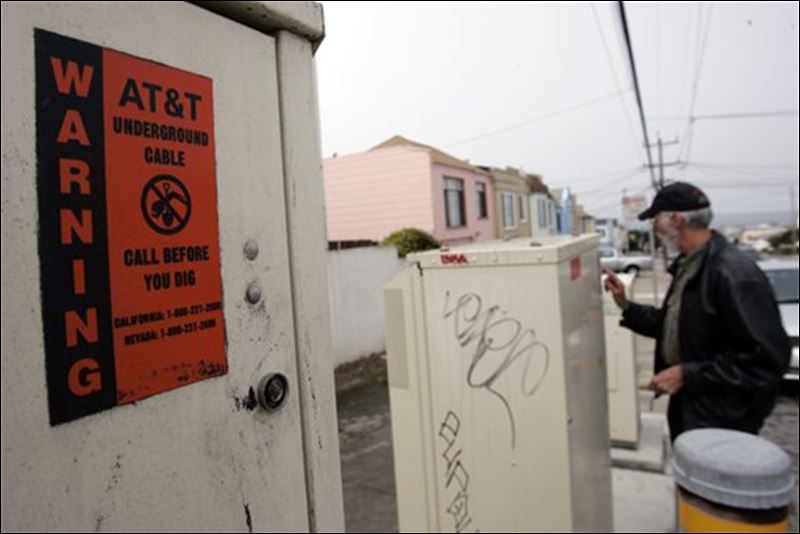
AT&T U-Verse Utility Box are an eyesore!

It's looks like this had been a long ongoing battle to install more of these large boxes on the sidewalks or not.


David Crommie, president of the Cole Valley Improvement Association, looks at an AT&T serving area interface (SAI) box in San Francisco, Tuesday, Aug. 19, 2008. The cabinet in the middle is a U-verse VRAD cabinet and the far left cabinet is a power transfer switch (PTS). Crommie said AT&T received an exemption from environmental review to install up to 850 cabinets in San Francisco, which his group appealed. AT&T backed down last month at a hearing before the board of supervisors and is expected to reapply for exemption.

Lawsuit by San Francisco groups: AT&T's U-verse boxes are an eyesore Aug 26, 2011

The NIMBYs Just Can’t Win in 2011: Here’s a Blow-By-Blow Account of the AT&T U-Verse Utility Box  Vote. Poor Comcast!  Jul 20, 2011

Board of Supervisors OK's AT&T utility boxes  Jul 19, 2011

AT&T makes final push for U-Verse service in S.F. Jul 17, 2011

Telecom video - Internet rollouts raise ire over utility boxes  Aug 22, 2008

Wednesday, August 03, 2011

Broadband services approach advertised speeds.

http://finance.yahoo.com/news/Broadband-services-approach-apf-3558500777.html?x=0&.v=2
http://news.yahoo.com/broadband-services-approach-advertised-speeds-143402340.html

The major providers of residential broadband services in the U.S. deliver Internet connections that are generally 80 percent to 90 percent of maximum advertised speeds, according to a government study released Tuesday.

Wednesday, July 27, 2011

Mark Cuban: Cable Has More Video Opportunities Than The Internet

From  Multichannel News

Mark Cuban: Cable Has More Video Opportunities Than The Internet

Dallas Mavericks and HDNet chief Mark Cuban said Tuesday that despite making a dollar or two off of the Internet himself from Broadcast.com, he is more bullish on cable right now from a video delivery standpoint.

"I'd rather advertise in a cable programming guide than on the Internet," he told an admittedly home court crowd of cable execs at The Independent Show here, noting people are buying more TV's than PC's. "The digital side of cable offers more opportunity than the Internet does."

Among his reasoning is there are just too many standards for web video right now. "If you want to advertise, you can't just do one ad and put it everywhere," he noted.

Saying he was tired of cable operators being forced to hold places in their lineups for smaller cable channels run by big media conglomerates, he said he has begun working on lobbying strategies for the first time.

On Netflix, he said that it is "successful because they took all the garbage no one -- wait, that's not fair to call it garbage, it's library content -- but they came to Viacom and everyone and said we'll pay you cash up front, whereas Apple and Amazon didn't. Netflix will be in great shape until someone else pays cash upfront."

Cuban is also rumored by many to be a potential bidder for the Los Angeles Dodgers baseball team, which is in the middle of an ownership mess. But the outspoken NBA team owner has been down that road before, when he was in the mix for the Chicago Cubs when they were on the block by Tribune.

"I learned a lot from the Cubs. I learned how to get abused and I learned how to get played. They kept on using me to drive up the price," he said, dismissing past reports he had bid $1.2 billion for the Cubs. "Tribune chief Sam Zell wouldn't meet with me.

Basketball and maybe baseball are not the only sports interests for Cuban, who says he has two people working full time on a new playoff system for college football. He says he can't make his plans public until next month, but hinted they would include a series of conference championship games leading to some sort of a playoff system. "The one thing we know is if it does pass, it's going to be on HDNet," he said.

Thursday, July 07, 2011

Mixed Signals: Majority Not Ready For Internet-Connected TV

From MediaPost

Consumers may be as indifferent to Internet-connected TVs as they are about 3D TVs.

A new study suggests a majority of consumers, 62%, "are not connected or not capable" and "most plan to stay that way," according to Knowledge Networks.

But those who are connected or fervent fans plan to dig deeper into new technology -- 21% of those capable plan to connect to a digital capable device next year. 8% of those who are not capable plan to get a connected device in the next year.

Of those already connected, Knowledge Networks says, two-thirds believe the quality of connected TVs are about the same, or better, than their regular TV reception. One-quarter of those cite watching TV shows through connected devices as their No. 1 choice.

But connected-TV viewers still have a yearning for old TV ways. Knowledge Networks say watching TV shows at their regular time is still their preference among all viewers.

As has been determined from other surveys, consumers of connected TV tend to be younger, better-educated, higher-income, heavy-technology users, as well as owning a diverse number of technologies/devices.

When using Internet-connected TVs, 10% of those consumers 13-64 watch TV programs; 11% watch movies (at least monthly) using a streaming service through a TV set. This increases to 17% to 18% among young viewers 13-31.

While video is most popular for connected TVs, search and Facebook are most frequently used Internet services. News services rank lower but still have good usage levels.

Panasonic opening up Viera Connect TV service to developers

From Hollywood reporter
Cloud-based IPTV applications to be available on Viera HD TV sets

TOKYO – Panasonic is opening up its Viera Connect cloud-based TV service for developers to create IPTV applications for the worldwide platform outside Japan.

“Because of the popularity of Actvila in Japan [the country’s leading IPTV portal, launched in 2007], the Viera Connect platform isn’t being released in the domestic market,” a Panasonic spokesperson told The Hollywood Reporter.

Actvila is operated by a consortium of major Japanese TV manufacturers, consisting of Panasonic, Sony, Toshiba, Sharp, and Hitachi.

The Viera Connect Developers website allows application developers and media companies to create services including games, social network platforms, video, music and other content to be delivered through Viera HD TVs. The Viera Connect service was launched globally in April and already offers video-on-demand, games and multi-media contents; the new website is designed to make the service more accessible to developers.

The cloud-based system means that applications don’t need to be downloaded to TV hard drives. According to Panasonic, the quick start-up and response times of the platform, along with the high-definition picture quality, will provide the opportunity to deliver a wide range of services and applications through Viera Connect.

The service is currently available in more than 100 countries.

Task force considers IPv6 protocols for home network needs

The advent of IPv6 and its potential effect on home networking has the Internet Engineering Task Force considering possible new protocols and work-arounds to help the network transition and to eliminate interoperability problems. The task force is considering forming a working group that would map out smooth deployment strategies using IETF standards. 

Source: Network World/IDG News Service

"All the devices in the home will have globally route-able addresses. I don't have to do anything to make those devices accessible to the rest of the Internet," Droms explained. 

"End-to-end communication is both an opportunity and a concern as it enables new applications but also exposes nodes in the internal networks to receipt of unwanted traffic from the Internet," read the proposal to the IESG (Internet Engineering Steering Group), which oversees the IETF.


Currently there are already IP solutions used by the Cable TV industry.
To learn more read about Docsis 3 and MoCA.

TV's increasingly will have Internet connectivity

Wi-Fi devices such as smartphones and tablets are among the reasons for the growth of Web-enabled TVs, and 47% of all flat-panel TVs shipped in 2015 will have Internet connectivity, according to a report by DisplaySearch. In that year, 138 million connected TVs are expected to ship, up from 60 million this year, and 98 million of them will have built-in Wi-Fi.  


More Than 500 Million Connected TVs Worldwide By 2015 : Forecast
Category Unit Shipments to Exceed 138 Million Units in 2015, According to DisplaySearch
Multichannel News

Half a Billion Connected TVs by 2015
New research says that 138 million web-enabled TVs will ship in 2015 alone.
ElectronicHouse.com

Thursday, June 23, 2011

Vint Cerf Says Fix the Net With More Pipe - Slashdot

He's right.   ISP's in Asia get this, applications that use more video sell more Internet and make them more money. Only here in the US, instead of welcoming high bandwidth application, instead they try to sabatoge them. They want to sell bandwidth and then not want users to use it.


From Vint Cerf Says Fix the Net With More Pipe - Slashdot

"While ISPs may fret about Netflix, Hulu and other streaming media services saturating their bandwidth, Internet forefather Vint Cerf has a simple answer for this potential problem: Increase bandwidth exponentially. With sufficient bandwidth, streaming video services of prerecorded content wouldn't be necessary, said the now-technology evangelist at Google. With sufficient throughput, the entire file of a movie or television show could be downloaded in a fraction of the time that it would take to stream the content. Cerf, speaking at Juniper Network's Nextwork conference, spoke about the company's decision to outfit Kansas City with fiber-optic connections that Google claims will be 100 times faster than today's services. The purpose of the project was 'to demonstrate what happens when you have gigabit speeds available,' Cerf said. 'Some pretty dramatic applications are possible.' One obvious application is greater access to high-definition video, he explained. 'When you are watching video today, streaming is a very common practice. At gigabit speeds, a video file [can be transferred] faster than you can watch it,' he said. 'So rather than [receiving] the bits out in a synchronous way, instead you could download the hour's worth of video in 15 seconds and watch it at your leisure.' He adds: 'It actually puts less stress on the network to have the higher speed of operation.'"


On Monday, AT&T Customers Enter Era of Broadband Caps
"The Age of Broadband Caps begins Monday, with AT&T imposing a 150 GB cap on DSL subscribers and 250 GB for UVerse users, and keeping the meter running after that. The move comes as AT&T's 16+ million customers are increasingly turning to online video such as Hulu and Netflix on-demand streaming service instead of paying for cable. With AT&T's Man in the White House, some fear there's a 'digital dirt road' in America's future. Already, the enforcement of data caps in Canada has prompted Netflix to default to lower-quality streaming video to shield its users from overage fees."

T-Mobile Joins the Capped Data Bandwagon
"It looks like T-Mobile is following the lead of Verizon and AT&T in shifting from unlimited data plans to tiered pricing. It starts with their family plans which may be cheaper than unlimited depending on your family's usage. Was this done for its customers' families or for its future parent, AT&T?"

Netflix Isn't Swamping the Internet
"Remember the Sandvine report from earlier this week that said Netflix gobbles up 30% of Internet traffic during peak hours? It needs clarification on a couple of important points, says blogger Kevin Fogarty. First, yes, Netflix traffic spikes during prime time, but only across the last mile. Second, ISPs underestimate what a 'normal' level of Internet use really is. 'When AT&T announced its data caps – 150GB per month for DSL users and 250GB for broadband – it called the data levels generous and said limits would only affect 2 percent of its customers. It turns out Netflix users take up an average of 40GB per month just from streaming media, according to a different Sandvine report (PDF).'"


App To Keep ISPs Honest About Bandwidth Caps
"A browser-based app developed by Georgia Tech researchers is designed to help Internet users make better use of their bandwidth – and to make sure ISPs are holding up their end of the bandwidth bargain. The Kermit app, which is being shown off Wednesday (PDF) at the CHI 2011 Conference on Human Factors in Computing in Vancouver, emerges at a time when service providers are starting to place bandwidth caps not just on wireless services, but on wireline services, too. AT&T, for example, is putting such caps in place this month for its DSL and U-verse customers. At least initially, such caps aren't expected to affect all but the very heaviest bandwidth users."


World Internet Traffic To Top 966 Exabytes In 2015
"Networking giant Cisco has released its latest annual Visual Networking Index (VNI) today, which forecasts that world internet traffic will quadruple by 2015 to reach 965.5 ExaBytes per year (up from 242.4 ExaBytes in 2010); when 40% of the world's population will be online (i.e. 3bn Internet users). Internet video will account for 61% of all consumer traffic in the same year, while P2P (File Sharing) will decline significantly to just 16%."

Saturday, June 18, 2011

Nginx - high performance web server

Nginx™ (pronounced “engine x”), a high performance web server and a reverse proxy server. nginx project started in 2002 and became public in 2004. According to Netcraft over 6% of top million sites run nginx. 


http://en.wikipedia.org/wiki/Nginx
http://nginx.net/

I see a number of sites serving streaming Flash Video using this web server.

I wonder how it compaires with AfterBurner or thhtpd.

Apache vs Nginx : Web Server Performance Deathmatch

Saturday, June 04, 2011

Will Netflix account sharing become a crime?

Tennessee is enacting a law to make it illegal to share passwords for "entertainment subscription services" like Netflix and Rhapsody.

From the Associated Press:

State lawmakers in country music's capital have passed a groundbreaking measure that would make it a crime to use a friend's login - even with permission - to listen to songs or watch movies from services such as Netflix or Rhapsody.

The bill, which has been signed by Gov. Bill Haslam and takes effect July 1, was pushed by recording industry officials....They hope other states will follow.

There is a web site that is working to block this.
The recording industry is pushing legislation to make sharing your Netflix password a crime -- it just passed in Tennessee, and now they want states across the country to push similar laws.

My friend thinks this an unenforceable law and therefore, null and void, an completely without legal force or binding effect.

I don't think that will stop them from trying to scare people with it.

Tuesday, May 17, 2011

Last mile WiFi over TV white space

Last mile WiFi over TV white space


What do you do when you can’t afford broadband and no-cost WiFi is just out of reach?
That was the problem Rice University grad student [Ryan Guerra] was tasked with solving. A local Houston resident could barely tap into the free service offered in her area, so [Ryan] set out to extend the signal’s range using white space previously occupied by TV signals.
Using channel 29 which operates at 563MHz, his “Super WiFi” project utilizes standard WiFi protocols and can extend the signal’s reach up to a mile. The WiFi signals at the closest tower are piped through a prototype frequency translator, shifting the signal from 2.4GHz down to 563MHz, which is far better suited for long(er)-haul transmissions. The system does not use channel bonding just yet, so it is limited to using about 25% of WiFi’s maximum bandwidth, which is far better than no signal at all.
While the widespread practical use of TV white space will take some time to come to fruition, this is definitely a step in the right direction.