Showing posts with label video conference. Show all posts
Showing posts with label video conference. Show all posts
Friday, January 29, 2021


Wednesday, August 19, 2020
PJSIP is an Open Source Embedded SIP protocol stack written in C.
PJSIP
PJSIP is an Open Source Embedded SIP protocol stack written in C.
The development of PJSIP is mainly focused on having a small footprint, modular, and very portable SIP stack for embedded development purposes (although it’s perfectly good for Win32/Linux/MacOS as well). Some of the characteristics of PJSIP:
- it is built on top of PJLIB, and since PJLIB is a very very portable library, basically PJSIP can run on any platforms where PJLIB is ported (including platforms where normally it would be hard to port existing programs to, such as Symbian and some custom OSes).
- it has quite a small footprint, although probably it’s not the smallest SIP stack on the planet (the smallest SIP stack would be a stack that does nothing!),
- it is quite customizable and modular, meaning that features that are not needed won’t get linked into the executable,
- it has pretty good performance (thousands of calls per second), and
- it has quite a lot of SIP features.
A high-level SIP multimedia user agent API is available for both C and Python language.
Links
- PJSIP – SIP Stack Features
- PJSIP – Open Source SIP Stack
- PJSUA – Console Based SIP User Agent
- PJMEDIA – Small footprint media stack
- PJSIP-JNI – A Java wrapper for the PJSIP library
- Open Source VOIP Software
https://www.pjsip.org/
https://github.com/pjsip/pjproject
New: Video codec VP8 & VP9!
PJSIP is a free and open source multimedia communication library written in C language implementing standard based protocols such as SIP, SDP, RTP, STUN, TURN, and ICE. It combines signaling protocol (SIP) with rich multimedia framework and NAT traversal functionality into high level API that is portable and suitable for almost any type of systems ranging from desktops, embedded systems, to mobile handsets.
PJSIP is both compact and feature rich. It supports audio, video, presence, and instant messaging, and has extensive documentation. PJSIP is very portable. On mobile devices, it abstracts system dependent features and in many cases is able to utilize the native multimedia capabilities of the device.
Learning VoIP, RTP and SIP (aka awesome pjsip) @ Medium.com
https://stackoverflow.com/questions/tagged/pjsip
This is interesting
Debugging SIP message traffic with PJSIP History
Tuesday, July 21, 2020
Introducing Kandao Meeting 360° All-in-one conference camera
Kandao Meeting, the 360° conferencing camera combines two high-quality fisheye lenses, 8 mics array and speaker together. It can be put in the center of a meeting room to capture all the attendees, while automatically focus on the people as they speak.
-Learn More: https://kandaovr.com/kandao-meeting/
Saturday, June 20, 2020
A history of video conferencing (VC) technology
Lifted from:
https://www.packetizer.com/ipmc/history-of-videoconferencing/
I started streaming audio in 1988 across the lan, and video across the Stanford IP Network in 1989. and was invited to work on video at Sun in 1992.
So I have the original global internet video stream I did at Sun in December 1992.
13000 viewers using 384 rebroadcast servers.
Now posted at:
https://github.com/johnsokol/holiday_greeting_1992
6/22/2020 With a little persuasion I convinced Ron Frederick to post this up on github.
https://github.com/ronf/nv
13000 viewers using 384 rebroadcast servers.
Now posted at:
https://github.com/johnsokol/holiday_greeting_1992
6/22/2020 With a little persuasion I convinced Ron Frederick to post this up on github.
https://github.com/ronf/nv
A history of video conferencing (VC) technology
"This 'telephone' has too many shortcomings to be seriously considered as a means of communication. The device is inherently of no value to us." -- Western Union internal memo, 1876.
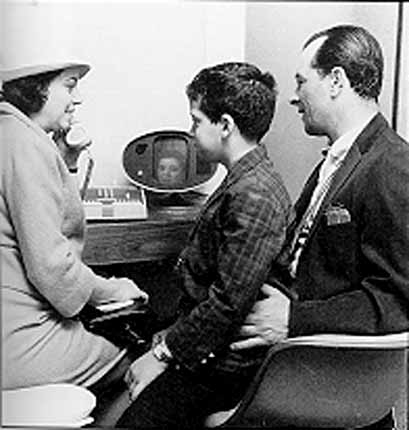
The Bell system Picturephone, 1964
- 1956: AT&T builds the first Picturephone test system
- 1964: AT&T introduces Picturephone at the World's Fair, New York
- 1970: AT&T offers Picturephone for $160 per month
- 1971: Ericsson demonstrates the first trans-atlantic video telephone (LME) call
- 1973 Dec: ARPAnet packet voice experiments [1]
- 1976 Mar: Network Voice Protocol (NVP), by Danny Cohen, USC/ISI
- 1981 Jul: Packet Video Protocol (PVP), by Randy Cole, USC/ISI [2]
- 1982: CCITT (forerunner of the ITU-T) standard H.120 (2 Mbit/s) video coding, by European COST 211 project
- 1982: Compression Labs begins selling $250,000 VC system, $1,000 per hour lines
- 1986: PictureTel's $80,000 VC system, $100 per hour lines
- 1987: Mitsubishi sells $1,500 still-picture phone
- 1989: Mitsubishi drops still-picture phone
- 1990: TWBnet packet audio/video experiments, vt (audio) and pvp (video) from ISI/BBN [3]
- 1990: CCITT standard H.261 (p x 64) video coding
- 1990 Dec: CCITT standard H.320 for ISDN conferencing
- 1991: PictureTel unveils $20,000 black-and-white VC system, $30 per hour lines
- 1991: IBM and PictureTel demonstrate videophone on PC
- 1991 Feb: DARTnet voice experiments, Voice Terminal (vt) program from USC/ISI [4]
- 1991 Jun: DARTnet packet video test between ISI and BBN.
- 1991 Aug: UCB/LBNL's audio tool vat releases for DARTnet use
- 1991 Sep: First audio/video conference (H.261 hardware codec) at DARTnet
- 1991 Dec: dvc (receive-only) program, by Paul Milazzo from BBN, IETF meeting, Santa Fe [5]
- 1992: AT&T's $1,500 videophone for home market
- 1992 Mar: World's first MBone audio cast (vat), 23rd IETF, San Diego
- 1992 Jul: MBone audio/video casts (vat/dvc), 24th IETF, Boston [6]
- 1992 Jul: INRIA Videoconferencing System (IVS), by Thierry Turletti from INRIA [7]
- 1992 Sep: CU-SeeMe v0.19 for Macintosh (without audio), by Tim Dorcey from Cornell [8]
- 1992 Nov: Network Video (nv) v1.0, by Ron Frederick from Xerox PARC, 25th IETF, Washington DC [9]
The Code nv this is LOST, and no longer available.6/22/2020 Correction, with a little persuasion I convinced Ron Frederick to post this up on github.
https://github.com/ronf/nv - 1992 Dec: Real-time Transport Protocol (RTP) v1, by Henning Schulzrinne
- 1992 Dec, First Global Video Stream, over Sun's private network. 13000 viewers.
This becomes Sun's CellB. - 1993 Apr: CU-SeeMe v0.40 for Macintosh (with multipoint conferencing)
- 1993 May: Network Video (nv) v3.2 (with color video)
- 1993 Oct: vic initial alpha, by Steven McCanne and Van Jacobson from UCB/LBNL [10]
Code for VIC at https://github.com/johnsokol/LBL-VIC
The only Source Code for Sun's Cellb Video compression - 1993 Nov: VocalChat v1.0, an audio conferencing software for Novell IPX networks [11]
- 1994 Feb: CU-SeeMe v0.70b1 for Macintosh (with audio) , audio code by Charley Kline's Maven [12]
- 1994 Apr: CU-SeeMe v0.33b1 for Windows (without audio), by Steve Edgar from Cornell
- 1994 Jun: John Sokol forms NetSys Inc and begins building first CDN for video Streaming of Livecam Motion Jpeg Streams.
- 1995 Feb: VocalTec Internet Phone v1.0 for Windows (without video)
- 1995 Aug: CU-SeeMe v0.66b1 for Windows (with audio)
- 1996 Jan: Real-time Transport Protocol (RTP) v2, by IETF avt-wg [13]
- 1996 Mar: ITU-T standard H.263 (p x 8) video coding for low bit-rate communication
- 1996 Mar: VocalTec Telephony Gateway
- 1996 May: ITU-T standard H.324 for POTS conferencing
- 1996 Jul: ITU-T standard T.120 for data conferencing
- 1996 Aug: Microsoft NetMeeting v1.0 (without video)
- 1996 Oct: ITU-T standard H.323 v1, by ITU-T SG 16 [14]
- 1996 Nov: VocalTec Surf&Call, the first Web to phone plugin
- 1996 Dec: Microsoft NetMeeting v2.0b2 (with video) [15]
- 1996 Dec: VocalTec Internet Phone v4.0 for Windows (with video)
- 1997 Jul: Virtual Room Videoconferencing System (VRVS), Caltech-CERN project
- 1997 Sep: Resource ReSerVation Protocol (RSVP) v1, by IETF rsvp-wg
- 1998 Jan: ITU-T standard H.323 v2
- 1998 Jan: ITU-T standard H.263 v2 (H.263+) video coding
- 1998 Apr: CU-SeeMe v1.0 for Windows and Macintosh (with color video), from Cornell
- 1998 May: Cornell's CU-SeeMe development team has completed their work and has gone on to other projects
- 1998 Oct: ISO/IEC standard MPEG-4 v1, by ISO/IEC JTC1/SC29/WG11 (MPEG)
- 1999 Feb: Session Initiation Protocol (SIP) makes proposed standard, by IETF mmusic-wg [16]
- 1999 Apr: Microsoft NetMeeting v3.0b (with gatekeeper)
- 1999 Aug: ITU-T H.26L Test Model Long-term (TML) project , by ITU-T SG16/Q.6 (VCEG)
- 1999 Sep: ITU-T standard H.323 v3
- 1999 Oct: NAT compatible version of iVisit, v2.3b5 for Windows and Mac
- 1999 Oct: Media Gateway Control Protocol (MGCP) v1, IETF
- 1999 Dec: Microsoft NetMeeting v3.01 service pack 1 (4.4.3388)
- 1999 Dec: ISO/IEC standard MPEG-4 v2
- 2000 May: Columbia SIP user agent sipc v1.30
- 2000 Oct: Samsung releases the first MPEG-4 streaming 3G (CDMA2000-1x) video cell phone
- 2000 Nov: ITU-T standard H.323 v4
- 2000 Nov: MEGACO/H.248 Protocol v1, by IETF megaco-wg and ITU-T SG 16
- 2000 Dec: Microsoft NetMeeting v3.01 service pack 2 (4.4.3396))
- 2000 Dec: ISO/IEC Motion JPEG 2000 (JPEG 2000, Part 3) project, by ISO/IEC JTC1/SC29/WG1 (JPEG)
- 2001 Jun: Windows XP Messenger supports the SIP
- 2001 Sep: World's first trans-atlantic tele gallbladder surgery (operation Lindbergh)
- 2001 Oct: NTT DoCoMo sells $570 3G (WCDMA) mobile videophone
- 2001 Oct: TV reporters use $7,950 portable satellite videophone to broadcast live from Afghanistan
- 2001 Oct: Microsoft NetMeeting v3.01 (4.4.3400) on XP
- 2001 Dec: JVT video coding (H.26L and MPEG-4 Part 10) project, by ITU-T SG16/Q.6 (VCEG) and ISO/IEC JTC1/SC29/WG 11 (MPEG)
- 2002 Jun: World's first 3G video cell phone roaming
- 2002 Dec: JVT completes the technical work leading to ITU-T H.264
- 2003 May: ITU-T recommendation H.264 advanced video coding
Sources : Wall Street Journal (27 February 1996), The MBone FAQ, rem-conf listserv, The MBone listserv, CU-SeeMe listserv, RTP: Historical Notes, and few PostScripts (*.ps).
Notes and References
[1] Danny Cohen, "Specifications for the Network Voice Protocol (NVP)", RFC 741, Internet Engineering Task Force, November 1977.
"The major objective of ARPA's Network Secure Communications (NSC) project is to develop and demonstrate the feasibility of secure, high-quality, low-bandwidth, real-time, full-duplex (two-way) digital voice communications over packet-switched computer communications networks. The Network Voice Protocol (NVP), implemented first in December 1973, and has been in use since then for local and transnet real-time voice communication over the ARPANET."
"The major objective of ARPA's Network Secure Communications (NSC) project is to develop and demonstrate the feasibility of secure, high-quality, low-bandwidth, real-time, full-duplex (two-way) digital voice communications over packet-switched computer communications networks. The Network Voice Protocol (NVP), implemented first in December 1973, and has been in use since then for local and transnet real-time voice communication over the ARPANET."
[2] Randy Cole, "PVP - A Packet Video Protocol", Internal Document, USC/ISI, July 1981.
"The Packet Video Protocol (PVP) is a set of extensions to the Network Voice Protocol (NVP-II) and consists mostly of a data protocol for transmission of video data. No specific changes to the NVP-II protocol are necessary for the PVP."
"The Packet Video Protocol (PVP) is a set of extensions to the Network Voice Protocol (NVP-II) and consists mostly of a data protocol for transmission of video data. No specific changes to the NVP-II protocol are necessary for the PVP."
[3] Eve M. Schooler, "A Distributed Architecture for Multimedia Conference Control", ISI research report ISI/RR-91-289, November 1991.
"Voice Terminal (VT) program and Packet Video Program (PVP) were originally implemented on a BBN Butterfly multiprocessor. VT and PVP digitize and packetize data, using the Netowrk Voice Protocol (NVP) for audio and the Packet Video Protocol (PVP) for video. They transmit this data across the network using the experimental Stream Protocol (SP) and the Terrestrial Wideband Network (TWBnet)."
"Voice Terminal (VT) program and Packet Video Program (PVP) were originally implemented on a BBN Butterfly multiprocessor. VT and PVP digitize and packetize data, using the Netowrk Voice Protocol (NVP) for audio and the Packet Video Protocol (PVP) for video. They transmit this data across the network using the experimental Stream Protocol (SP) and the Terrestrial Wideband Network (TWBnet)."
[4] DARTnet : A trans-continental IP network of about a dozen research sites connected by T1 trunks.
November 1988, small group (MIT, BBN, UDel, ISI, SLI, PARC, LBL) led by Bob Braden of USC/ISI proposes testbed net to DARPA. This becomes DARPA Research Testbed Net (DARTnet).
DARTnet has since evolved to CAIRN, which presently connects 27 institutions in the US and Britain.
November 1988, small group (MIT, BBN, UDel, ISI, SLI, PARC, LBL) led by Bob Braden of USC/ISI proposes testbed net to DARPA. This becomes DARPA Research Testbed Net (DARTnet).
DARTnet has since evolved to CAIRN, which presently connects 27 institutions in the US and Britain.
[5] Tim Dorcey, "CU-SeeMe Desktop VideoConferencing Software", Connexions, Volume 9, No.3, March 1995.
"In fact, it was Paul Milazzo's demonstration of such a tool in 1991 that inspired development of CU-SeeMe."
"In fact, it was Paul Milazzo's demonstration of such a tool in 1991 that inspired development of CU-SeeMe."
[6] The video used for the July 1992 Internet Engineering Task Force (IETF) was the Desktop Video Conferencing (DVC) program from BBN, written by Paul Milazzo and Bob Clements.
They have made available a receive-only program, but they retain a proprietary interest in the version that is capable of sending.
This program has since become a product, called PictureWindow.
They have made available a receive-only program, but they retain a proprietary interest in the version that is capable of sending.
This program has since become a product, called PictureWindow.
[7]INRIA Videoconferencing System (IVS) was used to broadcast part of the IETF 25 meeting held in Washington, DC during 16-20 November, 1992. The broadcast was sent over the Mbone. See Internet Monthly Report published in November 1992.
[8] "When development of CU-SeeMe began in July 1992, the only real-time videoconferencing software for the Internet required expensive hardware which severely limited the number of potential senders and receivers. Working with Richard Cogger in the summer of 1992, Tim Dorcey wrote the original version of CU-SeeMe."
URL: http://cu-seeme.cornell.edu
As the Macintosh did not have IP multicast support, CU-SeeMe took a more traditional approach and developed a multipoint server (Reflector) that CU-SeeMe clients could connect to.
URL: http://cu-seeme.cornell.edu
As the Macintosh did not have IP multicast support, CU-SeeMe took a more traditional approach and developed a multipoint server (Reflector) that CU-SeeMe clients could connect to.
[9] For the November 1992 IETF and several events since then, they have used two other programs.
The first is the Network Video (nv) program from Ron Frederick at Xerox PARC.
Also available from INRIA is the IVS program written by Thierry Turletti (as mentioned previously).
Van Jacobson, "Old timers might remember that the first, binary-only, release of nv happened 24 hours before the November 1992 IETF where it was first used."
The first is the Network Video (nv) program from Ron Frederick at Xerox PARC.
Also available from INRIA is the IVS program written by Thierry Turletti (as mentioned previously).
Van Jacobson, "Old timers might remember that the first, binary-only, release of nv happened 24 hours before the November 1992 IETF where it was first used."
[10] vic (vi/deo c/onfernece) was inspired by nv. Portions of vic (the ordered dither, the nv-format codec, and some of the video capture code) were derived from the nv source code.
An early version of vic was used by the Xunet research community to carry out distributed meetings in Fall 1993.
vic change history at http://www-nrg.ee.lbl.gov/vic/CHANGES.html
An early version of vic was used by the Xunet research community to carry out distributed meetings in Fall 1993.
vic change history at http://www-nrg.ee.lbl.gov/vic/CHANGES.html
[11] In 1991, 5 high school friends established ClassX, a start-up software company, at Raanana, Israel.
2 years later, 4 members of them joined VocalTec and they have developed the VocalChat v1.0-2.5, and the Internet Phone.
Ofer Shem Tov, "VocalChat early version was introduced first time in PCEXPO end of June 1993 in New York. It did half duplex calls over Novell IPX networks. VocalChat v1.0 was released in Comdex Fall, November 1993, in Las Vegas, it was a finished version of the PCEXPO product. First long distance call was done on Bell South Novell network from Atlanta to Miami. VocalChat 2.02 LAN and WAN were released in June 1994 and included voice mail, address book, TCP/IP support and support of VocalTec Compression Card (VCC) for low bandwidth links.
VocalChat GTI (Gateway To the Internet) was released in October 1994. It was focused on the Internet and required the VCC card."
2 years later, 4 members of them joined VocalTec and they have developed the VocalChat v1.0-2.5, and the Internet Phone.
Ofer Shem Tov, "VocalChat early version was introduced first time in PCEXPO end of June 1993 in New York. It did half duplex calls over Novell IPX networks. VocalChat v1.0 was released in Comdex Fall, November 1993, in Las Vegas, it was a finished version of the PCEXPO product. First long distance call was done on Bell South Novell network from Atlanta to Miami. VocalChat 2.02 LAN and WAN were released in June 1994 and included voice mail, address book, TCP/IP support and support of VocalTec Compression Card (VCC) for low bandwidth links.
VocalChat GTI (Gateway To the Internet) was released in October 1994. It was focused on the Internet and required the VCC card."
[12] Charley Kline, "I got annoyed at the Fall 1992 IETF when told that the only serious platform for multimedia conferencing was a hefty Unix workstation. I figured a Macintosh has better audio processing ability than a Sun (true!), so set about to write an audio conferencing tool for the Macintosh that would interoperate with the popular vat program for Unix."
URL: http://spiffy.ci.uiuc.edu/~kline/cvk-ido.html
URL: http://spiffy.ci.uiuc.edu/~kline/cvk-ido.html
[13] Henning Schulzrinne, "Real-time Transport Protocol (RTP) is the Internet-standard protocol for the transport of real-time data, including audio and video. It can be used for media-on-demand as well as interactive services such as Internet telephony. RTP consists of a data and a control part. The latter is called RTP Control Protocol (RTCP)."
RTP has its roots in the early work done using Network Voice Protocol 2 (NVP-II) with vat, vt and nevot in 1991, which in turn has its roots in the Network Voice Protocol (NVP) experiences in the early 1970s.
RTP has its roots in the early work done using Network Voice Protocol 2 (NVP-II) with vat, vt and nevot in 1991, which in turn has its roots in the Network Voice Protocol (NVP) experiences in the early 1970s.
[14] H.323 : "Visual telephone systems and equipment for Local Area Networks which provide a non-guaranteed Quality of Service." (original title)
"Packet-based multimedia communications systems." (revised title in H.323 v2 drafts)
4 main H.323 network components; Terminals, Gateways, Gatekeepers, and Multipoint Control Units (MCUs).
H.320 (N-ISDN), H.321 (B-ISDN, ATM), H.322 (GQoS LAN), H.323 (H.320 over LAN), H.324 (SCN), H.324 M (Mobile).
"Packet-based multimedia communications systems." (revised title in H.323 v2 drafts)
4 main H.323 network components; Terminals, Gateways, Gatekeepers, and Multipoint Control Units (MCUs).
H.320 (N-ISDN), H.321 (B-ISDN, ATM), H.322 (GQoS LAN), H.323 (H.320 over LAN), H.324 (SCN), H.324 M (Mobile).
[15] Toby Nixon, "Microsoft NetMeeting version 2.0 and below uses an alternative call setup procedure that is permitted for combined H.323/T.120 terminals. Because NetMeeting was originally a T.120-based product (without H.323 support), it sets up the T.120 (data conference) call first, and then the H.323 (audio and video conference) call."
Current versions of NetMeeting are not compliant with the H.323 standard as they do not attempt to register with a gatekeeper, a required function.
Current versions of NetMeeting are not compliant with the H.323 standard as they do not attempt to register with a gatekeeper, a required function.
[16] SIP is a simple signaling protocol for Internet conferencing and telephony.
H.323 is an ITU-T standard, while SIP is the IETF approach.
H.323 is an ITU-T standard, while SIP is the IETF approach.
The pioneering video conferencing tools :
- CU-SeeMe [video]
from Cornell University
platform : Apple Macintosh - DVC [video]
from BBN
platform : Sun SPARC - IVS [video & audio]
from INRIA
platform : Sun SPARC, HP, SGI and DEC stations - NV [video]
from Xerox PARC
platform : Sun SPARC, SGI and DEC stations
6/22/2020 With a little persuasion I convinced Ron Frederick to post this up on github.
https://github.com/ronf/nv
I am told it will build and run on modern machines and Ron was surprised on how well his codec performs against more modern ones.
Wednesday, April 15, 2020
Saturday, May 23, 2015
Monday, May 19, 2014
Glimpse of the future
Science Fiction author Jonathan Vos Post said on Facebook:
"Back in 1964, 50 years ago this summer, my mother, father, sister and I drove from our home in suburban New Jersey to New York City, where we caught a glimpse of the future."

Tuesday, March 25, 2014
Telemba: World Cheapest Tele-presence Robot Kit
Android on a Roomba.
Telemba is a affordable tele-presence robot kit. You can control the robot as a avatar of yourself, from distance via Internet. It consists of your Roomba, your Android tablet, and some parts we provides. You can own your robot very low cost if you have a Roomba and Android tablets! Check it out!
Homepage of the project (in English)
https://sites.google.com/site/telemba...
Follow us on twitter @telemba_en
Telemba(テレンバ)は、とても安価なテレプレゼンス・ロボットキットです。ネ
プロジェクトのホームページ(日本語)
https://sites.google.com/site/telemba...
Monday, March 10, 2014
Video chat with your dog.

Petchatz $349.00
This interactive pet-cam thing lets you video chat with your pet when you’re away. You can also set it up to give him a treat or a “sniff” of the stuff he loves most. If he’s sleeping or busy giving his undercarriage a tongue-bath when you call, you can even record a video your pet will surely appreciate when he gets around to watching it.
Friday, February 07, 2014
A Conference Call in Real Life - YouTube
http://youtu.be/DYu_bGbZiiQ
Great commentary on conference calls.
Wednesday, September 18, 2013
Blue Jeans Network securesh $50 million in funding
http://mobile.reuters.com/article/idUSL2N0HD0ZU20130918?irpc=932
Blue Jeans Network secures $50 million in funding
Wed, Sep 18 07:30 AM EDT
Sept 18 (Reuters) - Blue Jeans Network, a software-based video conferencing company, has raised $50 million in new funding led by Battery Ventures, the startup said on Wednesday.
The new funding round brings overall financing to nearly $100 million, Blue Jeans Network said.
The company, founded in November 2009, allows users to talk to each other no matter what video service they use.
It enables Skype users to talk with those using Google hangout, for example, and bridges services from vendors such as Microsoft, Cisco or Polycom. It is also integrated with LinkedIn.
"Along the way, Blue Jeans set a new standard for SaaS (software as a service) business models with exceptional revenue growth and retention rates that rivals companies like Salesforce and Workday at similar stages," said Battery Ventures' general partner Roger Lee.
The company was founded by former Cisco executive Krish Ramakrishnan and former Blue Coat Systems CTO Alagu Periyannan and is backed by Accel Partners, Norwest Venture Partners, and New Enterprise Associates, who also participated in the new funding round.
Blue Jeans Network's customers include Facebook, Foursquare, Match.com and Stanford University.
Tuesday, September 17, 2013
Friday, July 26, 2013
Anybots creates new virtual presence robot in partnership with Polycom Inc.
https://www.anybots.com/anybots-creates-new-virtual-presence-robot-in-partnership-with-polycom-inc/


A sneak peak of the Q(x) hanging out in the Polycom lobby.
The Anybots Q(x) is the first new development in mobile telepresence technology from Anybots since the QB was introduced in 2010. The Q(x) model is designed to be integrated with many different technology platforms, employing the same self balancing technology of its predecessors with updated audio and video through the Polycom Group500 Codec. This development is the result of a Technology Innovation Partner Agreement with Polycom, encouraging innovative contributions to improve medical virtual presence technology and patient quality of life.
The press release of Anybot’s technology partnership with Polycom can be read here
Wednesday, July 03, 2013
The coolest video project yet.
Anybots telepresence,

It's the first time I've ever had Dilbert do a cartoon on what I am working on.
Coca Cola & Anybots presents The Social Robot
Anybots QX Prototype running Polycom Group 500 video conferencing system.
From: http://videotechnology.blogspot.com/2013/07/anybots-creates-new-virtual-presence.html

From before my tenure:
Jeri Ellsworth - Cyborg & Anybots - Oct 6, 2009
CES Jan 2009: Anybots QA Demo
Wednesday, June 27, 2012
FuzeBox apple centric video conferencing.
https://www.fuzebox.com/
Don't know much other then I am told they use Amazon EC2 and UDP based video streaming.
Don't know much other then I am told they use Amazon EC2 and UDP based video streaming.
Vulnerabilities in the Cisco WebEx Player
"The Cisco WebEx Recording Format (WRF) player contains four buffer overflow vulnerabilities and the Cisco Advanced Recording Format (ARF) player contains one buffer overflow vulnerability. In some cases, exploitation of the vulnerabilities could allow a remote attacker to execute arbitrary code on the system with the privileges of a targeted user."
Cisco Security Advisory: Buffer Overflow Vulnerabilities in the Cisco WebEx Player
The Cisco WebEx Recording Format (WRF) player contains four buffer overflow vulnerabilities and the Cisco Advanced Recording Format (ARF) player contains one buffer overflow vulnerability. In some cases, exploitatio
Monday, December 12, 2011
The Startup That Powers Videoconferencing For Facebook Just Poached Another Key Cisco Exec (CSCO)
From : http://www.businessinsider.com/cisco-loses-key-videoconferencing-exec-to-hot-cloud-competitor-2011-12#ixzz1gNQMteeM
Cisco just lost the guy who led its cloud videoconferencing unit -- to a competing company started by a bunch of Cisco alums. Ted Tracy has bailed on Cisco to join up-and-coming cloud videoconferencing startup Blue Jeans Network.
Web conferencing is one of the few cloud-y areas where Cisco competes directly with these service providers, as Cisco also sells its videoconferencing service WebEx directly to customers.
As of last year, Tracy was out chanting the Cisco fight song explaining to enterprises how and why they need to roll out on premises video services. Cisco is banking on video as its next great area of growth, and John Chambers is fond of insisting that video will be the basis for all enterprise networks in the future. That's a self-interested prophecy if ever there was one, as using the corporate network to run massive amounts of video would necessitate major investments in high-end networking gear by most companies.
But if Facebook can hire out for its web conferencing services, as they have with Blue Jeans, that kind of blows the hole in the theory that enterprises need to do video on their own networks themselves.
Blue Jeans launched in June 2011, and now lays claims to customers in 1,500 cities in about 150 countries.
http://bluejeans.com/
Cisco just lost the guy who led its cloud videoconferencing unit -- to a competing company started by a bunch of Cisco alums. Ted Tracy has bailed on Cisco to join up-and-coming cloud videoconferencing startup Blue Jeans Network.
Blue Jeans was founded by a group of Cisco alums and funded by Charlie Giancarl, who was once expected to be Cisco's next CEO but is now a venture capitalist. Blue Jeans' claim to fame is that it's the go-to choice for Facebook , it says.
Tracy joins Blue Jeans as its engineering VP. At Cisco, he led the engineering team for TelePresence Exchange, a product Cisco sold to service providers so that they could set up their own cloud Web conferencing services.
Web conferencing is one of the few cloud-y areas where Cisco competes directly with these service providers, as Cisco also sells its videoconferencing service WebEx directly to customers.
As of last year, Tracy was out chanting the Cisco fight song explaining to enterprises how and why they need to roll out on premises video services. Cisco is banking on video as its next great area of growth, and John Chambers is fond of insisting that video will be the basis for all enterprise networks in the future. That's a self-interested prophecy if ever there was one, as using the corporate network to run massive amounts of video would necessitate major investments in high-end networking gear by most companies.
But if Facebook can hire out for its web conferencing services, as they have with Blue Jeans, that kind of blows the hole in the theory that enterprises need to do video on their own networks themselves.
Blue Jeans launched in June 2011, and now lays claims to customers in 1,500 cities in about 150 countries.
Cisco has a lot staked on TelePresence, too. In 2009, it plunked down $3 billion to buy rival Tandberg, one of its biggest deals of the decade.
http://bluejeans.com/
Friday, December 09, 2011
Friday, December 02, 2011
Big Blue Button - open source web video conferencing
BigBlueButton
An open source web conferencing system developed primarily for distance education.
http://en.wikipedia.org/wiki/BigBlueButton
Links
http://en.wikipedia.org/wiki/BigBlueButton
Features
As of version 0.71a, BigBlueButton supports multiple audio and video sharing, presentations with extended whiteboard capabilities - such as a pointer, zooming and drawing - public and private chat, desktop sharing, integrated VoIP using Asterisk or FreeSWITCH, and support for Microsoft Office documents using OpenOffice. Moreover, users may enter the conference in one of two roles: viewer or moderator.
As a viewer, a user may join the voice conference, share their webcam, raise their hand, and chat with others. As a moderator, a user may mute/unmute others, eject any user from the session, and make any user the current presenter. The presenter may upload slides and control the presentation.
Although its components are open source, the BigBlueButton client depends on a browser plugin for the Adobe Flash platform. The BigBlueButton server runs on Linux and can be installed either from source code or from Ubuntu packages. BigBlueButton is also downloadable as a Virtual Machine (VM) that runs within VMware Player on PC and Unix computers and within VMWare Fusion on Macs.
Architecture
Similar to Openmeetings, BigBlueButton uses red5, an open source implementation of Adobe's Flash Media Server, to support its real-time collaboration.
The BigBlueButton server can run within a cloud environment, such as Amazon EC2, but in version 0.70 there were problems with audio delays using the built-in VoIP in such environments. The core developers recently demonstrated improvements to the VoIP in the upcoming BigBlueButton 0.8.
Wednesday, July 13, 2011
New iPhone Software Beams FaceTime Video Calls to TV | Gadget Lab | Wired.com
With iOS 5 Beta 3, you can mirror your FaceTime call onto a larger display
http://www.wired.com/gadgetlab/2011/07/iphone-facetime-mirroring
http://www.wired.com/gadgetlab/2011/07/iphone-facetime-mirroring
Subscribe to:
Posts (Atom)


