MUMBAI: The era of India being a country that lags behind the more developed nations is gone. Indian DTH operators in the country are waking up, ancticipating future desires of Indian TV viewers. Which is why one of the oldest and largest DTH operators Tata Sky, is keeping itself and its subscribers up to date with the introduction of its 4k Ultra HD service.
The first quarter of 2015 will see Tata Sky roll out its set top boxes (STBs) for its 4k Ultra HD service. The STBs are being made by Technicolor and are based on the high efficiency video coding (HEVC) format that 4k uses the world over. However, prices of the STB are not yet known as the DTH operator wants to reveal it closer to the commercial launch date.
At a demonstration event in Mumbai, Tata Sky along with Sony Six unveiled the 4k UHD service with a live uninterrupted broadcast of the France versus Germany FIFA World Cup 2014 quarter final. The FIFA 4k signal rights had been bought by Sony Six while the cost of acquisition and transmission was split 50:50 by the broadcaster and the operator. The telecast took place live via satellite transmission.
Indiantelevision.com readers will note that Videocon d2h had previewed its 4K service on 3 July 2014 too, a day before Tata Sky..
Even though most industry professionals claim that it is too early to launch 4k Ultra HD in India, Tata Sky chief commercial officer Vikram Mehra feels otherwise. “When we launched HD in 2010, people doubted us saying it won’t work. As you keep enhancing TV experience, the viewer will appreciate it. So, Ultra HD is our endeavour in that area. A technology becomes popular when mainline pay-TV adopts it.”
Mehra feels that movies and sports will be the initial drivers for 4k technology and talks with broadcasters have already commenced. In three to four years, he expects it to be the way of life for most Indians TV viewers. Even though currently there is a lack of 4k content, he feels that it isn’t too far away. “We will make a product that makes sense to the customer. Customers will not buy STBs to adorn their homes. They will buy it for content,” he says.
Sony Six business head Prasana Krishnan feels that more sporting events should be produced in 4k soon, probably in the next year or so. “4K is the future of broadcasting, specially sports. We saw technology move from SD to HD and now HD has become standard. 4k is next,” he says. Krishnan is aware that a full-fledged 4k channel can’t be expected very soon. Big sporting events will have 4k production on crucial days such as the finals, while the run up matches will be in HD and SD.
The 4k screening of the FIFA World Cup 2014 quarter finals that took place in Mumbai yesterday, 4 July saw the Sony Six logo being superimposed on the FIFA feed on an 84 inch Sony television set that is soon to be launched in India and across the world. 4k screens give four times the clarity as compared to an HD feed.
Mehra was not willing to venture any guesstimates about how much uptake the Tata Sky 4k service will have when it launches next year as he feels making futuristic statements is of no use. However, the fact that the DTH operator is confident about its prospects is clear from the contract that it has signed with Technicolor, according to which deliveries of 4K set top boxes in "volume" are expected to commence in early 2015.
SOURCE: IndianTelevision
Showing posts with label UHD. Show all posts
Showing posts with label UHD. Show all posts
Friday, July 04, 2014


Tuesday, July 01, 2014
CEA: UHDTV is 8-bit, 3840x2160
New characteristics for connected ultra high-definition display also issued
NEW YORK—The Consumer Electronics Association has announced updated core characteristics for ultra high-definition TVs, monitors and projectors for the home. As devised and approved by CEA’s Video Division Board, these characteristics build on the first-generation UHD characteristics released by CEA in October 2012.
These expanded display characteristics (CEA’s Ultra High-Definition Display Characteristics V2) – voluntary guidelines that take effect in September 2014 – are designed to address various attributes of picture quality and help move toward interoperability, while providing clarity for consumers and retailers alike.
“Ultra high-definition TV is the next revolution in home display technology, offering consumers an incredibly immersive viewing experience with outstanding new levels of picture quality,” said Gary Shapiro, president and CEO of the CEA. “These updated attributes will help ensure consumers get the most out of this exciting new technology and will provide additional certainty in the marketplace.”
Under CEA’s expanded characteristics, a TV, monitor or projector may be referred to as Ultra High-Definition if it meets the following minimum performance attributes:
— Display Resolution – Has at least eight million active pixels, with at least 3,840 horizontally and at least 2,160 vertically.
— Aspect Ratio – Has a width to height ratio of the display’s native resolution of 16:9 or wider.
— Upconversion – Is capable of upscaling HD video and displaying it at ultra high-definition resolution.
— Digital Input – Has one or more HDMI inputs supporting at least 3840x2160 native content resolution at 24p, 30p and 60p frames per second. At least one of the 3840x2160 HDMI inputs shall support HDCP revision 2.2 or equivalent content protection.
— Colorimetry – Processes 2160p video inputs encoded according to ITU-R BT.709 color space and may support wider colorimetry standards.
— Bit Depth – Has a minimum color bit depth of eight bits.
Because one of the first ways consumers will have access to native 4K content is via Internet streaming on connected ultra HDTVs, CEA has defined new characteristics for connected UHDTV displays. Under these new characteristics, which complement the updated core UHD attributes, a display system may be referred to as a connected ultra HD device if it meets the following minimum performance attributes:
— Ultra High-Definition Capability – Meets all of the requirements of the CEA Ultra High-Definition Display Characteristics V2 (listed above).
— Video Codec – Decodes IP-delivered video of 3840x2160 resolution that has been compressed using HEVC* and may decode video from other standard encoders.
— Audio Codec – Receives and reproduces, and/or outputs multichannel audio.
— IP and Networking – Receives IP-delivered Ultra HD video through a Wi-Fi, Ethernet or other appropriate connection.
— Application Services – Supports IP-delivered Ultra HD video through services or applications on the platform of the manufacturer’s choosing.
CEA’s expanded display characteristics also include guidance on nomenclature designed to help provide manufacturers with marketing flexibility while still providing clarity for consumers. Specifically, the guidance states, “The terms ‘Ultra High-Definition,’ ‘Ultra HD’ or ‘UHD’ may be used in conjunction with other modifiers,” for example “Ultra High-Definition TV 4K”.
In addition, CEA is working with its member companies to develop a UHD logo to assist consumers in identifying UHD products in the marketplace that meet CEA’s guidelines. The logo will be made available for voluntary use by manufacturers for product packaging, marketing materials and promotional activities. The companion voluntary logo program is expected to be launched later this year.
*High Efficiency Video Compression Main Profile, Level 5, Main tier, as defined in ISO/IEC 23008-2 MPEG-H Part 2 or ITU-T H.265, and may support higher profiles, levels or tiers.
Source: TV Technology
Thursday, February 21, 2013
MIT researchers build ultrahigh-definition Quad HD (4K) TV chip
At the International Solid-State Circuits Conference this week, MIT researchers unveiled their own Quad HD video chip design.
Quad HD is also known as 4K and ultrahigh-definition (UHD). The new Quad HD video standard enables a fourfold increase in the resolution of TV screens.
At the Consumer Electronics Show (CES) in January, several manufacturers debuted new UHD models.
There is no UHD content yet, but the Japanese government plans to launch the world's first 4K TV broadcast in July 2014, from communications satellites, followed by satellite broadcasting and ground digital broadcasting, NBC News Gadget Box has reported.
Nonetheless, 4K TVs are now on sale by Japanese makers including Sony, Panasonic and Sharp. Other manufacturers include South Korea's LG Electronics.
HEVC
[+]

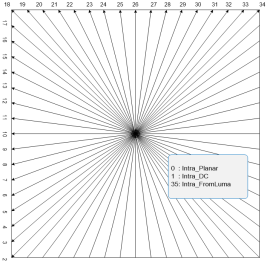
A key to efficient video compression is predicting future video frames on the basis of past ones. This diagram concerns "intra angular prediction."
(Credit: ISO)
UHD also requires a new video-coding standard, known as high-efficiency video coding, or HEVC (aka or H.265).
Although the MIT chip isn't intended for commercial release, its developers believe that the challenge of implementing HEVC algorithms in silicon helps illustrate design principles that could be broadly useful.
Moreover, "because now we have the chip with us, it is now possible for us to figure out ways in which different types of video data actually interact with hardware," says Mehul Tikekar, an MIT graduate student in electrical engineering and computer science and one of the paper's co-authors.
How HEVC works
Like older coding standards, the HEVC standard exploits the fact that in successive frames of video, most of the pixels stay the same. Rather than transmitting entire frames, it's usually enough for broadcasters to transmit just the moving pixels, saving a great deal of bandwidth. The first step in the encoding process is thus to calculate "motion vectors" — mathematical descriptions of the motion of objects in the frame.
On the receiving, end, however, that description will not yield a perfectly faithful image, as the orientation of a moving object and the way it's illuminated can change as it moves. So the next step is to add a little extra information to correct motion estimates that are based solely on the vectors. Finally, to save even more bandwidth, the motion vectors and the corrective information are run through a standard data-compression algorithm, and the results are sent to the receiver.
The new chip performs this process in reverse. It was designed by researchers in the lab of Anantha Chandrakasan, the Joseph F. and Nancy P. Keithley Professor of Electrical Engineering and head of the MIT Department of Electrical Engineering and Computer Science.
The chip's first trick for increasing efficiency is to "pipeline" the decoding process: a chunk of data is decompressed and passed to a motion-compensation circuit, but as soon as the motion compensation begins, the decompression circuit takes in the next chunk of data. After motion compensation is complete, the data passes to a circuit that applies the corrective data and, finally, to a filtering circuit that smooths out whatever rough edges remain.
Fine-tuning
Pipelining is fairly standard in most video chips, but the MIT researchers developed a couple of other tricks to further improve efficiency. The application of the corrective data, for instance, is a single calculation known as matrix multiplication. A matrix is just a big grid of numbers; in matrix multiplication, numbers in the rows of one matrix are multiplied by numbers in the columns of another, and the results are added together to produce entries in a new matrix.
"We observed that the matrix has some patterns in it," Tikekar explains. In the new standard, a 32-by-32 matrix, representing a 32-by-32 block of pixels, is multiplied by another 32-by-32 matrix, containing corrective information. In principle, the corrective matrix could contain 1,024 different values. But the MIT researchers observed that, in practice, "there are only 32 unique numbers," Tikekar says. "So we can efficiently implement one of these [multiplications] and then use the same hardware to do the rest."
Similarly, Chiraag Juvekar, another graduate student in Chandrakasan's group, developed a more efficient way to store video data in memory. The "naive way," he explains, would be to store the values of each row of pixels at successive memory addresses. In that scheme, the values of pixels that are next to each other in a row would also be adjacent in memory, but the value of the pixels below them would be far away.
In video decoding, however, "it is highly likely that if you need the pixel on top, you also need the pixel right below it," Juvekar says. "So we optimize the data into small square blocks that are stored together. When you access something from memory, you not only get the pixels on the right and left, but you also get the pixels on the top and bottom in the same request."
Chandrakasan's group specializes in low-power devices, and in ongoing work, the researchers are trying to reduce the power consumption of the chip even further, to prolong the battery life of quad-HD cell phones or tablet computers.
One design modification they plan to investigate, Tikekar says, is the use of several smaller decoding pipelines that work in parallel. Reducing the computational demands on each group of circuits would also reduce the chip's operating voltage.
Subscribe to:
Posts (Atom)
