Showing posts with label HEVC. Show all posts

Friday, August 07, 2020

High Efficiency Image File Format (HEIF)


https://en.wikipedia.org/wiki/High_Efficiency_Image_File_Format

High Efficiency Image File Format (HEIF) is a container format for individual images and image sequences. It was developed by the Moving Picture Experts Group (MPEG) and is defined as Part 12 within the MPEG-H media suite (ISO/IEC 23008-12). MPEG claims that a HEIF image using HEVC requires about half the storage space as the equivalent quality JPEG. HEIF also supports animation, and is capable of storing more information[citation needed] than an animated GIF or APNG at a small fraction of the size.
Introduced in 2015, HEIF was adopted by Apple in 2017 with the introduction of iOS 11, and support on other platforms is growing.
HEIF files are a special case of the ISO Base Media File Format (ISOBMFF, ISO/IEC 14496-12), first defined in 2001 as a shared part of MP4 and JPEG 2000. This file format standard covers multimedia files that can also include other media streams, such as timed text, audio and video.

High Efficiency Image Container (HEIC) in iOS 11 and macOS High Sierra in 2017.


HEIC And HEIF

HEIC is the container or file extension that holds HEIF images or sequences of images. HEIF borrows technology from the High Efficiency Video Compression (HEVC) codec, also known as h.265. Both HEVC and HEIF are proprietary technologies developed by the Moving Picture Experts Group (MPEG).


HEIF came into the mainstream when Apple made it the default format for its pictures on iOS11 devices and macOS High Sierra. However, other operating systems or websites don’t yet support HEIF and its HEIC file extension, so Apple’s operating systems will automatically convert the images to JPEG when users want to share them with friends who don’t use Apple products.
HEIC files can store not just multiple individual images, but also their image properties, HDR data, alpha and depth maps, and even their thumbnails.

Friday, July 04, 2014

Tata Sky demos 4K TV with FIFA World Cup quarter-final match

MUMBAI: The era of India being a country that lags behind the more developed nations is gone. Indian  DTH operators in the country are waking up, ancticipating  future desires of Indian TV viewers. Which is why one of the oldest and largest DTH operators Tata Sky, is keeping itself and its subscribers up to date with the  introduction of its 4k Ultra HD service.
 
The first quarter of 2015 will see Tata Sky roll out its set top boxes (STBs) for its 4k Ultra HD service. The STBs are being made by Technicolor and are based on the high efficiency video coding (HEVC) format that 4k uses the world over. However, prices of the STB are not yet known as the DTH operator wants to reveal it closer to the commercial launch date.
 
At a demonstration event in Mumbai, Tata Sky along with Sony Six unveiled the 4k UHD service with a live uninterrupted broadcast of the France versus Germany FIFA World Cup 2014 quarter final. The FIFA 4k signal rights had been bought by Sony Six while the cost of acquisition and transmission was split 50:50 by the broadcaster and the operator. The telecast took place live via satellite transmission.  
 
Indiantelevision.com readers will note that Videocon d2h had previewed its 4K service on 3 July 2014 too, a day before Tata Sky..
 
Even though most industry professionals  claim that it is too early to launch 4k Ultra HD in India, Tata Sky chief commercial officer Vikram Mehra feels otherwise. “When we launched HD in 2010, people doubted us saying it won’t work. As you keep enhancing TV experience, the viewer will appreciate it. So, Ultra HD is our endeavour in that area. A technology becomes popular when mainline pay-TV adopts it.”
 
Mehra feels that movies and sports will be the initial drivers for 4k technology and talks with broadcasters have already commenced. In three to four years, he expects it to be the way of life for most Indians TV viewers. Even though currently there is a lack of 4k content, he feels that it isn’t too far away. “We will make a product that makes sense to the customer. Customers will not buy STBs to adorn their homes. They will buy it for content,” he says.
 
Sony Six business head Prasana Krishnan feels that more sporting events should be produced in 4k soon, probably in the next year or so. “4K is the future of broadcasting, specially sports. We saw technology move from SD to HD and now HD has become standard. 4k is next,” he says. Krishnan is aware that a full-fledged 4k channel can’t be expected very soon. Big sporting events will have 4k production on crucial days such as the finals, while the run up matches will be in HD and SD.
 
The 4k screening of the FIFA World Cup 2014 quarter finals that took place in Mumbai yesterday, 4 July saw the Sony Six logo being superimposed on the FIFA feed on an 84 inch Sony television set that is soon to be launched in India and across the world. 4k screens give four times the clarity as compared to an HD feed.
 
Mehra  was not willing to venture any guesstimates about how much uptake the Tata Sky 4k service will have when it launches next year as he feels making futuristic statements is of no use. However, the fact that the DTH operator is confident about its prospects is clear from the contract that it has signed with Technicolor, according to which deliveries of 4K set top boxes in "volume" are expected to commence in early 2015.

SOURCE: IndianTelevision

DVB Approves UHDTV HEVC Delivery Profile

A significant step in the road to Ultra High Definition TV services has been taken with the approval of the DVB-UHDTV Phase 1 specification at the 77th meeting of the DVB Steering Board. The specification includes an HEVC Profile for DVB broadcasting services that draws, from the options available with HEVC, those that will match the requirements for delivery of UHDTV Phase 1 and other formats. The specification updates ETSI TS 101 154 (Specification for the use of Video and Audio Coding in Broadcasting Applications based on the MPEG-2 Transport Stream).

The new DVB-UHDTV Phase 1 will allow images with four times the static resolution of the 1080p HDTV format, at frame rates of up to 60 images per second. Contrast will be drastically improved by increasing the number of bits per pixel to 10 bit. From the wide range of options defined in the HEVC Main 10 profile, Level 5.1 is specified for UHD content for resolutions up to 2160p. For HD content, HEVC Main profile level 4.1 is specified for supporting resolutions up to 1080p.

The DVB-UHDTV Phase 1 specification takes into account the possibility that UHDTV Phase 2 may use higher frame rates in a compatible way, which will add further to the image quality of UHDTV Phase 1.

“HEVC is the most recently-developed compression technology and, among other uses, it is the key that will unlock UHDTV broadcasting,” said DVB Steering Board Chairman, Phil Laven. “This new DVB–UHDTV Phase 1 specification not only opens the door to the age of UHDTV delivery but also potentially sets the stage for Phase 2, the next level of UHDTV quality, which will be considered in upcoming DVB work,” he continued.

Also approved was the specification for Companion Screens and Streams, Part 2: Content Identification and Media Synchronization. Companion Devices (tablets, smart phones) enable new user experiences for broadcast service consumption. Many of these require synchronisation between the Broadcast Service at the TV Device and the Timed Content presented at the Companion Device. This specification focuses on the identification and synchronisation of a Broadcast Service on a TV Device (Connected TV or STB and screen) and Timed Content on a Companion Screen Application running on a Companion Device. Part 2 outlines the enabling factors for the identification of, and synchronisation with, broadcast content, timed content and trigger events on TV devices (for example a Connected TV or STB) and related content presented by an application running on a personal device.

Another specification to gain approval from the Steering Board was the MPEG-DASH Profile for Transport of ISO BMFF Based DVB Services over IP Based Networks. This specification defines the delivery of TV content via HTTP adaptive streaming. MPEG-DASH covers a wide range of use cases and options. Transmission of audiovisual content is based on the ISOBMFF file specification. Video and audio codecs from the DVB toolbox that are technically appropriate with MPEG-DASH have been selected. Conditional Access is based on MPEG Common Encryption and delivery of subtitles will be XML based. The DVB Profile of MPEG-DASH reduces the number of options and also the complexity for implementers. The new specification will facilitate implementation and usage of MPEG-DASH in a DVB environment.

The three new specifications will now be sent to ICT standards body ETSI for formal standardisation and the relevant BlueBooks will be published shortly.

Source: Advanced Television

Detailed Overview of HEVC/H.265


Prepared by Shevach Riabtsev the HEVC presentation (110 slides) as part of a technical course on HEVC

The HEVC presentation is located at:

https://app.box.com/s/rxxxzr1a1lnh7709yvih


The Continuing Evolution of Video Codecs


From a LinkedIn discussion in HEVC / H.265.

Saturday, June 21, 2014

HEVC , H265 Technical Overview


January 25, 2013, the ITU announced the completion of the first stage approval of the H.265 video codec standard and in the last 1 year several vendors/entities have started to work on the first implementations of H.265 encoders and decoders. Theoretically HEVC is said to be from 30 to 50% more efficient than H.264 (especially at higher resolutions) but is it really that simple ? 

Read the article:
http://sonnati.wordpress.com/2014/06/20/h265-part-i-technical-overview/


Aditional info:
http://en.wikipedia.org/wiki/High_Efficiency_Video_Coding

HEVC defines a “low delay” configuration capable of low latency operation, it's unclear what will be sacrified.  

 In general, HEVC decoders are expected to have 2-3 times the computational complexity of AVC decoders, and HEVC encoders are expected to have up to 10 times the computational complexity of AVC encoders.

Thursday, February 21, 2013

MIT researchers build ultrahigh-definition Quad HD (4K) TV chip


At the International Solid-State Circuits Conference this week, MIT researchers unveiled their own Quad HD video chip design.
Quad HD is also known as 4K and ultrahigh-definition (UHD). The new Quad HD video standard enables a fourfold increase in the resolution of TV screens.
At the Consumer Electronics Show (CES) in January, several manufacturers debuted new UHD models.
There is no UHD content yet, but the Japanese government plans to launch the world's first 4K TV broadcast in July 2014, from communications satellites, followed by satellite broadcasting and ground digital broadcasting, NBC News Gadget Box has reported.
Nonetheless, 4K TVs are now on sale by Japanese makers including Sony, Panasonic and Sharp. Other manufacturers include South Korea's LG Electronics.
HEVC
[+]

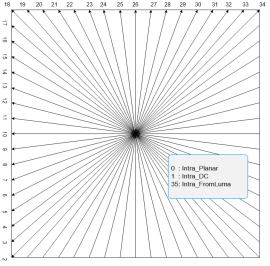
A key to efficient video compression is predicting future video frames on the basis of past ones. This diagram concerns "intra angular prediction."
(Credit: ISO)
UHD also requires a new video-coding standard, known as high-efficiency video coding, or HEVC (aka or H.265).
Although the MIT chip isn't intended for commercial release, its developers believe that the challenge of implementing HEVC algorithms in silicon helps illustrate design principles that could be broadly useful.
Moreover, "because now we have the chip with us, it is now possible for us to figure out ways in which different types of video data actually interact with hardware," says Mehul Tikekar, an MIT graduate student in electrical engineering and computer science and one of the paper's co-authors.
How HEVC works
Like older coding standards, the HEVC standard exploits the fact that in successive frames of video, most of the pixels stay the same. Rather than transmitting entire frames, it's usually enough for broadcasters to transmit just the moving pixels, saving a great deal of bandwidth. The first step in the encoding process is thus to calculate "motion vectors" — mathematical descriptions of the motion of objects in the frame.
On the receiving, end, however, that description will not yield a perfectly faithful image, as the orientation of a moving object and the way it's illuminated can change as it moves. So the next step is to add a little extra information to correct motion estimates that are based solely on the vectors. Finally, to save even more bandwidth, the motion vectors and the corrective information are run through a standard data-compression algorithm, and the results are sent to the receiver.
The new chip performs this process in reverse. It was designed by researchers in the lab of Anantha Chandrakasan, the Joseph F. and Nancy P. Keithley Professor of Electrical Engineering and head of the MIT Department of Electrical Engineering and Computer Science.
The chip's first trick for increasing efficiency is to "pipeline" the decoding process: a chunk of data is decompressed and passed to a motion-compensation circuit, but as soon as the motion compensation begins, the decompression circuit takes in the next chunk of data. After motion compensation is complete, the data passes to a circuit that applies the corrective data and, finally, to a filtering circuit that smooths out whatever rough edges remain.
Fine-tuning
Pipelining is fairly standard in most video chips, but the MIT researchers developed a couple of other tricks to further improve efficiency. The application of the corrective data, for instance, is a single calculation known as matrix multiplication. A matrix is just a big grid of numbers; in matrix multiplication, numbers in the rows of one matrix are multiplied by numbers in the columns of another, and the results are added together to produce entries in a new matrix.
"We observed that the matrix has some patterns in it," Tikekar explains. In the new standard, a 32-by-32 matrix, representing a 32-by-32 block of pixels, is multiplied by another 32-by-32 matrix, containing corrective information. In principle, the corrective matrix could contain 1,024 different values. But the MIT researchers observed that, in practice, "there are only 32 unique numbers," Tikekar says. "So we can efficiently implement one of these [multiplications] and then use the same hardware to do the rest."
Similarly, Chiraag Juvekar, another graduate student in Chandrakasan's group, developed a more efficient way to store video data in memory. The "naive way," he explains, would be to store the values of each row of pixels at successive memory addresses. In that scheme, the values of pixels that are next to each other in a row would also be adjacent in memory, but the value of the pixels below them would be far away.
In video decoding, however, "it is highly likely that if you need the pixel on top, you also need the pixel right below it," Juvekar says. "So we optimize the data into small square blocks that are stored together. When you access something from memory, you not only get the pixels on the right and left, but you also get the pixels on the top and bottom in the same request."
Chandrakasan's group specializes in low-power devices, and in ongoing work, the researchers are trying to reduce the power consumption of the chip even further, to prolong the battery life of quad-HD cell phones or tablet computers.
One design modification they plan to investigate, Tikekar says, is the use of several smaller decoding pipelines that work in parallel. Reducing the computational demands on each group of circuits would also reduce the chip's operating voltage.