LPD uses a laser engine and a phosphor panel to create stunning, lifesize images with low-power, solid-state lasers. Fundamentally different than LED- and LCD-based technologies, LPD solutions—packaged configurations containing LPD technology and other components—are designed to a human scale and offer brilliant image quality, unmatched viewing angles, and the industry’s smallest environmental footprint. Compared to other digital technologies,
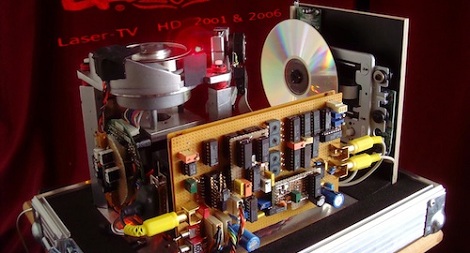
Back in 2001, [Helmar] made an awesome monochrome video display out of a red laser pointer and a spinning 18-sided mirror. Blue and green lasers are much less expensive than they were a decade ago, so [Helmar] decided to go full color with his laser projector. (In German, so fire up Chrome or get the Google translation)
The ancient website for [Helmar]‘s green-only projector goes over the principles of operation. A single laser shines onto a multi-faceted polygonal mirror. This is reflected onto another mirror that provides the reflection for each line in a frame of video. Earlier this year, [Helmar] hacked up a red and blue laser to complement the preexisting green laser. The end result is an RGB projector powered by friggin’ lasers.
As far as we can tell, the projector only has composite input; the attached DVD player provides all the signaling for that. Amazingly, [Helmar] didn’t use a microcontroller for the circuitry. All the electronics are simple logic gates. Really amazing if you ask us.
3D display technology is fairly limited. Most 3D displays out there rely on either prisms refracting light from a normal flat-panel display, or shooting lasers into some sort of space-filling device. A few researchers in Japan
went with a more unconventional method of making a 3D display that actually lives up to the promises of the displays seen in Star Wars
From the coverage of this display we.ve found, the green laser demonstration is a scaled-down version that uses water as the display medium. There's a short clip that shows a red, green, and blue laser projecting a few white voxels into mid-air. The video of both these demonstrations is a bit jumpy, but that.s probably because of the difference in frame rate between the display and camera.
We.re not really sure how the .plasma excitations of air molecules with focused beams. actually work, or even how to control 50,000 of these dots at 15 frames per second. If you.ve got any idea how to build one of these guys, leave a note in the comments.
Light Blue uses what they call "holographic laser projection" They have a white paper on it. I haven't been able to understand how this is different then a normal LCOS projector other then adding a laser light sources. but the results seem impressive.
At CEATEC JAPAN 2010, Pioneer presented a next-generation in-car display device, the Network Vision Head-Up Display.
A laser projector, using red, green, and blue laser light sources projects information, in full color onto the windscreen, overlaid on the drivers field of vision. The aim of the Network Vision HUD is to provide safe, convenient access to content by networking with a smartphone. In this way, the display can access navigation services, traffic news, and electric vehicle services, as well as recommendations for each user's favorite content.
"In terms of technology, this display is a laser projector, with an RGB laser light-source module. It forms a small screen and uses a special-purpose combiner, which is a half-mirror, to enlarge the picture and project it in mid-air. This achieves a big-screen display, which hasn't been possible with HUDs before. The screen size is equivalent to 25 inches. Because the light source is a laser, this display achieves high brightness, high contrast, and full color - features that distinguish it from previous HUDs."
This Network Vision HUD is based on Pioneer's laser module technology, which was originally developed for DVD and Blu-ray drives, and Pioneer's own SmartLoop service platform, developed through its experience in the car navigation business.
"Here, we're demonstrating the SmartLoop shared traffic-news service. For example, information about congestion, sent from other cars, can be shown on the HUD. And as an application for EVs, we're also demonstrating how this display can navigate to the least crowded charging station within the driving distance remaining on the battery."
Pioneer is currently developing this display, with the aim of market launch in 2012.
This projector works by scanning laser light in two dimensions, using an MEMS mirror. It can be made compact and energy-efficient, so it's expected to be used in mobile phones and digital cameras.
"Because this projector has a laser as the light source, it doesn't involve the concept of a focal point. So a feature of this projector is that it's always in focus, regardless of the projection distance. This enables it to show pictures even when tilted, like this. Also, the picture gradation is achieved by controlling the laser output. For example, in black areas, no electrical output is used, so this projector is very energy-efficient."
Because the projector is focus-free, it can project onto spherical surfaces. With an ordinary projector, the edges of the picture would be out of focus or distorted, but with this one, there's no blurring or distortion. It can also project onto complex shapes, so it's expected to be used for digital signage.
"This projector works by combining the light from red, green, and blue lasers, and directing it onto an MEMS mirror. The light is scanned by moving the MEMS mirror. So this is a scanning projector; the scanning method is very similar to that used in a CRT."
From Slashdot: "It's not every day you hear about a brand new display technology, but San Jose, CA-based Prysm came out of stealth mode yesterday to talk about its plans for manufacturing laser phosphor displays, or LPDs. The new devices, which the company will show off at the Integrated Systems Europe trade show in Amsterdam next month, reportedly use 25 percent as much electricity as equivalently-sized LCD screens. And they should be easier to manufacture too, since they don't have a backplane of transistors like LCD screens: the image is generated by a laser beam that sweeps across phosphor stripes under the control of a scanning mirror. The venture-funded startup, which plans to build and sell LPD screens under its own brand, is promoting them as a low-cost, low-maintenance way to display information in lobbies, airports, broadcast studios, command centers, and the like."