Showing posts with label Digital Cinema. Show all posts

Tuesday, September 03, 2013

EIZO DuraVision FDH3601 4K x 2K resolution across a 36.4" screen.


http://www.eizo.com/global/products/duravision/fdh3601/index.html

4K x 2K in a Single Glance

The DuraVision FDH3601 displays 8.8 megapixels (4096 x 2160 native resolution) across its 36.4-inch screen. This is enough pixels to display the content of several desktop monitors but without the distractive bezels between screens.
4K x 2K in a Single Glance

Monitor for Air Traffic Control and Geophysical Services

The DuraVision FDH3601 ideal for fields like air traffic control and geophysical services requiring large monitors that can display a high volume of information. The DuraVision FDH3601 enhances EIZO's selection of primary control monitors for ATC by offering new ways of displaying information. For example, it can display one 4K x 2K image across the entire screen or it can display a 2K x 2K image and auxiliary information simultaneously.
Monitor for Air Traffic Control and Geophysical Services

Wide Dimming Range

Using the latest white LED backlight technology the DuraVision FDH3601 offers a brightness range from 30 cd/m2 up to 700 cd/m2, making it ideal for almost any ambient lighting environment.

Fine Rendering of Detail

With an extremely tight pixel pitch of 0.1995, text and images such as contours on a map can be displayed in fine detail. The tight pixel pitch allows the monitor to display the equivalent of four full HD monitors on its 36.4-inch screen without bezels to divide the screens.
Fine Rendering of Detail

Presence Sensor for Power Savings

EcoView SenseEIZO's EcoView Sense feature unites convenience with energy savings by ensuring that the monitor automatically conserves power when it is not in use. EcoView Sense is an integrated presence sensor that prompts the monitor to switch to power save mode when it detects your absence, and then resume normal operation when you return. To prevent the screen from reactivating when it shouldn't, EcoView Sense differentiates between your presence and a still object like an empty chair or general office activity in the background.

Zero Watts When Turned Off

When the monitor is switched off via its AC adapter's main power switch it consumes no electricity at all.

Brightness and Color Uniformity with DUE

Fluctuations in brightness and chroma on different parts of the screen are characteristic of LCD panels. Generally, the larger the screen, the more noticeable these uniformity errors become. EIZO's Digital Uniformity Equalizer (DUE) helps to compensate for these errors, resulting in a much more uniform image.
Brightness and Color Uniformity with DUE

DVI-D and DisplayPort Inputs

The DuraVision FDH3601 includes two dual-link DVI-D and two DisplayPort connectors for connecting to up to four computers. A USB hub with one upstream and two downstream ports is also included.

Smooth Rendering of Color Tones and 10-Bit Simultaneous Display

A 16-bit look-up table offers a palette of about 278 trillion colors from which the most appropriate 16.7 million are displayed. This produces smooth reproduction of color and grayscale tones. Furthermore, with the DisplayPort inputs, the monitor can display simultaneous 10-bit color *. This is more than 1 billion colors shown simultaneously which is 64 times greater than the 16.7 million colors of 8-bit display. The result is even smoother display of gradations and reduced Delta-E between two adjacent colors.
  • A graphics board and software which support 10-bit output are also necessary for 10-bit display.

Ergonomic Stand

The DuraVision FDH 3601 comes with EIZO's ergonomic FlexStand 2. It offers very versatile positioning with 100 mm height adjustment, 25° tilt, and 344° swivel. The monitor can be removed from the stand and mounted on a VESA-compatible arm or wall mount.

On-Screen Button Guide

An on-screen button guide appears above the buttons to indicate what each one is for. This is convenient when using the monitor in a dimly-lit working environment. Furthermore, the brightness of the power lamp can be adjusted in eight stages including shutting off the lamp.

Mercury-Free, White LED Backlight

The white LED backlight provides very stable brightness even at low settings like the monitor's minimum brightness of 30 cd/m2. Unlike a CCFL backlight, an LED backlight is mercury free so it will have less impact on the environment when it is disposed of.

Wide Viewing Angles

The DuraVision FDH3601 uses an LCD panel that has viewing angles of 176° and exhibits minimal color shift so two or more people can view the screen at once.

Preset Modes

Five preset modes are included: sRGB, Text, and three customizable modes where users can input their preferred values for brightness, color temperature, and gamma.

Monday, January 30, 2012

You Can Edit 4K Video on a MacBook Air (With a Red Rocket)

http://www.tomshardware.com/news/macbook-air-video-4k-video-red-rocket,14584.html


Since you can't even play 4K video on any PC, most of us would not automatically come up with an idea to edit 12-megapixel resolution video on a Macbook Air.
However, a demo published by Dave Helmly, in charge of tech sales of Adobe's pro audio and video products, shows that it is possible.
4K video editing
Helmly used a flagship Macbook Air with an Intel 1.8 GHz i7-2677M processor, which retails for $1700. The 4K video quickly overwhelmed the dual-core processor and its four threads. However, the video, apparently recorded with a Red One camera, ran in real-time via a Thunderbolt-connected Red Rocket accelerator and transcoder card. The Red Rocket card is key to getting 4K video to be played at 30 fps on a PC and can be purchased for $4,750.
It's important to note that Helmly went with the Apple hardware, but on the OS side it's running Windows 7 in boot camp. Helmly explained to Gizmodo on his choice:
No real reason I chose to show it running under Windows 7 other than I've been surprised that we haven't seen any demos of Windows running TB before now. It actually works pretty good in it's current beta state. That said the Mac OS kicks @ss running the same config. Please keep in mind that half the battle is getting alpha/beta Windows 7 64bit drivers for each TB device. All TB devices need drivers at some level. All necessary Mac OS driver are already shipping.
The Mac + TB is really last years news and we all want more TB peripherals to start shipping and to start showing Intel and PC makers that there is lots of interest on both sides and it will benefit all TB users. I have no preference on OS and use both everyday.
4K video is still an emerging standard and out of reach for mainstream customers. The Red One camera, which supports recording formats up to 4.5K at 4480x1920 pixels, is currently sold for $25,000. YouTube began supporting 4K videos in mid-2010. An example can be seen below (but you'll have to blow it up to original size if you want to see it in all its glory).
Surf NYC 4K Video

Thursday, January 26, 2012

Film makers finally wake up to the fact they are now shooting VIDEO!!!!

It seems amazing that they would want to use the New Digital Technology and then want to stick with 24 fps, a carry over from when you had to pay for film by the foot and if you made a mistake, toss it out and start over.

Just wait till they learn about 120 Fps.

And don't even mention free view point, light fields and dare I say it "digital holography".


James Cameron Wants to Blow Your Mind With 60 Frames Per Second - Wired.com

Shooting in 3-D might get you an occasional holy-crap moment, but if you really want to blow an audience’s mind, increase your frame rate. Movies shot and projected faster than the standard 24 frames per second—at, say, 48 or 60 fps—have startling clarity and emotional impact. Even better, the strobing you sometimes get with 3-D (filmmakers call it the judders) vanishes at 48 fps and up.

Who cares? Peter Jackson and James Cameron. Jackson is shooting The Hobbit in 3-D at 48 fps with high-end digital cameras—no more film for him. And Cameron is leaning toward 60 fps for his Avatar sequels. Cameron says that when he screened test footage for theater owners, “you could literally hear a gasp from the audience when they were shown the difference between 24-frame and 48 frames. And they liked 60 frames even better.”

The irony is that filmmakers have known about the technique for decades. Visual-effects titan Douglas Trumbull wanted to use 60 fps for his 1983 film, Brainstorm, and invented a projection technology he called Showscan. “I got very hooked on this whole idea of immersive cinema,” Trumbull says. “We saw a profoundly different kind of experience happening at up around 60 frames.”

But studios and theaters snubbed the pricey Showscan gear. Trumbull was so bummed that he left Hollywood for Massachusetts. Cameron thinks the world is finally ready. “Doug had the right idea,” he says. “It was just premature brilliance.” Sometimes the industry judders.

Saturday, December 31, 2011

LG Unveils a Monstrous 84 Inch 4K Resolution 3D Television

LG Unveils a Monstrous 84 Inch 4K Resolution 3D Television

As most of our avid readers know, Videomaker has faithfully scoured the CES floor to find the world’s most interesting products to write home to you all about. This year will be no exception. In an odd twist of the norm, LG just unveiled what might be the world’s largest 4K 3D television at a whopping 84 inches. It’s hard to imagine that there would be some other television revealed at CES this year that could match the specs and size of this television but be assured that if there is, we’ll be one of the first to report it right here on our blog next week.
As of right now, there are few details about what this television can do, but we can guess that the price for such a bohemoth will likely cost more than the average person makes in an entire years worth of salary.  What we do know is that this television will feature LG’s Smart TV functionality which includes access to various 3D movies and over 1,200 apps.
Lest you get confused about what 4K exactly means, LG has already told us that their television will display images at 3840×2160 pixels. Not exactly a true 4K picture but still double what we usually get on our 1080 televisions. Of course you may be asking how much 4K really improves the television viewing experience. I can tell you as someone who’s personally seen a 4K television and a 1080 television side to side that the extra pixels are definitely worth it.
Even so, there is no infrastructure currently in place for television stations to broadcast television at 4K resolutions. That will likely be a long time coming especially since most stations have just completed their move to HD content and will probably be resistant to changing things all over again. Also, you’ll be hard pressed to find any set-top players that can output resolutions this high without completely choking. Nonetheless, it seems like 4K is going to be just as big at CES as 3D televisions were last year. RED has already announced it’s plans for 4K disc players, many camcorders can already record at 4K resolutions, and even YouTube allows users to upload 4K content. These are all strong indications that 4K television is coming – and sooner than we think. I just hope computers and graphics cards will be able to keep up.

From: http://www.videomaker.com/community/videonews/2011/12/12278-lg-unveils-a-monstrous-84-inch-4k-resolution-3d-television/

Monday, December 26, 2011

Sharp Demos World’s First 85-inch 8K4K Display

From Tom's Guide:


Sharp is sporting an 85-inch 8K4K display at IFA 2011, but don't expect market saturation until after 2020.


Now that 1080p HDTVs are saturating the market at a comfortable level (financially), what's next for the general consumer? Graphics so sharp and life-like that eyes will melt and brains will suddenly ignite into flames? No, try jacking up the resolution to 7680 x 4320 (33 million color dots), or 8K4K, like Sharp has done with an 85-inch display it's currently showcasing at IFA 2011 in Berlin.
While many home theater junkies my simply drop in giddy delight at the sight of such a monstrous display, Sharp points out in the video below that currently there's no content to support an 8K4K display. As it stands now, Sharp had to use a special camera in order to capture compatible footage, and supposedly a special "recorder" to store the footage and pipe it to the display. Unfortunately, Sharp wouldn’t specify the actual size of the stored video files -- we can only imagine.
Trusted Reviews, which got an up-close-and-personal view of the 8K4K screen, had this to say about the viewing experience:
"The quality of the native 8k4k material on Sharp's screen almost defies description. You could see levels of detail in people's faces, the ground, the tree, or actually any part of the image that the event being shown felt so tangible you felt you could just step forward and join the madness. Never before, in other words, has the idea of HDTV giving you a 'window on the world' been so accurately realized."
So when will consumers begin to see 8K4K HDTVs roll out to retail shelves? Given that the market is still living in a 1080p world, it may be a long, long time. Various reports indicate that experimental broadcasting on 8K4K content won't even begin until 2020.

Sharp 8K4K TV, 7680x4320 resolution, 85", the future of HDTV

Wednesday, November 30, 2011

IMF for a Multi-Platform World

IMF for a Multi-Platform World
Posted: 30 Nov 2011 02:15 AM PST
Among other things, the looming arrival of the Interoperable Master Format (IMF) is illustrating that the digital media industry is now capable of moving "nimbly and quickly" to create technical standards to address and evolve the ways that it packages, moves, and protects precious content in the form of digital assets in a world where the technology used to do all that, and the very industry itself, is fundamentally changing at a startling rate. The term "nimbly and quickly" comes from Annie Chang, Disney's VP of Post-Production Technology who also chairs the SMPTE IMF work group (TC-35PM50).
Six Hollywood Studios through the University of Southern California Entertainment Technology Center (USC ETC) started to develop IMF in 2007, and in early 2011, they created an input document that the SMPTE IMF working group is now using as the basis of the IMF standardization effort. Over time, IMF has developed into an interchangeable, flexible master file format designed to allow content creators to efficiently disseminate a project's single master file to distributors and broadcasters across the globe.
Chang reports that progress has moved quickly enough for the work group to expect to finalize a basic version of the IMF standard in coming months, with draft documents possibly ready by early 2012 that focus on a core framework for IMF, and possibly a few of the potential modular applications that could plug into that framework.
Once that happens, content creators who have prepared for IMF will be in a position to start feeding all their distributors downstream far more effectively than has been the case until now in this world of seemingly unending formats. They will, according to Chang, be able to remove videotape from their production workflow, reduce file storage by eliminating the need for full linear versions of each edit or foreign language version of their content, and yet be able to take advantage of a true file-based workflow, including potentially automated transcoding, and much more.
The rollout will still need to be deliberate as various questions and unanticipated consequences and potential new uses of IMF begin to unfold. But that said, Chang emphasizes that the goal of being able to streamline and improve the head end of the process—creating a single, high quality, ultimate master for all versions is real and viable, and with a little more work and input, will be happening soon enough.
"Today, we have multiple versions, different resolutions, different languages, different frame rates, different kinds of HD versions, standard-definition versions, different aspect ratios—it's an asset management nightmare," she says, explaining why getting IMF right is so important to the industry.
"Everyone creates master files on tape or DPX frames or ProRes or others, and then they have to create mezzanine files in different formats for each distribution channel. IMF is designed to fix the first problem—the issue of too many file formats to use as masters."
Therefore, IMF stands to be a major boon for content creators who repeatedly and endlessly create different language versions of their material.
"For a ProRes QuickTime, you are talking about a full res version of a movie each time you have it in a new language," Chang says. "So 42 languages would be 42 QuickTime files. IMF is a standardized file solution built on existing standards that will allow people to just add the new language or whatever other changes they need to make to the existing master and send it down the chain more efficiently."
Chang emphasizes the word "flexible" in describing IMF, and the word "interoperable" in the name itself because, at its core, IMF allows content distributors to uniformly send everybody anything that is common, while strategically transmitting the differences only to where they need to go. In that sense, IMF is based on the same architectural concept as the Digital Cinema specification—common material wrapped together, combined with a streamlined way to package and distribute supplemental material. Eventually, each delivery will include an Output Profile List (OPL) to allow those transcoding on the other end a seamless way to configure the file as they format and push it into their distribution chain.
Unlike the DCI spec, however, IMF is not built of wholly new parts. Wherever possible, the file package will consist of existing pieces combined together in an MXF-flavored wrapper. This should, Chang hopes, make it easier for businesses across the industry to adapt without huge infrastructure changes in most cases as IMF comes to fruition.
"With IMF, we are using existing standards—a form of MXF (called MXF OP1A/AS-02) to wrap the files, and parts of the Digital Cinema format and other formats that many manufacturers already use," she says. "So, hopefully, there is not much of a learning curve. We hope that most of the big companies involved in the process won't be caught unaware, and will be able to make firmware or software upgrades to their systems in order to support IMF. Hopefully, companies will not have to buy all new equipment in order to use IMF.
"And with the concept of the Output Profile List (OPL), which essentially will be global instructions on output preferences for how to take an IMF file and do something with it relative to your particular distribution platform, companies that are doing transcoding right now will have an opportunity to use that to their advantage to better automate their processes. IMF has all the pieces of an asset management system and can use them all together to create standardized ways to create packages that fit into all sorts of other profiles. It's up to the content owners to take these OPL's and transcode the files. As they do now, they could do it in-house or take it to a facility. But if transcoding facilities get smart and use IMF to its potential, they can take advantage of IMF's capabilities to streamline their processes."
Chang says major technology manufacturers have been extremely supportive of the SMPTE standardization effort. Several, such as Avid, Harmonic, DVS, Amberfin, and others have actively participated and given input on the process, which is important because changes to existing editing, transcoding, and playback hardware and software, and the eventual creation of new tools for those tasks, will eventually need to happen as IMF proliferates. After all, as Chang says, "what good is a standard unless people use it?"
She emphasizes that manufacturer support is crucial for IMF, since it is meant to be a business-to-business tool for managing and distributing content, and not a standard for how consumers will view content. Therefore, outside of the SMPTE standardization effort, there is a plan to have manufacturers across the globe join in so-called "Plugfests" in 2012 to create IMF content out of draft documents, interchange them with each-other, and report on their findings.
As Chang suggests, "it's important to hit IMF from multiple directions since, after all, the first word in the name is 'interoperable.' " As a consequence of all these developments, it's reasonable to assume that IMF will officially be part of the industry's typical workflow chain where content distributors can start sending material to all sorts of platforms in the next year. Some studios and networks are already overhauling their infrastructures and workflow approaches to account for IMF's insertion into the process, and encoding houses and other post-production facilities should also, in most cases, have the information and infrastructure to adapt to the IMF world without any sort of fundamental shift. But the post industry will be somewhat changed by IMF, especially if some facilities or studios decide on processes for automating encoding at the front end of the process that changes their reliance on certain facilities currently doing that kind of work.
However, Chang adds, the broadcast industry specifically will probably have the most significant learning curve in terms of how best to dive into IMF since, unlike studios, which have been discussing their needs and pondering IMF since about 2006, the broadcast industry was only exposed more directly to IMF earlier this year when SMPTE took the process over. IMF was originally designed and intended as a higher bit-rate master (around 150-500MB/s for HD, possibly even lossless, according to Chang), but broadcasters normally use lower bit-rate files (more like 15-50MB/s).
"However, I feel that broadcasters would like to have that flexibility in versioning," Chang says. "But because they need different codecs and lower bit-rates, there is still discussion in SMPTE about what those codecs should be. Broadcasters are only now starting to evaluate what they need out of IMF, but there is still plenty of time for them to get involved."
Of course, as the explosion of mobile devices and web-enabled broadcasting on all sorts of platforms in a relatively short period of time illustrates, viewing platforms will inevitably change over time, and therefore, distribution of data will have to evolve, as well. As to the issue of whether IMF is relatively future-proofed, or merely the start of a continually evolving conversation, Chang is confident the standard can be in place for a long time because of its core framework—the primary focus to date. That framework contains composition playlists, general image data, audio data (unlimited tracks, up to 16 channels each), sub-titling/captioning data, any dynamic metadata needed, and so on.
Modular applications that could plug into that framework need to be further explored, Chang says, but the potential to allow IMF to accommodate new, higher compressed codecs, new or odd resolutions or frame rates, and all sorts of unique data for particular versions is quite high.
"The core framework we created with documents is something we tried to future proof," she says. "The question is the applications that might plug into that core framework (over time). We are trying to make it as flexible as possible so that if, in the future, even if you have some crazy new image codec that goes up to 16k or uses a new audio scheme, it will still plug into the IMF framework. So image, audio, or sub-titling could be constrained, for example, but as long as the sequence can be described by the composition playlist and the essence can be wrapped in the MFX Generic Container, the core framework should hold up for some time to come."
To connect with the SMPTE IMF effort, you can join the SMPTE 35PM Technology Committee, and then sign up as a member of 35PM50. The IMF Format Forum will have the latest news and discussions about the status of the IMF specification.
More information about IMF:
Overview of the IMF presentation at NAB 2011's Post Pit event.
Amberfin's Bruce Devlin SMPTE PDA Now Educational Webcasts, discussing MXF application designs coming out of the IMF Work Group.
By Michael Goldman, SMPTE Newswatch

Sunday, November 13, 2011

Fwd: intoPIX JPEG 2000 technology adopted by NHK Engineering Services for developing a compact 4K high-resolution outdoor acquisition system

---------- Forwarded message ----------
From: Raiffa Lanove <r.lanove@intopix.com>
Date: Sun, Nov 13, 2011 at 4:53 PM
Subject: intoPIX JPEG 2000 technology adopted by NHK Engineering Services for developing a compact 4K high-resolution outdoor acquisition system
To: SOKOL@videotechnology.com


Dear John,

intoPIX is pleased to announce that NHK Engineering Services has adopted intoPIX JPEG 2000 technology for developing a compact 4K high-resolution outdoor acquisition system. Please find the official press release attached for your reference.

For further information, please contact Katty Van Mele – Director Business Development or visit our booth at interBee 2011 in Japan.

With kind regards,
Raiffa Lanove
Marketing & Administrative Assistant – intoPIX s.a.
----------------------------------------------------------
email :                  r.lanove@intopix.com
phone :                 +32 10 23 84 70

Katty Van Mele
Director Business Development - intoPIX s.a.
----------------------------------------------------------
email :                  k.vanmele@intopix.com
mobile :                +32 492 73 04 01
website :               www.intopix.com


PRESS RELEASE
13 November 2011


For immediate release


intoPIX JPEG 2000 technology adopted by NHK Engineering Services for developing a compact 4K high-resolution outdoor acquisition system


Louvain-la-Neuve, Belgium - intoPIX – the leading provider of JPEG 2000 compression solutions – has cooperated with NHK Engineering Services, Inc. (Japan) in the development of a JPEG 2000 encoding technology for 4K high-resolution image acquisition.
intoPIX JPEG 2000 FPGA based IP-cores enable 4K image compression (4 times the resolution of HDTV) into a single JPEG 2000 code stream in real-time and without any tiling.
NHK Engineering Services has already developed a "JPEG 2000 outdoor acquisition system for 4K high-resolution images" that makes the acquisition as easy as if it was HDTV images.  It has been utilized during the acquisition of high-speed running scenes (using a vehicle-mounted system) and the live broadcast of cardiac surgery.
The technology developed by NHK Engineering Services in collaboration with intoPIX enables a more compact and easier system for the outdoor acquisition of 4K high-resolution images. NHK Engineering Services will continue to expand the features of this technology and is planning to make full use of JPEG 2000 characteristics, such as its scalability.
This technology will be presented at the intoPIX Island booth (No. 7301 in Hall 7), at InterBEE 2011 in Japan, November 16-18.

About intoPIX
intoPIX is a leading supplier of image compression technology to audiovisual equipment manufacturers. We are passionate about offering people a higher quality image experience.  That's why we've developed FPGA IP-cores and boards enabling high-end JPEG 2000 image compression while protecting the content with security and hardware enforcement layers. More information on our products, customers and company can be found on www.intopix.com.

About NHK Engineering Services
Headquartered in Tokyo, Japan, NHK Engineering Services, Inc. was founded in 1981 to widely exploit research and development results accumulated by NHK in society.
Business of NHK Engineering Services includes transfer of technology developed within NHK R&D including Ultra high definition images " Super Hi-vision", publicity and assistance of patents and technical know-how originated by NHK, breakthrough research of video, audio and wireless, engineering test and research, education of engineers and dissemination of technology, as well as research and development of unique technology. More i
nformation can be found on www.nes.or.jp.


 intoPIX SA www.intopix.com  
If you no longer wish to receive emails from us click here

Friday, November 04, 2011

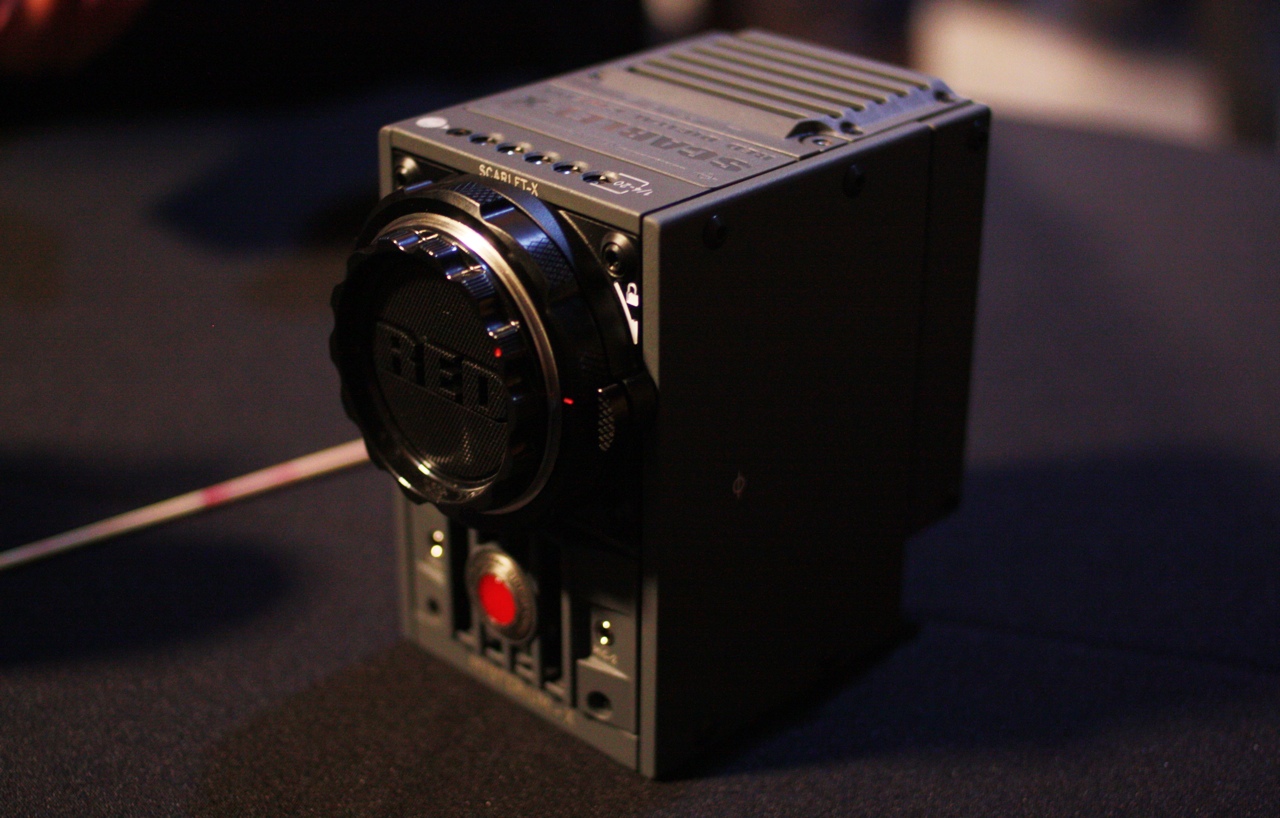
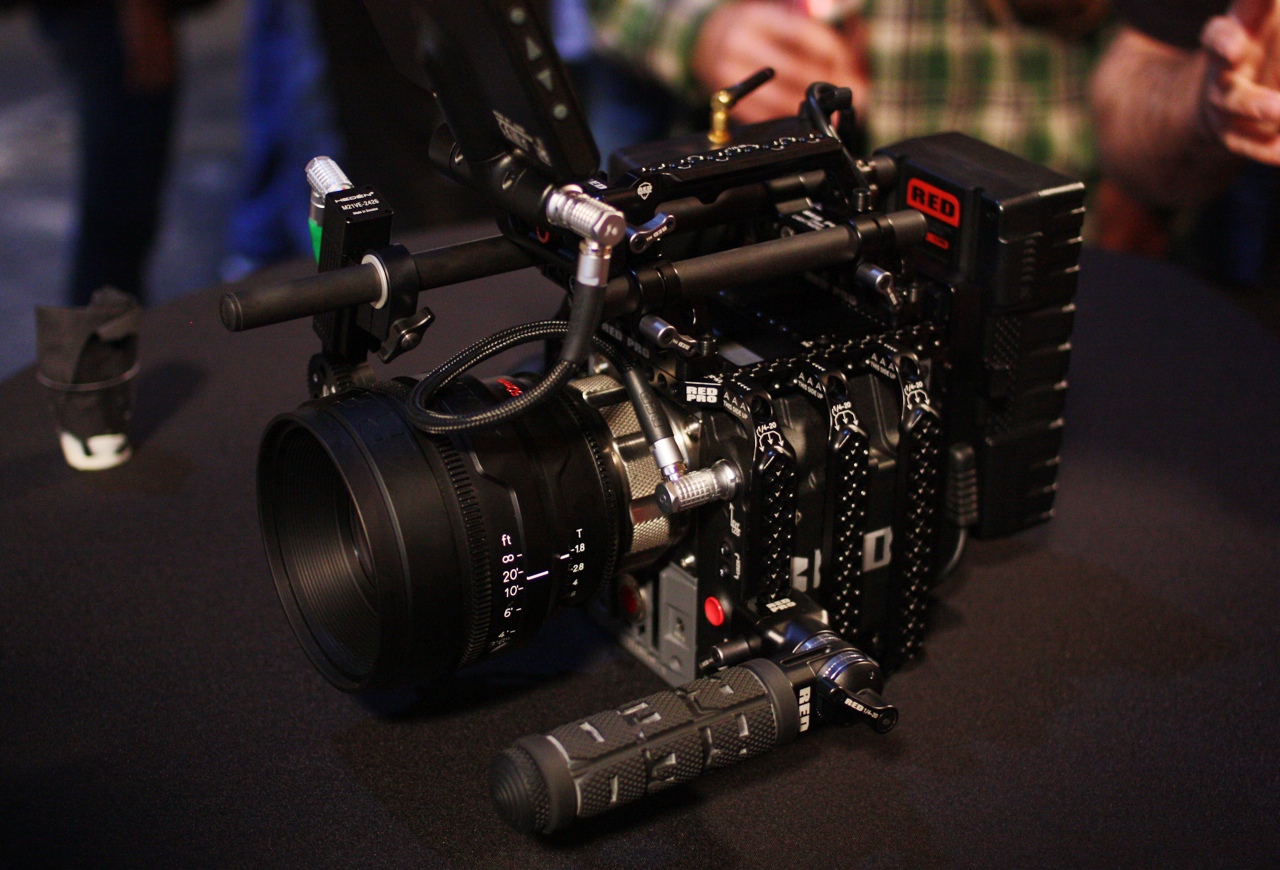
RED’s Scarlet Gets Official: 4K For Under $10K

From TechCrunch


scarlet_logo
For more than three years, upstart camera maker RED has been teasing the Scarlet, a compact camera in the same class as their more powerful, but bulkier, RED One and Epic cameras. We actually saw one at CES this year, but they’ve completely redone the design and capabilities. They were going to publish all this information on their website, but they’re apparently under attack so we’re doing this live.
It used to do 3K and have a fixed 8x zoom. Now it’s essentially the same type of camera as the Epic (that is to say, a sort of chunky “brain” onto which you can fix lenses and so on), just for a much lower price.
The brain:
Fully accoutred:
The Scarlet X, as it’s now called, will sell for $9750 and will be shipping as early as November 17th – the date they said they’d ship earlier, at least after they revised the shipping estimate a dozen times or so. So what can it do?
Well, it does 4K, for one thing. That’s 4096×2160, at up to 25FPS, or quad HD at 30. This is at compression rates that are superior to what they’ve been shooting movies on for years, yet at a data rate that’s still eight times what Canon’s new C300 system shoots at. That’s 50 megabytes per second, or 400mbit/s for those keeping track. The full sensor size is 5120×2700 for stills.
It’ll also do 3K at 48fps, 2K at 60fps, and 1K at 120fps, which is fairly low-resolution but retains the color depth and so on. It’s a Super 35-sized sensor and they’re using leftover chips from Epic brains, which cost almost three times as much. In fact, if you shoot the same type of footage with the same lenses using the Scarlet and the Epic, the images should be “identical.” Here are some datarate specs for those who like that sort of thing:
Aesthetically, it’s similar to the rest, since it’s compatible with all the accessories, but it’s “battleship grey,” as RED founder Jim Jannard described it, and it doesn’t have “ribs,” because “she’s a girl, she’s smooth.”
It’s shipping November 17th, but only if you’re willing to shell out an extra $1500 for the titanium PL mount. The new aluminum Canon mount they’re putting on it will be available starting on December 1st. That $9750 price gets you the brain and an SSD; Jannard said that a fully-functional camera, with LCD, lens, rails, and handles will set you back around $13k.

Tuesday, July 26, 2011

Brainstorm Tech video: Katzenberg on the future of movie watching

Brainstorm Tech video: Katzenberg on the future of movie watching

Dreamworks CEO Jeffrey Katzenberg sat down with Fortune's Andy Serwer to discuss 3D technology, joining the Zynga board, and why movies suck this summer.

Monday, May 23, 2011

Many theaters misuse 3-D lenses to show 2-D films

If a theater plays a 2D movie with the 3D filters in place it reduce the amount of light reaching the screen making the image dark and the colors weak.

Read more at this article: A movie lover’s plea: Let there be light

Tuesday, March 15, 2011

Independent Teleport Operator of the Year: Arqiva

The World Teleport Association Announces Independent Teleport Operator, Teleport Technology and Corporate Social Responsibility Awards at the Annual Teleport Awards For Excellence

Arqiva, XipLink and Thaicom honored for exceptional service and dedication to the teleport industry

(New York City and Washington DC, March 15, 2011) – The World Teleport Association (WTA) announced the recipients of its 16th annual Teleport Awards for Excellence during a luncheon ceremony. The awards are presented each year to organizations and individuals in the teleport industry whose achievements have been deemed exceptional by the international trade association and its awards committees, made up of industry members from across the globe.

The 2011 recipients are:

Independent Teleport Operator of the Year: Arqiva Broadcast and Media – In addition to providing ongoing provision of teleport services for key customers including Sky, BBC, Viacom, ESPN, Universal Networks International, Traffic Sports International, ABS-CBN, USEI, and EchoStar, Arqiva Broadcast and Media (2007 Independent Teleport Operator of the Year) has taken a leadership role in the industry with regard to the electronic delivery of media content to cinemas via satellite. Over the last 12 months, Arqiva has set the bar for Digital Cinema Platforms, including dissemination of films, trailers and advertising to such clients as Dolby, Arts Alliance Media, Opus Arte (The Royal Opera House); Ciel Ecran (Bolshoi Ballet), The Metropolitan Opera, as well as major distributors and cinema chains.

Teleport Technology of the Year: XipLink Hub Optimizations – XipOS Hub Optimizations (“XHO”) feature bandwidth savings and performance enhancements that operate on a standalone appliance located at the teleport or Internet point of presence in a satellite network, allowing operators to compress HTTP traffic by a factor of 1.5. The technology can be limited to the teleport only with no changes to remote sites, yet offers a highly effective bandwidth savings solution that can span multiple networks at the same time. A recent deployment for Omniglobe significantly reduced bandwidth to remote communities by a blended rate of over 15%, resulting in considerably faster web browsing for users, better use of the bandwidth, a higher potential subscription ratio, with an ROI of only a few months.

Corporate Social Responsibility Award: Thaicom – According to the statistics of Distant Learning Foundation in 2009, there were 30,000 schools under the Ministry of Education throughout Thailand, with 10,000 in rural areas unable to access the national education channels. Thaicom established an ongoing program to support education in these rural areas by installing DTH terminals and televisions in select schools to level the educational opportunities between kids in rural areas versus those living in cities. As of the end of February 2011, 759 of the projected 999 school installations were completed. In addition, Thaicom employees volunteer at 63 schools.

The winners for all three categories were selected by a volunteer committee of WTA members and previous Award winners based on nominations submitted during the first quarter of 2011.

In addition to the above honorees, WTA presented the previously announced Teleport Executive of the Year to Adrian Ballintine, President of NewSat.

The 2011 Luncheon and Awards Ceremony, sponsored by SES, hosted many of the world’s leading teleport operators and previous winners of WTA’s Teleport Awards for Excellence. A senior representative from SES, Chris Schram, gave the Host's Welcome and presented the awards to the recipients, with WTA Director of Development Louis A. Zacharilla announcing the winners.

Commenting on the 2011 Awards, WTA’s Director of Development Louis Zacharilla noted that, "Innovation and dedication to service have long been motivating drivers for the teleport industry. Each of the finalists in the 2011 Teleport Awards for Excellence has gone above and beyond a daily commitment to quality operations. As a group they exemplify the drive that has made this industry successful, as well as a community with a dedication to helping others.”

About World Teleport Association
Since 1985, the World Teleport Association (www.worldteleport.org) has focused on improving the business of satellite communications from the ground up. At the core of its membership are the world's most innovative operators of teleports, from independents to multinationals, niche service providers to global carriers. WTA is dedicated to advocating for the interests of teleport operators in the global telecommunications market and promoting excellence in teleport business practice, technology and operations.
Independent Teleport Operator of the Year: Arqiva Broadcast and Media – In addition to providing ongoing provision of teleport services for key customers including Sky, BBC, Viacom, ESPN, Universal Networks International, Traffic Sports International, ABS-CBN, USEI, and EchoStar, Arqiva Broadcast and Media (2007 Independent Teleport Operator of the Year) has taken a leadership role in the industry with regard to the electronic delivery of media content to cinemas via satellite. Over the last 12 months, Arqiva has set the bar for Digital Cinema Platforms, including dissemination of films, trailers and advertising to such clients as Dolby, Arts Alliance Media, Opus Arte (The Royal Opera House); Ciel Ecran (Bolshoi Ballet), The Metropolitan Opera, as well as major distributors and cinema chains.

Monday, January 03, 2011

Movie Theaters Using 3-D Facial Recognition to Measure Audience Reactions


When you sit in the audience of a theater with their system, you'll be illuminated with an infra-red beam, and three or more cameras will continually monitor the crowd to create stereoscopic images--just like the 3-D digital cameras that are now launching on the consumer markets.

The system should be able to detect a great deal. It will know the direction your face is pointing in, your expression, whether you're shocked by something, whether you're sitting in a family group or on your own, at what point you get bored, and so on.

Read Article

Additional Info:
Anti-piracy technology to study cinemagoers
Aralia Systems

Thursday, December 30, 2010

1080p HD over WiFi or wired Ethernet


Cube is the world’s first camera-top wireless HD video encoder. Cube streams up to 1080p over WiFi or wired Ethernet. Cube is the ideal solution for guerilla filmmakers who need on-set video monitoring without the cost or complexity of a full VTR rig. Cube is also a great solution for full-scale film productions to eliminate camera tethering on long dolly moves, running footage, steadicam shots, hand-held operation, jib-arms, and crane shots.


Cube’s ad-hoc networking mode creates a network and streams directly to a decoding device such as a Laptop or iPad with no other equipment required. Using Cube’s infrastructure network mode Cube’s IP video stream can be distributed over a LAN/WAN or over the Internet. Cube uses the world’s most advanced video compression – H.264 High Profile Level 4.1 and provides Blu-ray video quality. Cube’s end-to-end latency is approximately 1/8-1/2 second.*


Cube is tiny (about the size of a deck of cards), uses only 2.5W of DC power, and weighs only 7 ounces, and mounts easily to a rail system, cage, hotshoe, or camera baseplate. Cube’s line-of-sight WiFi range is approximately 300 feet when used with a high quality WiFi access point. Cube has been tested extensively with RED ONE**, Arri Alexa, Panavision Genesis, Canon 5Dii, Canon 7D, various handi-cams and more.


Latency measured by independent third party testers. iPad’s native video decoder adds approximately 10 seconds of latency. An RTP solution for iPad will be available shortly to eliminate the latency issue.

Cube is not compatible with RED ONE’s HDMI output as its output is non-standard. Cube works beautifully with RED ONE’s HD-SDI.

Download Cube Spec Sheet


Supported Input Resolutions
• 1080p/PsF @ 23.98/24/25/29.97/30Hz
• 1080i @ 50/59.94/60Hz
• 720p @ 50/59.94/60Hz

Streaming Output Resolutions
Cube features a built-in scaler to downscale to lower resolutions.
• 1080p/PsF @ 23.98/24/25/29.97/30Hz
• 1080i @ 50/59.94/60Hz
• 720p @ 50/59.94/60Hz
• 480p @ 50/59.94/60Hz

Video Codec
• Compression Algorithm: High Profile H.264 (L4.1), MJPEG
• Bit Rate: 250 Kbps to 10 Mbps

Audio
• Embedded Stereo over HD-SDI or HDMI
• 1/8” Stereo TRS Line Level input
• Audio Compression: AAC-LC, MPEG Layer 2

Network
• Ethernet: 10/100BASE-T
• Network Protocols: TCP/IP, UDP, HTTP, DHCP, NTP, SSL, IGMP
•Transport Protocols: RTP, RTSP, RTP over HTTP, MPEG-TS*, HTTP Live Steaming
• Feature-rich WebUI for configuration and control
• Point to Point (TCP or UDP), Multiple Unicast (UDP), or
• Multicast (UDP+IGMP)*

Physical
• Dimensions: 2.5”W x 3.5”D x 0.9”H
• Weight: 7 oz.
• Nominal Power Consumption: 2.5W
• PoE: 802.3af Compliant
• Auxiliary Power Input: 9-24V DC

Price
• $1,490 to $2,190 depending on model.

Teradek

Thursday, December 23, 2010

Digital Cinema Open System Alliance

The Digital Cinema Open System Alliance is an industry group committed to promoting interoperability between digital cinema equipment from different vendors

DCOSA

Dolby Laboratories, MikroM, USL, and XDC Collaborate on Interface Specifications to Lower Development Costs, to Increase Flexibility, and to Support Innovation for the Digital Cinema Industry
Digital Cinema Open System Alliance Announces Launch of Interoperability Effort

Wednesday, December 22, 2010

Tron: 82% of viewers watched in 3D; 24% in IMAX

The week before Christmas is notoriously bad for movies.
"Tron: Legacy," brought in an estimated $43.6 million in it's  first 3 days.

 Of 3,451 locations, 2,424 were 3D-equipped, including 234 Imax runs.

 Many theaters were offering both 2D and 3D showings.

Tron earned an overwhelming 82% of its weekend gross from 3D, 24% for digital or large format IMAX.

While "Yogi Bear" saw 57% from 3D, slightly higher than Disney's "Tangled."

Keep in mind this is for around $3 extra per ticket to see it in 3D.

"Tron" earned 24% of its weekend gross from Imax, for the exhib's largest opening share ever, with $10.3 million: Imax per-screen average was $44,000. Pic's Imax take even beat the $9.5 million bow for "Avatar," though it launched at 55 fewer Imax theaters.

It's no secret that 3D causes problems for a lot of people. Some people can't even see 3D, such as Cinemalogue's Rubin Safaya. But even Rubin, who gets a headache when attempting to watch any 3D movie admits that Tron: Legacy was better for him than most. He says, “I got a pretty intense headache with Avatar, I can tell you that. for the first 1/3rd of the film. Tron wasn't nearly that bad.” In part this may be because the opening minutes of the film are actually in 2D, which gives your eyes some relief before launching into all the 3D scenery. But for people who, unlike Rubin can see 3D, a lot of the time it has to do with brightness, and whether you have to strain to see the movie's 3D effects as they're projected. None of that's a problem with Tron: Legacy and, unless you're like Rubin odds are you won't have any problem with it at all. Even if you are like Rubin, it sounds like Tron: Legacy's 3D will treat you better than most. Leave the Tylenol at home.


To 3D Or Not To 3D: Buy The Right Tron: Legacy Ticket


'Tron' is tops at weekend B.O.

Friday, December 17, 2010

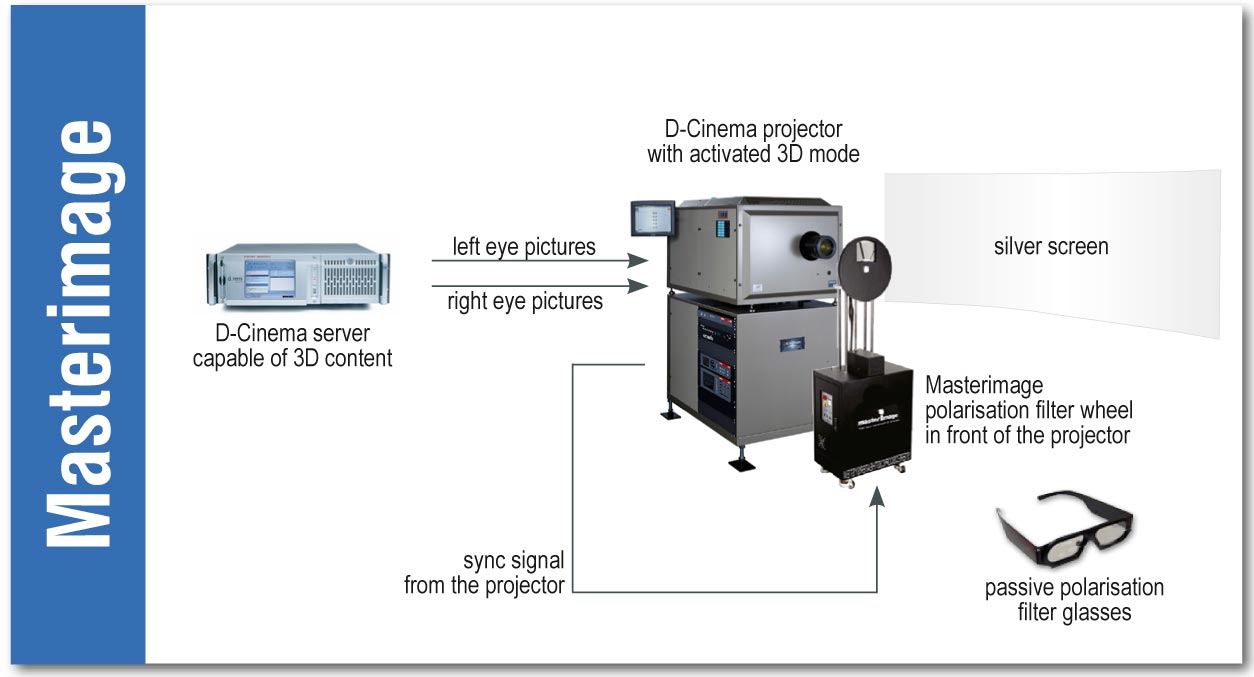
3 reasons why MasterImage may win the 3D Cinema wars.

1.) Low cost recyclable / disposable Glasses

Glasses need to be sterilized before handing then out a second time to customers.
This is a laborious process that will significantly increase the cost of man power to operate a theater. It this cost that I think will limit the Dolby system to only the most high end theaters.

One of the more successful business strategies is "Give away the razors..sell the blades" It's taught at every business school in the country.

Well with the MasterImage glasses this seems to be the case, where they recycle the glasses over and over can keep reselling sterilized and sealed packaged glasses to theater operators. It's a brilliant strategy with glasses being the blades


The plastic glasses to cost under 0.50 a pair new.  With cleaning and reuse it's totally down to cleaning, packaging and shipping costs. What this means is even buying new glasses from China for each viewing isn't competitive with recycling.


Packaging on MasterImage recyclable plastic Glasses

2.) RealD uses a perpetual licensing agreement while MasterImage sells systems to theater chains, allowing them to own the 3-D technology outright.

3.) Low tech light polarizer on the projector. These are the razors. This is used to turn each film/video frame from clockwise and counterclockwise polarization. Real-D uses a transparent LCD panel, which is high tech with no moving parts while the master image uses a synchronized rotating wheel with low cost plastic filters.  I suspect it is much lower cost to produce then the Real-D system.

The custom Polarizing LCD panel called is Z-Screen that Real-D depends on can only be produced by a few companies at best, and maybe only one.   The MasterImage system is something that someone who can repair a projector could probably fix.

The Dolby system uses the most advanced filter system that filters out narrow bands of light. This filter is made of very thing vacuum deposited metal layers to form an Interference filter. These are only made by one company JDSU is the world's largest producer of optical coatings. It must be built in to the projector itself and placed between the light source and the DLP or LCOS light valves.


Wednesday, December 15, 2010

Dolby Digital 3D vs Real D / Master image systems.

It's interesting to watch this evolutionary battle play out.

Dolby 3D Digital Cinema / INFITEC Glasses

VS.

Real-D / Master Image Circular Polarized Glasses

Dolby's 3D is clearly superior, I mean just breathtaking 3D, but in the end it's the costs and not just the image quality that may end up determining the winners in this game.

Glasses

I am told the Dolby glasses are $38 a pair, which is an amazing deal for 2 precision interference filters.

The Real D / Masterimage system using inexpensive plastic polarizers. This make them almost disposable.  But this lower cost in glasses comes at a cost.

 
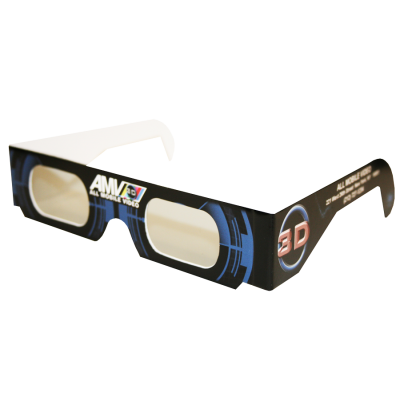
American Paper Optics Even make disposable paper glasses for 3D movies that I am sure the theaters really have consider deeply.  I think they went for the recyclable plastic just because the paper seemed too cheap.

I wonder if they ask their customers, "Would you like that in paper or plastic?"


There is also a shutter goggle system that nearly identical to what they are now pushing with 3D HDTV's. These are my least favorite as they require batteries, and are bulky and don't work 1/2 the time.  I have not seen these use in a normal theater setting ever, only in amusement parts, older IMAX system and trade show demos.

It's getting push with HDTV's only because it required no changed to existing TV designs and they can charge more.   Just the addition of an IR LED to provide a sync signal to the glasses and a sticker and double the price. I will discuss shutter goggle technology in more depth in a later article.


Screen

3D projection using polarization requires non-depolarizing screens. What this means in that the screen must be coated with a special polarization preserving material, usually silver or aluminum metals in paint.

Regular white matte theater screens cost normally around $6000 for an ordinary screen which the Dolby system and shutter glasses can use.

But not just any screen will work with polarized light it cost $13000 or more for an old fashion silver screen or specialized 3D Polarization preserving screen.

Da-Lite 3D Silver Matte or Virtual Grey front projection material

Silver screen in general don't give as good of an image as the high reflectivity white matte plastic screens.  You can see an almost metallic luster and they have more of a Grey appearance.


Maintenance

But there is a hidden cost with the Dolby system, with the increased cost of the glasses this brings about several other problems.

The need to keep to employees by the theater doors when the film ends to collect the glasses even with the anti-theft RF tag.

Also the cost of washing and sterilizing the glasses and the manpower needed to do this.

When they recycle the polarizing glasses the issues are the same they can order many pair of glasses and eat the cost of the ones that aren't returned.

The glasses can be sterilized in one of two ways.
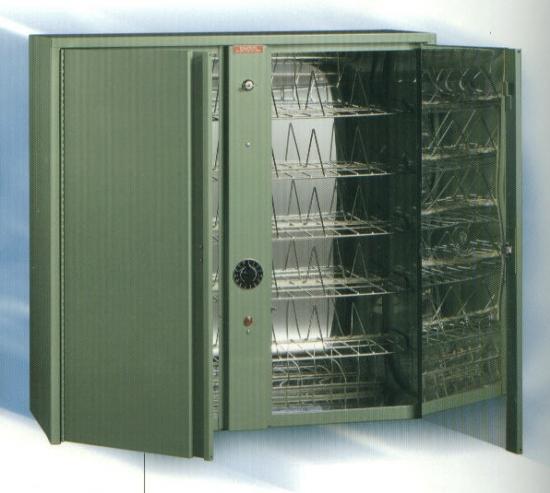
1.) UV sterilization system but most UV sterilizers are only small capacity and usually used for laboratory safety goggles.

2.) A commercial washer that uses a special disinfectant detergent.

Both take about 1 hour and some man power to load and unload the glasses.

 UV sterilizer

Projectors & Filter Wheels.

Both systems use synchronized wheels in front of a digital projector.

In the Dolby system they provide now is a sealed Barco SUPERKONTRAST projector system with the filter wheel inside. The Theater operators can not open it and if they do an Alarm system prevents the projector from running till a technician comes out and resets it.

Dolby 3D filter wheel


JDSU is the world's largest producer of optical coatings, developed the 3D filter wheel technology for use in an exclusive partnership deal with Dolby.

I just can't tell you how cool this technology is. Some of the most impressive optical interference filters to split the RGB into and upper and lower spectrum for each eye. 


Master Image also has a rotating wheel system, with alternating Clockwise and Counterclockwise circular polarizers.

I see is both of these as some sort of throwback to the film days with all the the clockwork and moving parts.


The Real D system uses "Z Screen" basically an electronic polarizing filter but for the most part is 100% compatible with the Master Image system.


Summary


$38 Glasses, expensive to clean
Uses existing screens
Special Projector, cost unknown.
Needs special digital cinema server.


Glasses almost disposable. They are recycled, meaning washed and repackaged.
Needs special screen at 2x the cost.
Can use any standard projector and digital cinema server.


Glasses almost disposable. They are recycled, meaning washed and repackaged.
Needs special screen at 2x the cost.
Can use any standard projector and digital cinema server.


$50+ Glasses, expensive & difficult to clean, (can't get electronics wet),
The glasses are also prone to malfunction, with batteries dying, contact failing etc.
Uses existing screens
Can use any standard projector and digital cinema server.


OPINION

It's my opinion that even though the Dolby system is superior, the circular polarized systems will win, the glasses are lighter, cheaper and disposable. (really important with small kids)

I think in the end they will also win the battle on the HDTV front also for this very same reason.


More Reading:

I explain in some depth how the Dolby system work here.
Dolby 3D Digital Cinema
MasterImage site
Chinese source for Circular Polarized glasses

Eye Wear

Through the 3D looking glass

http://www.avsforum.com/avs-vb/showthread.php?t=953978&page=5


http://www.reald.com/

3D projection in cinemas

Digital 3D-Systems

American Paper Optics

Dolby 3D Glasses Training Video