Showing posts with label laser. Show all posts

Saturday, December 31, 2011

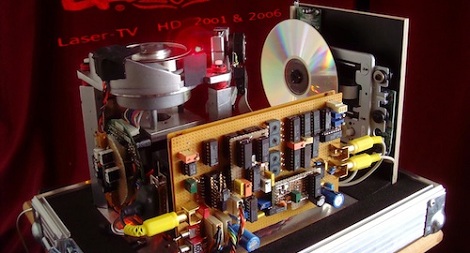
Full color laser TV

http://www.laser-tv.eu/    In English

From Hack-a-Day:
Full color laser TV
posted Dec 31st 2011 9:05am by 
filed under: laser hacks
Back in 2001, [Helmar] made an awesome monochrome video display out of a red laser pointer and a spinning 18-sided mirror. Blue and green lasers are much less expensive than they were a decade ago, so [Helmar] decided to go full color with his laser projector. (In German, so fire up Chrome or get the Google translation)
The ancient website for [Helmar]‘s green-only projector goes over the principles of operation. A single laser shines onto a multi-faceted polygonal mirror. This is reflected onto another mirror that provides the reflection for each line in a frame of video. Earlier this year, [Helmar] hacked up a red and blue laser to complement the preexisting green laser. The end result is an RGB projector powered by friggin’ lasers.
As far as we can tell, the projector only has composite input; the attached DVD player provides all the signaling for that. Amazingly, [Helmar] didn’t use a microcontroller for the circuitry. All the electronics are simple logic gates. Really amazing if you ask us.

Monday, November 07, 2011

Mixed-Reality 3D Volumetric Projector - Slashdot

http://hardware.slashdot.org/story/11/11/06/2137257/mixed-reality-3d-volumetric-projector

"We are describing and demonstrating a 3D Volumetric Projector (YouTube video); in short words: a device that enables mixed reality. The 3D projector has very poor quality, we just have 10 rotational voxels (as we are using only 10 regular LCD projectors), but is proof of concept for developing a commercial solution."


http://volumetricprojection.blogspot.com/

Monday, August 22, 2011

Coming Soon: Superman’s Memory Crystals

http://www.wired.com/geekdad/2011/08/coming-soon-supermans-memory-crystals

One of the critical elements of the Superman mythos is the tacit information transfer from Jor-El to his son, despite the former having been blown to smithereens on Krypton years earlier. In the 1978 movie, the technology used is a memory crystal containing an artificial intelligence version of the late Jor-El acting as a guide to the sum of Kryptonian knowledge about the universe.
While the self-replicating properties of these crystals are still an unknown, real-life scientists are trying to unlock the data storage capabilities of glass. The process has resulted in a storage capacity of 50 GB (the equivalent of a Blu-ray Disc) on a slice of glass about the size of a mobile phone screen.

Researchers from Optoelectronics Research Centre at Southampton University have developed a technique for computer memory using lasers and glass. This glass memory, they claim, is more stable than current storage techniques for hard drive memory, offering higher resistance to temperature, moisture and time. It is also about 20 times cheaper than current techniques.
The technique uses a silver dollar-sized circle of glass as an Optical Vortex Converter to create whirlpools of polarized light. A laser cuts tiny dots — 3D pixels, or voxels — into the surface, changing the opacity of the glass and giving optical detectors something to read. Data can be written and re-written into the molecular structure of the glass, a durable material that can withstand temperatures of 1800 degrees (F). The academic paper published in Applied Physics Letters is available online (PDF).
The ORC scientists who developed the technique and published their research are working with Altechna to bring the tech to market. As vortex drives work their way toward shelves at Best Buy, companies and institutions with large archives (like museums) can dream about eliminating the data protection cycles that force replacements of hard drives every 5-10 years.
I’m suddenly picturing my drawers of old Zip drives and CDs being replaced by a penholder filled with thin data rods containing all of our family photos, videos and media collection. When that happens, some company better make a memory crystal that glows green automatically when my child comes of age.
Wednesday, January 13, 2010

Forget LCDs and LEDs, Here Come LPDs

From Slashdot:
"It's not every day you hear about a brand new display technology, but San Jose, CA-based Prysm came out of stealth mode yesterday to talk about its plans for manufacturing laser phosphor displays, or LPDs. The new devices, which the company will show off at the Integrated Systems Europe trade show in Amsterdam next month, reportedly use 25 percent as much electricity as equivalently-sized LCD screens. And they should be easier to manufacture too, since they don't have a backplane of transistors like LCD screens: the image is generated by a laser beam that sweeps across phosphor stripes under the control of a scanning mirror. The venture-funded startup, which plans to build and sell LPD screens under its own brand, is promoting them as a low-cost, low-maintenance way to display information in lobbies, airports, broadcast studios, command centers, and the like."


Friday, October 23, 2009

Aj the laser show guy on the worlds largest HD TV Screen.


 Aj Seabeck of Stellar Designs on the worlds largest HDTV Screen at Dallas Cowboys stadium.

He's on tour with the StarWars in Concert series and the show's come to Dallas.  Such a long way from such beginnings as the A/V nerd of Clifton Senior High school.
The massive display weighs 600 tons, is 180 feet long and 72 feet tall. It's made of 10.5 million LEDs.  13000 square feet display was installed back in May of 2009.


Monday, September 21, 2009

Anti-Photo Shield

Russian Billionaire Installs Anti-Photo Shield on Giant Yacht [Wired]
Roman Abramovich zaps snappers with laser shield [Times]
Celebrity Photographer ‘Laser Shield’ - Is It Legal? [Amateur Photographer]


Sounds good, not too sure how well it will work in practice.

What I did find that works was ultra high powered IR LED's.
Cameras either white out, or AGC kicks in and your face is blacked out.

Another interesting this is people have to avert there eyes from looking directly at you, but can not see IR and don't become consciously aware that they are avoiding looking at you.

Staring directly at one of these high power IR sources is like looking in to the sun, your eyes bug out and you eventually are force to look away. I suppose you cold go blind if you insist on staring. I'd be these would work fantastic on a ship.

As for the article, it mentions.
[Wired]
Lasers sweep the surroundings and when they detect a CCD, they fire a bolt of light right at the camera to obliterate any photograph.

[Times]
Infrared lasers detect the electronic light sensors in nearby cameras, known as charge-coupled devices. When the system detects such a device, it fires a focused beam of light at the camera, disrupting its ability to record a digital image.
The beams can also be activated manually by security guards if they spot a photographer loitering.

Well I don't see how there is any way to detect a CCD or these days CMOS image sensors. I guess there could be a bit of a "red eye" effect, but then it would also detect when humans looks as well.

And secondly firing a laser while the camera's shutter is not open will do nothing to the film or in the case of a digital image the flash. But if the camera operator was using a reflex lens, you'd probably blow the the retina out of the back of his eye leaving them permanently blind.

In addition lasers only operate on a few select frequencies and there are already some excellent interference filters that can block just those narrow bands, so if you know what laser is being used, just place a $500 filter over the camera for that filter and you'd be able to keep snapping away completely uneffected.


UPDATE: I learned about another article that made some good points. 9/22/2009
How to ZAP a Camera: Using Lasers to Temporarily Neutralize Camera Sensors by Michael Naimar
A Google search of "anti paparazzi device" yielded two hits, both about near-identical devices called "Eagle Eye" and "Backflash" (and both unfindable as actual products). These devices apparently couple a light sensor to a flash unit: when a flash of light is detected, the devices instantaneously flash back. They're both small, made to be worn, and claim to obscure a portion of the photographic image near them whenever a flash is used (ostensibly as protection against intruding photographers). If these devices work, they obviously would only work for still, flash photography.
Antisensor lasers are capable of scanning a region looking for "glints" of reflected light coming from lenses aimed at them, then switching to a high energy laser capable of overloading or destroying the sensor (or whatever) behind the lens. The U.S. developed such a system called the Stingray and deployed two tank-based prototypes in Saudi Arabia during the Gulf War (they allegedly were not used). The Stingray's range of operation is claimed to be several kilometers. It's not clear if (or how) the Stingray could discriminate between lenses and eyeballs, or between sensors behind a lens and human eyeballs behind a lens.
 Maybe I was wrong I don't think you can destroy one, but I can see how a little image processing could detect a telephoto lens from an eyeball then shine a low power laser ~5mw at that camera and without any sort of filtering would ruin any photographs that they try to take, basically washing out the image with bright red or green, even blue as desired. But anything that could damage the roll of film or camera would also injure the photographer. 


If anyone need help defeating this give me drop me a line.