Several technologies are required for VR's holy grail: the fabled holodeck. We already have graphical VR experiences that let us move throughout volumentric spaces, such as video games. And we have photorealistic media that lets us look around a 360 plane from a fixed position (a.k.a. head tracking).
But what about the best of both worlds?
We're talking volumetric spaces in which you can move around, but are also photorealistic. In addition to things like positional tracking and lots of processing horsepower, the heart of this vision is lightfields. They define how photons hit our eyes and render what we see.
Because it's a challenge to capture photorealistic imagery from every possible angle in a given space -- as our eyes do in real reality -- the art of lightfields in VR involves extrapolating many vantage points, once a fixed point is captured. And that requires clever algorithms, processing, and whole lot of data.
Image copyrightFEDERICO CAPASSOImage captionThis electron microscope image shows the structure of the lens (white line is 0.002mm long)
A flat lens made of paint whitener on a sliver of glass could revolutionise optics, according to its US inventors.
Just 2mm across and finer than a human hair, the tiny device can magnify nanoscale objects and gives a sharper focus than top-end microscope lenses.
It is the latest example of the power of metamaterials, whose novel properties emerge from their structure.
Shapes on the surface of this lens are smaller than the wavelength of light involved: a thousandth of a millimetre.
"In my opinion, this technology will be game-changing," said Federico Capasso of Harvard University, the senior author of a report on the new lens which appears in the journal Science.
The lens is quite unlike the curved disks of glass familiar from cameras and binoculars. Instead, it is made of a thin layer of transparent quartz coated in millions of tiny pillars, each just tens of nanometres across and hundreds high.
Singly, each pillar interacts strongly with light. Their combined effect is to slice up a light beam and remould it as the rays pass through the array (see video below).
Media captionLight passing through the "metalens" is focussed by the array of nanostructures on its surface (video: Capasso Lab/Harvard)
Computer calculations are needed to find the exact pattern which will replicate the focussing effect of a conventional lens.
The advantage, Prof Capasso said, is that these "metalenses" avoid shortfalls - called aberrations - that are inherent in traditional glass optics.
"The quality of our images is actually better than with a state-of-the-art objective lens. I think it is no exaggeration to say that this is potentially revolutionary."
Those comparisons were made against top-end lenses used in research microscopes, designed to achieve absolute maximum magnification. The focal spot of the flat lens was typically 30% sharper than its competition, meaning that in a lab setting, finer details can be revealed.
But the technology could be revolutionary for another reason, Prof Capasso maintains.
"The conventional fabrication of shaped lenses depends on moulding and essentially goes back to 19th Century technology.
"But our lenses, being planar, can be fabricated in the same foundries that make computer chips. So all of a sudden the factories that make integrated circuits can make our lenses."
And with ease. Electronics manufacturers making microprocessors and memory chips routinely craft components far smaller than the pillars in the flat lenses. Yet a memory chip containing billions of components may cost just a few pounds.
Image copyrightFEDERICO CAPASSOImage captionThe lens is much more compact than a traditional microscope objective
Mass production is the key to managing costs, which is why Prof Capasso sees cell-phone cameras as an obvious target. Most of their other components, including the camera's detector, are already made with chip technology. Extending that to include the lens would be natural, he argues.
There are many other potential uses: mass-produced cameras for quality control in factories, light-weight optics for virtual-reality headsets, even contact lenses. "We can make these on soft materials," Prof Capasso assured the BBC.
The prototypes lenses are 2mm across, but only because of the limitations of the Harvard manufacturing equipment. In principle, the method could scale to any size, Prof Capasso said.
"Once you have the foundry - you want a 12-inch lens? Feel free, you can make a 12-inch lens. There's no limit."
The precise character of the lens depends on the layout and composition of the pillars. Paint-whitener - titanium dioxide - is used to make the pillars, because it is transparent and interacts strongly with visible light. It is also cheap.
Image copyrightPETER ALLEN/HARVARDImage captionThe minuscule pillars have a powerful effect on light passing through
The team has previously worked with silicon, which functions well in the infrared. Other materials could be used to make ultraviolet lenses.
Or to get a different focus, engineers could change the size, spacing and orientation of the pillars. It simply means doing the computer calculations and dialling the results into the new design.
The team is already working on beating the performance of its first prototypes. Watch this space, they say - if possible, with a pair of metalenses.
Rambus publishes a Youtube video with Patrick Gill showing the company's lensless camera operation:
Dr. Patrick Gill demonstrates a diffraction-based lensless imaging system
Meanwhile, it appears that Rambus somewhat downplays its image sensor
activities in its recent investor presentations. For example, in the Nov. 2014 presentation, imaging appears in only one slide #29:
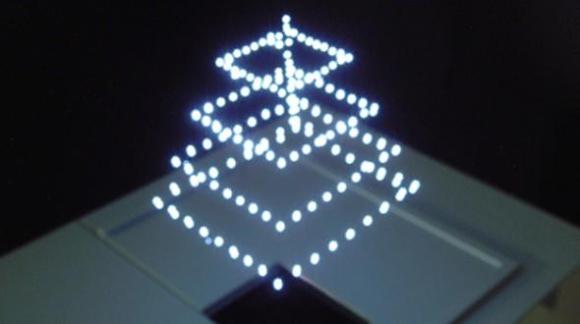
There’s a new display technique that’s making the blog rounds, and like anything that seems like its torn from [George Lucas]‘ cutting room floor, it’s getting a lot of attention. It’s a device that can display voxels in midair, forming low-resolution three-dimensional patterns without any screen, any fog machine, or any reflective medium. It’s really the closest thing to the projectors in a holodeck we’ve seen yet, leading a few people to ask how it’s done.
This isn’t the first time we’ve seen something like this. A few years ago. a similar 3D display technology was demonstrated that used a green laser to display tens of thousands of voxels in a display medium. The same company used this technology to draw white voxels in air, without a smoke machine or anything else for the laser beam to reflect off of. We couldn’t grasp how this worked at the time, but with a little bit of research we can find the relevant documentation.
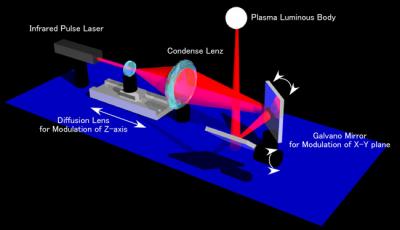
A system like this was first published in 2006, built upon earlier work that only displayed pixels on a 2D plane. The device worked by taking an infrared Nd:YAG laser, and focusing the beam to an extremely small point. At that point, the atmosphere heats up enough to turn into plasma and turns into a bright, if temporary, point of light. With the laser pulsing several hundred times a second, a picture can be built up with these small plasma bursts.
Moving a ball of plasma around in 2D space is rather easy; all you need are a few mirrors. To get a third dimension to projected 3D images, a lens mounted on a linear rail moves back and forth changing the focal length of the optics setup. It’s an extremely impressive optical setup, but simple enough to get the jist of.
Having a device that projects images with balls of plasma leads to another question: how safe is this thing? There’s no mention of how powerful the laser used in this device is, but in every picture of this projector, people are wearing goggles. In the videos – one is available below – there is something that is obviously missing once you notice it: sound. This projector is creating tiny balls of expanding air hundreds of times per second. We don’t know what it sounds like – or if you can hear it at all – but a constant buzz would limit its application as an advertising medium.
As with any state-of-the-art project where we kinda know how it works, there’s a good chance someone with experience in optics could put something like this together. A normal green laser pointer in a water medium would be much safer than an IR YAG laser, but other than that the door is wide open for a replication of this project.

 FEDERICO CAPASSO
 FEDERICO CAPASSO
 PETER ALLEN/HARVARD