Sunday, July 10, 2011

Panasonic encourage purchase intent with Facebook Black Friday deals

http://wave.wavemetrix.com/content/panasonic-encourage-purchase-intent-facebook-black-friday-deals-00657


Consumers discuss the products they “want” and those they “love” and “already have”: People say Panasonic make “great products” and mention a wide variety of products that they “love” such as TVs, cameras, projectors, blu-ray players, camcorders, clippers and turntables. For example, they praise the Lumix FS33 camera with touchscreen that is “the best of 2010” and say the DMP-BD85 Blu-ray player has “the best picture quality”. However, some consumers complain about “durability”, “bugs” and “technical problems” with products such as “flickering” and “floating blacks” on the G20, “slow data transmission” on the Lumix FS33 and “screen issues” on the Viera 50” plasma TV


Panasonic social media is successful at prompting consumers to consider purchase: One in three consumers say they are “interested in the Black Friday deals” or “can’t wait” to buy a product such as the “new Lumix GH2”, “awesome” 3D camcorder or “3D Plasma”

Saturday, July 09, 2011

Bitbop - Watch TV on Your Phone

http://offers.bitbop.com/go/signup?pid=137&gclid=CKLF_cr18qkCFQFUgwodWCxKvw

Mini USB display. Shows up as monitor in windows.

ChibiMo – an AVR-based USB display


ChibiMo is a DIY PC monitor display that is based on popular dot matrix LCD and AVR or Arduino. The device works as a secondary (or thirdly, fourthly, ...) monitor for an Windows PC, so almost anything that shows up on a PC display will also show up on ChibiMo.
ChibiMo can be built either with a DIY hardware with an AVR microcontroller or an Arduino board. The Arduino-based model is designed to be very easy to build so that everyone who can do a little bit of soldering can build it.


http://hackaday.com/2011/07/08/chibimo-an-avr-based-usb-display/

http://q61.org/en/chibimo/

Sony Announces End For MiniDisc Walkman - Slashdot

http://news.slashdot.org/story/11/07/09/150211/Sony-Announces-End-For-MiniDisc-Walkman

Really? I didn't know these thing made it past the 90's. 

Motorola’s Latest Phone Comes as No Friend to Hackers | Gadget Lab | Wired.com

http://m.wired.com/gadgetlab/2011/07/motorola-droid-3-hack

I want to write on this subject more,  because it's requirements being pushed by content providers such as Netflix that's forcing hardware vendors to close there platforms to modding.

" In today's smartphone landscape, handset manufacturers face pressure from wireless carriers like Verizon and AT&T to lock down phone boot loaders. This is done especially to prohibit the potential installation of software used to do things that carriers don't want you doing, like, say, capture licensed streaming content."

Friday, July 08, 2011

Online Video Editors and Video Creation tools.

From http://www.youtube.com/create


Create Videos


One True Media

One True Media, simply powerful video creation. Robust, fast and easy video editing. Combine and clip video and photos. Edit as little or as much as you want with professio... by SpotMixer

GoAnimate

GoAnimate is a fun app that lets you make animated videos, for free, in just 10 minutes, without having to draw. You can even create your own cast of characters. There ar... by GoAnimate

Stupeflix Video Maker

Tell a story with your digital content. Mix pictures, videos, maps, text, music and watch Stupeflix produce a stunning video in a few seconds. It's fast, easy, and free to ... by stupeflix

Xtranormal Movie Maker

Xtranormal lets you to turn anything you type into a fully-animated CG movie. Set up your scene, type in your script, and animate it instantly. Easily share something funny... by Xtranormal

YouTube Partnership Program: Agreement - AKA, signing your life away.

Why must this alway be a painful process.  Here is the agreement you just sign off on to do revinue sharing on Youtube.

I don't know about you, but I do think it's possible for someone with a law degree to fully understand this in a week let alone just a smart computer guy in a few minutes or an hour.

I wonder if reposting this is a copyright violation?

John


VIDEO MONETIZATION AGREEMENT
 
 
This Video Monetization Agreement (“Agreement”) between you (“Provider”) and Google Inc., a Delaware corporation, and its affiliates (“Google”) is entered into as of the date this Agreement is electronically accepted by you (the “Agreement Effective Date”).
 
  1. 1. DEFINITIONS
 
“Ad Revenues” means recognized revenues from ads provided by Google or an approved third party and displayed or streamed in or on the YouTube Video Player and on Playback Pages with the streaming of a Monetized Video.
“Google Services” means the YouTube Website and other Google websites, products and services.
“Monetized Video” means the audiovisual content and related metadata and materials uploaded to the YouTube Website by Provider, in connection with which advertising may be associated, in Google’s sole discretion, pursuant to this Agreement.
“Playback Pages” means pages on the YouTube Website that stream at no cost to the end user the selected Monetized Video and display associated ads.
“YouTube Video Player” means the media player that streams at no cost to the end user the selected Monetized Video and displays any associated advertising. 
“YouTube Website” means the Google Service known as YouTube located at http://www.youtube.com, including replacements or successor versions and international versions.
 
2.            LICENSES
 
2.1              Monetized Video.  Provider grants to Google a non-exclusive, limited right and license to host, cache, route, transmit, store, copy, distribute, perform, display, reformat, excerpt, analyze, and otherwise use the Monetized Video on the Google Services to: (a) host the Monetized Video on Google’s servers; (b) index the Monetized Video; (c) display, perform, and distribute the Monetized Video on Google Services; and (d) make continuing improvements to Google Services. The foregoing includes all necessary licenses to use any compositions and sound recordings of any music included in the Monetized Video in order to host, index, display, perform, synchronize, and distribute the Monetized Video (except for the necessary rights and permissions for the public performance in the United States of any musical compositions embodied in the Monetized Video), and the right to modify the Monetized Video to the extent technically necessary to index and display the Monetized Video.  Provider understands and agrees that Google Services incorporating the Monetized Video may be syndicated to Google’s affiliates and syndication partners. 
             
2.2              Brand Features License.  Provider grants to Google a non-exclusive, limited, worldwide, royalty-free license to use any trademarks, trade names, domain names, designs, and logos (“Brand Features”) furnished by Provider in connection with the Monetized Video to fulfill Google’s obligations under this Agreement and to include in partner lists and presentations.
             
3.              OBLIGATIONS
 
3.1              Delivery, Hosting, Serving, Storage, Territorial Limitations. Provider’s delivery of the Monetized Video and associated metadata will be in accordance with specifications provided by Google. Subject to Google’s hosting policies and terms, Google will host, store, and serve the Monetized Video on the YouTube Website, through the YouTube Video Player, and via other Google Services. Google may create or enable Provider to create, using Google templates, a Provider channel on the YouTube Website that prominently displays: (a) the Monetized Video; (b) certain Brand Features of Provider; and (c) such additional content of Provider as may otherwise be furnished to Google pursuant to Provider’s prior or subsequent agreement(s) therewith (specifically including the YouTube Terms of Service) (the “Additional Provider Content”). Provider will specify in a metadata feed or other Google interface any territorial limitations for streaming the Monetized Video, and may set other limitations on distribution and display via Google Services other than the YouTube Website. Provider will not include any promotions, sponsorships, or other advertisements as part of the Monetized Video. If any such ads are included as part of the Monetized Video, Google may elect not to serve advertisements that would be subject to the revenue share in Section 4.1 or may remove the Monetized Video from display. The Monetized Video may not be comprised substantially of third party materials unless Provider is the exclusive licensee of online distribution rights for the underlying material. If a third party provides Google with a claim of ownership of any material contained within the Monetized Video, then: (x) the Monetized Video may be blocked from the YouTube Website and the YouTube Video Player; (y) payments accruing to Provider pursuant to Section 4 may be suspended or cancelled; and (z) if Provider disputes the third party claim, Provider will participate in a procedure to resolve the dispute.
 
3.2              No Alteration. Once a Monetized Video has been approved for delivery of advertising in connection therewith, Provider agrees not to alter in any way the content of such Monetized Video for the duration of the Term. Any alteration of any approved Monetized Video will be deemed a breach of this Agreement and may result in termination and non-payment of Ad Revenues.
 
3.3              Removal.  If Provider notifies Google or Google determines that its use of the Monetized Video may create liability for Google or harm the integrity of Google’s servers or the Google Services, Google may stop displaying the Monetized Video.  Provider may remove the Monetized Video through methods made available by Google. If the Monetized Video continues appearing on Google Services more than 48 hours after Provider has successfully initiated removal, Provider will notify Google of the URL by sending an email to partner-takedownrequest@youtube.com or other addresses Google may designate.
 
4.              ADVERTISING
4.1          Sales, Payments, Reports.   Provider will receive 55% of Ad Revenues recognized by Google.   Recognized revenues do not include items listed in Section 4.4 or taxes. Payments will be furnished to Provider within approximately sixty (60) days after the end of any calendar month, provided that Provider’s earned balance is $100 or more in the aggregate. When Provider’s monthly earned balance is less than $100, there will be no payment and the balance will accumulate until it exceeds $100, at which time it will be paid to Provider in accordance with the preceding sentence. If this Agreement is terminated, Google will pay Provider’s earned balance within approximately 90 days after the end of the calendar month of termination, with no payment obligation if the earned balance is less than $10. Payments shall be made by check or wire transfer pursuant to instructions provided by Provider. Google retains all other revenues from Google Services.  Advertising statistics compiled by Google will be the official data for calculating Ad Revenues hereunder. Within 60 days after each calendar month, Provider will be furnished with a report stating the amount of Ad Revenues for the month and the amount owed Provider, if any.
 
4.2    Payment Processing Account. Unless otherwise directed by Google, in order to facilitate the processing of Ad Revenue payments, if any, Provider will maintain an AdSense account for the duration of the Term and provide the associated account information to Google simultaneously with the execution of this Agreement. In the event Provider does not currently have an AdSense account, Provider will create such an account using tools provided by Google in connection with this Agreement. For the avoidance of doubt, no Ad Revenue payments will be furnished to Provider unless and until such AdSense account has been created and such account information has been furnished to Google.
 
4.3        Taxes.  All payments made in connection with this Agreement are exclusive of taxes imposed by governmental entities of whatever kind and imposed with respect to the transactions for services provided under this Agreement. Google will be responsible for any taxes relating to payments it makes under this Agreement other than taxes based on Provider's income.  If Google is required to deduct or withhold taxes from any payments made to Provider and remits such taxes to the local taxing jurisdiction, then Google will duly withhold and remit such taxes and will pay to Provider the remaining net amount after the taxes have been withheld.
 
4.4        Non-Qualifying Ads.  Google is not required to make payments based on: (a) invalid queries or clicks originating from Provider’s IP addresses or computers or solicited by Provider for the purpose of generating revenues; (b) ads delivered to browsers with JavaScript disabled; (c) ads for charities or transparent (empty) ads; (d) advertisements for Google Services; (e) clicks co-mingled with a significant number of invalid clicks; or (f) breach of this Agreement by Provider. Google may withhold payment or charge back Provider for the foregoing, or any breach of this Agreement by Provider, pending Google’s reasonable investigation. Provider will cooperate with Google in any investigation. Provider will not, and will not authorize or encourage any third party to generate invalid or fraudulent clicks, queries, or impressions.
 
5              CONFIDENTIALITY.  Neither party will disclose the terms of this Agreement to any third party, or issue any public announcement regarding the terms of this Agreement, without the other party’s prior written agreement.  The parties will not disclose to any third parties nonpublic information disclosed by one party to the other under this Agreement, and will protect such information applying the same degree of care used by the parties to protect their own confidential information.  If this Agreement or any confidential information of either party is required to be produced by law, the noticed party will promptly notify the other party and cooperate to obtain an appropriate protective order prior to disclosing any confidential information.
 
6.              REPRESENTATIONS AND WARRANTIES; INDEMNIFICATION.  Each party represents and warrants that it has authority to enter into the Agreement. Provider represents and warrants that it has all necessary rights to grant the licenses set forth in Section 2.  Each party will indemnify, defend and hold harmless the other and their directors, officers, employees, and agents from third party claims arising from or related to a breach of such party’s representations and warranties. Provider will indemnify, defend and hold harmless Google and its directors, officers, employees, and agents from third party claims arising from or related to Google’s authorized use of the Monetized Video, the Provider Brand Features, or any other materials furnished by Provider to Google under this Agreement.
 
7.               DISCLAIMERS, LIMITATIONS OF LIABILITY.  Except for the express warranties made by the parties in Section 6, the parties disclaim all warranties, express or implied, including any implied warranty of merchantability or fitness for a particular purpose. Except for the indemnities in Section 6: (a) neither party will be liable to the other for indirect, consequential, special, punitive or exemplary damages or penalties arising from or related to this Agreement; and (b) neither party’s aggregate liability for any cause of action arising from or related to this Agreement will exceed $50,000.
     
8.               TERM, TERMINATION.  Unless earlier terminated by Google (which may occur in its sole discretion), the term of this Agreement (“Term”) will continue in perpetuity until such time as Provider removes the Monetized Video from display on the YouTube Website or otherwise advises Google in writing that it no longer wishes to have advertising served in connection with same. In the event Google’s termination of this Agreement also requires the removal by Google of the Monetized Video itself from display on the YouTube Website, Google will provide notice of same to Provider, generally within five (5) business days of such removal. All licenses granted in this Agreement will expire upon termination. Sections 1, 5, 6, 7, 8 and 9 survive termination.
 
9.               MISCELLANEOUS.  The parties are independent contractors, and nothing in this Agreement creates an agency, partnership, or joint venture. Neither party may assign this Agreement to any third party, except to its parent company or any majority owned subsidiaries, without the prior written consent of the other. This Agreement sets forth the entire agreement between the parties and supersedes any prior or contemporaneous written or oral agreements regarding its subject matter. The terms of this Agreement relate solely to the Monetized Video and do not apply to any Additional Provider Content (inclusive of any other Provider videos monetized under separate agreement). This Agreement may be amended only in a writing signed by both parties.  Failure to enforce any provision of this Agreement will not be deemed a waiver. Any notices hereunder will be delivered in writing, to the address of record of the receiving party. If any provision of this Agreement conflicts with applicable laws or is adjudications, that provision will be deemed eliminated from the Agreement and the Agreement will remain in effect so long as the essential purpose can still be achieved.  This Agreement is governed by the laws of the State of California (excluding its choice of law rules) and applicable federal laws.  Any litigation hereunder will be brought exclusively in any state or federal court of competent jurisdiction in Santa Clara County, California; each party consents to venue and exclusive personal jurisdiction of such courts. This Agreement may be executed in one or more counterparts, each of which will be deemed an original and all of which, when taken together, will constitute a single instrument.
 
 
By clicking the “I Accept” button below, Provider accepts this Agreement on behalf of itself or such other person or entity for whom it serves as an authorized representative, and agrees to bound by all of its terms and conditions.
 
November 13, 2007 v1.0


YouTube Partnership Program: Video Submission Complete

Your video has been submitted for revenue sharing consideration. If it is approved, you will start to see ads displayed next to your video. Processing your video can take up to 2 weeks, so please be patient!
Thanks again for entering your video into the YouTube Partnership Program!


S3 Graphics, HTC, VIA, WTI, Chip | HTC to buy graphics chip firm S3

http://eetimes.com/electronics-news/4217595/HTC-to-buy-graphics-chip-firm-S3?cid=NL_EETimesDaily

Smart TVs, Report | Report: 'Smart' TVs coming sooner than later

http://www.eetimes.com/electronics-news/4217561/-Report-Smart--TVs-coming-sooner-than-later?cid=NL_EETimesDaily

PowerFilm, flexible, military, display, rollable, roll-to-roll | Solar firm demos flexible military display tech

http://www.eetimes.com/electronics-news/4217530/PowerFilm-flexible-military-display?cid=NL_EETimesDaily

Thursday, July 07, 2011

Play dress up with Kinect

This is very similar to the Virtual Fashion Show I posted about an few months back.


Wait till someone combines a Kinect with a Projector, they you can wear white cloths and have a pattern projected against it.


"Now imagine adding 3D position data using something like the Microsoft Kinect , and you could do real time video mapping on to a live person."  - John Sokol

From Hack-A-Day : Play dress up with Kinect

While we have seen Kinect-based virtual dressing rooms before, the team at Arbuzz is taking a slightly different approach (Translation) to the digital dress up game. Rather than using flat images of clothes superimposed on the subject’s body, their solution uses full 3D models of the clothing to achieve the desired effect. This method allows them to create a more true to life experience, where the clothing follows the subject around, flowing naturally with the user’s movements.
Like many other Kinect hacks, they use openNI and NITE to obtain skeletal data from the sensor. The application itself was written in C# with Microsoft’s XNA game development tools, and uses a special physics engine to render the simulated cloth in a realistic fashion
[Lukasz] says that the system is still in its infancy, and will require plenty of work before they are completely happy with the results. From where we’re sitting, the demo video embedded below is pretty neat, even if it is a bit rough around the edges. We were particularly pleased to see the Xbox’s native Kinect interface put to work in a DIY project, and we are quite interested to see how things look once they put the final touches on it.

Media Companies Create Copyright Enforcement Framework

From Slashdot : Media Companies Create Copyright Enforcement Framework

"American Internet users, get ready for three strikes^W^W 'six strikes.' Major US Internet providers — including AT&T, Verizon, Comcast, Cablevision, and Time Warner Cable — have just signed on to a voluntary agreement with the movie and music businesses to crack down on online copyright infringers. But they will protect subscriber privacy and they won't filter or monitor their own networks for infringement. And after the sixth 'strike,' you won't necessarily be 'out.'" 

It's not suspicious at all that most of the ISPs signing on for this are owned by or own media companies.

Infrared control for appliances

From Hack-A-Day Infrared control for appliances


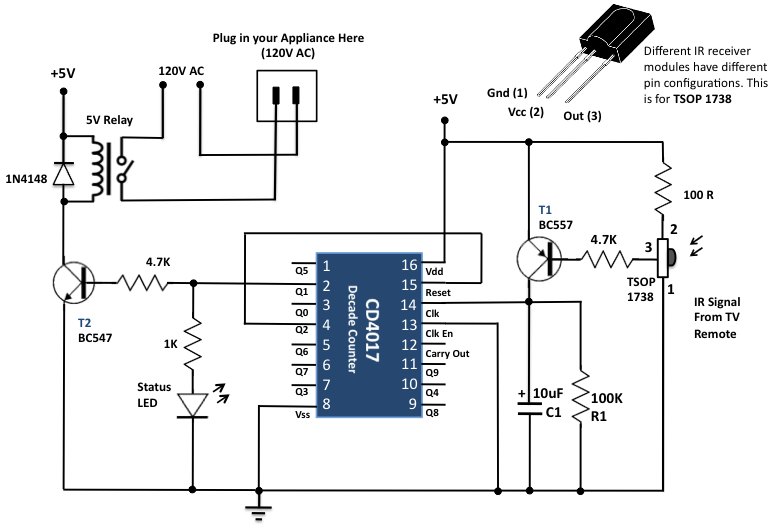
[RB] at Embedded Lab sent in a great guide on how to control appliances with a remote control using a really clever implementation of a decade counter and IR receiver.
The build itself is very simple – just a relay connected to mains power and a handful of resistors and transistors. The device is controlled with a decade counter and an infrared module usually found tucked away in the bezel of a TV.
When everything is plugged in, the first pulse from the remote switches the relay on, providing power to the outlet. When a second pulse is received, the reset pin on the decade counter is activated, setting the device back to its original off state. It’s a pretty clever build, and could be built with parts lying around the bench.
The project is powered through wall power with the help of a transformer and a 7805 regulator, but we think the size could be reduced with a pass-through power enclosure – the circuit certainly is small enough. In all, a very nice, low component count build.

Mixed Signals: Majority Not Ready For Internet-Connected TV

From MediaPost

Consumers may be as indifferent to Internet-connected TVs as they are about 3D TVs.

A new study suggests a majority of consumers, 62%, "are not connected or not capable" and "most plan to stay that way," according to Knowledge Networks.

But those who are connected or fervent fans plan to dig deeper into new technology -- 21% of those capable plan to connect to a digital capable device next year. 8% of those who are not capable plan to get a connected device in the next year.

Of those already connected, Knowledge Networks says, two-thirds believe the quality of connected TVs are about the same, or better, than their regular TV reception. One-quarter of those cite watching TV shows through connected devices as their No. 1 choice.

But connected-TV viewers still have a yearning for old TV ways. Knowledge Networks say watching TV shows at their regular time is still their preference among all viewers.

As has been determined from other surveys, consumers of connected TV tend to be younger, better-educated, higher-income, heavy-technology users, as well as owning a diverse number of technologies/devices.

When using Internet-connected TVs, 10% of those consumers 13-64 watch TV programs; 11% watch movies (at least monthly) using a streaming service through a TV set. This increases to 17% to 18% among young viewers 13-31.

While video is most popular for connected TVs, search and Facebook are most frequently used Internet services. News services rank lower but still have good usage levels.

Video Analytics

Ran Into another interesting blog. 

http://videoanalytics.blogspot.com/

Video Analytics is a technology that is used to analyze video for specific data, behavior, objects or attitude. It has a wide range of applications including safety and security.

Film, television groups band together to fight piracy

Major film and television industry companies have joined to form Creative America, a collaboration designed to combat copyright theft. The group's website, CreativeAmerica.org, offers information about piracy and provides legislative contacts. "When the movies and TV shows that we create and finance are stolen, there is a ripple effect throughout our business," said director Jonathan Mostow.

Home Media Magazine: Content Protection Goes Grassroots

Google, Microsoft are among potential Hulu buyers

Talks have begun with potential buyers of Hulu, and Walt Disney CEO Robert Iger says the site's current owners are "committed to selling." The company, which is on course to reach more than 1 million users faster than initially predicted, could go for more than $2 billion. If Hulu is sold, its current owners, which include Disney, Comcast's NBCUniversal and News Corp., would continue to supply content for the site, but it is not clear for how long.

Bloomberg: Disney’s Iger Says Hulu’s Owners Are ‘Committed to Selling’   

The Wall Street Journal (tiered subscription model)

Reuters:  Hulu to hit 1 million paid users by summer's end

Panasonic opening up Viera Connect TV service to developers

From Hollywood reporter
Cloud-based IPTV applications to be available on Viera HD TV sets

TOKYO – Panasonic is opening up its Viera Connect cloud-based TV service for developers to create IPTV applications for the worldwide platform outside Japan.

“Because of the popularity of Actvila in Japan [the country’s leading IPTV portal, launched in 2007], the Viera Connect platform isn’t being released in the domestic market,” a Panasonic spokesperson told The Hollywood Reporter.

Actvila is operated by a consortium of major Japanese TV manufacturers, consisting of Panasonic, Sony, Toshiba, Sharp, and Hitachi.

The Viera Connect Developers website allows application developers and media companies to create services including games, social network platforms, video, music and other content to be delivered through Viera HD TVs. The Viera Connect service was launched globally in April and already offers video-on-demand, games and multi-media contents; the new website is designed to make the service more accessible to developers.

The cloud-based system means that applications don’t need to be downloaded to TV hard drives. According to Panasonic, the quick start-up and response times of the platform, along with the high-definition picture quality, will provide the opportunity to deliver a wide range of services and applications through Viera Connect.

The service is currently available in more than 100 countries.

Task force considers IPv6 protocols for home network needs

The advent of IPv6 and its potential effect on home networking has the Internet Engineering Task Force considering possible new protocols and work-arounds to help the network transition and to eliminate interoperability problems. The task force is considering forming a working group that would map out smooth deployment strategies using IETF standards. 

Source: Network World/IDG News Service

"All the devices in the home will have globally route-able addresses. I don't have to do anything to make those devices accessible to the rest of the Internet," Droms explained. 

"End-to-end communication is both an opportunity and a concern as it enables new applications but also exposes nodes in the internal networks to receipt of unwanted traffic from the Internet," read the proposal to the IESG (Internet Engineering Steering Group), which oversees the IETF.


Currently there are already IP solutions used by the Cable TV industry.
To learn more read about Docsis 3 and MoCA.

TV's increasingly will have Internet connectivity

Wi-Fi devices such as smartphones and tablets are among the reasons for the growth of Web-enabled TVs, and 47% of all flat-panel TVs shipped in 2015 will have Internet connectivity, according to a report by DisplaySearch. In that year, 138 million connected TVs are expected to ship, up from 60 million this year, and 98 million of them will have built-in Wi-Fi.  


More Than 500 Million Connected TVs Worldwide By 2015 : Forecast
Category Unit Shipments to Exceed 138 Million Units in 2015, According to DisplaySearch
Multichannel News

Half a Billion Connected TVs by 2015
New research says that 138 million web-enabled TVs will ship in 2015 alone.
ElectronicHouse.com

Fwd: NEW Fish Eye IP Camera From Planet

Disclaimer: I have no affiliation with this company, I have not tried their  products and take no responsibility for it's quality. I only post this here as a service to my readers.  If anyone has tried one please leave a comment. 
Planet 2-Mega-Pixel Internet H.264 Fish-Eye Camera

The ICA-HM830 is an H.264 2Mega-Pixel Fixed Dome IP camera featuring a fish-eye lens for 360 degree panoramic wide angle view without blind spot. The ICA-HM830 delivers clear image through Multi-streaming H.264 and Motion JPEG video up to UXGA (1600 x 1200 pixels). The fish-eye lens with 2Mega Pixel high resolution images provides 360 degree wide view surveillance and the panorama function with quad view enables four different angles images to display simultaneously for monitoring and recording.

ICA-HM830
Was $575
NOW $
495


---------- Forwarded message ----------
From: "CCTV Imports" <sales@cctvimports.com>
Date: Jul 7, 2011 3:41 AM
Subject: NEW Fish Eye IP Camera From Planet
To: sokol


Having trouble viewing this email? Click here


Planet 2-Mega-Pixel Internet H.264
Fish-Eye Camera


The ICA-HM830 is an H.264 2Mega-Pixel Fixed Dome IP camera featuring a fish-eye lens for 360 degree panoramic wide angle view without blind spot. The ICA-HM830 delivers clear image through Multi-streaming H.264 and Motion JPEG video up to UXGA (1600 x 1200 pixels). The fish-eye lens with 2Mega Pixel high resolution images provides 360 degree wide view surveillance and the panorama function with quad view enables four different angles images to display simultaneously for monitoring and recording.
ICA-HM830
Was $
575
NOW $
495
Place Your Order TODAY To Receive The Introductory Price.
Limit 2 Per Customer.
Pre-Order Now For Larger Quantities.
view pdf catalog  |  contact us  |  about us  |  add sales@cctvimports.com to your address book
Security Cameras Direct Security Cameras Hidden Cameras Security Systems DVRs Monitors Accessories


CCTV Imports | 600 Deer Cross Court East | Madisonville | LA | 70447/1-888-315-1219

Wednesday, July 06, 2011

Tons Of YouTube Users Putting Up Videos In Protest To S.978

More on S.978, I had an earlier article on this:
Congress Wants To Make Streaming A Felony


From TechDirt: Tons Of YouTube Users Putting Up Videos In Protest To S.978  

We've been talking a lot about Senate bill S.978, from Senators Amy Klobuchar, John Cornyn and Christopher Coons, which would adjust the criminal copyright statutes to make some forms of linking/embedding/streaming a felony for which people could face 5 years in jail. As we've noted from the beginning, the really scary part is the ignorance of people supporting this bill, in ignoring how it could make tons of people liable. They insist that there's no problem here because (a) the bill requires the streams/embeds to be for commercial purposes and (b) because the "value" has to be greater than $2,500. What they ignore (despite plenty of people pointing it out) is that it's not hard for people to show that something is done for commercial purposes. If you have ads on your site, even if they make you pennies, you're "making money." And the "value" of the work can easily be estimated or exaggerated at over $2,500. Again, no one is claiming that the feds are suddenly going to go after your average YouTube embedder, but the problem with this change to the law is that it could be used that way. Federal prosecutors have made use of ambiguous or questionable laws like this in the past, such as attempts to misuse the CFAA bill, which is designed for those who break into computer systems, against people like Lori Drew who was mean to a teenager on MySpace.

We've noted that the bill is getting more attention of late, and it appears that the YouTube community has awakened to the problems with it. If you now do a YouTube search on s978, there are a rapidly growing number of results, with plenty of people speaking out against the bill, in part due to claims and some videos from YouTubers related to worries from video gamers.

Tragically, going through a bunch of the videos... nearly all of them gets the facts wrong in some manner (sometimes getting nearly all the details wrong). I worry about that, because it allows politicians to brush aside the very real concerns about the unintended consequences of the bill. Also, some of the incorrect statements seem to lead to people saying that the bill won't pass because "something that stupid can't pass." And, indeed, no bill is going to pass that will force all these people to take their videos down or to fine them for old videos as some have suggested. The risk is in how the bill could be used by federal prosecutors to go after people embedding certain videos, and then using the letter of the law (though clearly not the spirit) to go after people.

It's good to see so many people speaking out, but it would be better if they spoke factually about the bill, rather than running with some of the wilder assumptions that people seem to be making.

Fwd: Re: Standalone DVR

---------- Forwarded message ----------
From: "alinnadeng" <alinnadeng@yahoo.com.cn>
Date: Jul 6, 2011 6:25 AM
Subject: Re: Standalone DVR
To: "sokol" <sokol@videotechnology.com>


Dear Manager,
Sweet day.
May i recommend you a excellent 16ch DVR? It is very hot now. The price is 123USD only.
Please kindly check the picture in the attachment.
NO MOQ
Any questions will be welcomed!
Kind regards!

Alinna (Ms)
Daymark Electronics Co.,Ltd
Tel: 86-20-86180132
Skype: alinna.deng
 
--------------------
 
MOQ is Minimum Order Quantity

Tuesday, July 05, 2011

Echoprint: Open acoustic fingerprinting

Acoustic fingerprinting is now available on many mobile smartphones.

You have probably seen the basic scenario in television commercials many even tried it in person.

A user holds up a phone to capture a few seconds of audio playing nearby, and the application computes a "fingerprint" of the track, which is then used to query a remote database for the mystery artist and track name.

The space has been dominated by proprietary software, but a new open source project was unveiled last week, Echoprint.

Saturday, July 02, 2011

Turn Your iPhone Into a Universal Remote For $10 With BlinQ - Lifehacker

http://m.lifehacker.com/5817504/turn-your-iphone-into-a-universal-remote-for-10-with-blinq

Techdirt: Ericsson Recognizes That 'Piracy' Isn't The Problem, But A Symptom Of Failed Business Models

http://www.techdirt.com/articles/20110630/03485014921/ericsson-recognizes-that-piracy-isnt-problem-symptom-failed-business-models.shtml


Ericsson Recognizes That 'Piracy' Isn't The Problem, But A Symptom Of Failed Business Models
The folks in the industry (and the politicians who support them) keep thinking that the problem is "piracy." And if they just got rid of these "freeloaders," the business model solves itself. That is, they look at infringement as the problem, and business model problems as the symptoms. They've got it backwards. The problem is the business model. The infringement is the symptom -- showing that they haven't yet adapted. If you look at the history of infringement, it's the same thing every time: it's always been a leading indicator of industry not adapting fast enough.
Apparently, I'm not the only one thinking that way. Rene Summer, Director of Government and Industry Relations at Ericsson, has more or less said the same thing:
"File-sharing is a symptom of a problem, rather than a problem in itself. This problem is the inadequate availability of legal, timely, competitively priced and wide-ranging choices of affordable digital-content offerings. Consumers also expect to be able to make decisions freely regarding when and how to consume the content of their choice. By clinging to outdated business methods such as windowing and territoriality, economic-rights holders are in fact creating the consumer behavior against which they so violently protest."
Is this the point where I whine about being ripped off? I'm trying to understand how that works...

More seriously, it's good that this concept is getting some traction. Once you realize that "piracy" is a symptom of an unsatisfied consumer base, you begin to recognize that it's often the leading indicator for innovation. That's because it shows you what consumers want, and satisfying the desires of consumers is where innovation comes from.