A high-precision camera sensor manufactured by Swiss company iniVation, which develops neuromorphic vision systems.
Employs a patented technology that works like the human retina, significantly reducing power consumption, data rate and computational requirements compared to conventional camera sensors, while providing a dynamic range of 120dB and latency of 1ms. Has less and higher performance.
It is expected to be used in the following fields:
The camera does not output frames of intensity images.
However, similar intensity images can be reconstructed from the event output by
their DV software.
There is support for multi-camera time synchronization via daisy chain connection and external event injection.
CED: Color Event Camera Dataset CED is the first Color Event Camera Dataset, featuring 50 minutes of footage with both color frames and color events from the Color-DAVIS346. Event cameras have several advantages over conventional cameras: high dynamic range, low latency and immunity to motion blur. We include sequences that showcase these attractive properties, such as high-speed, low-light etc. All the data are released as binary (rosbag) files.
This module simply initializes socket.io and configures it in a way that single broadcast can be relayed over unlimited users without any bandwidth/CPU usage issues. Everything happens peer-to-peer!
RTCMultiConnection v3 and Scalable Broadcast
RTCMultiConnection v3 now naively supports scalable-broadcast:
host means the browser that is used to forward remote-stream.
Host
Streams
Receivers
Issues
Chrome
Audio+Video
Chrome,Firefox
Remote audio tracks are skipped.
Chrome
Audio
None
Chrome can NOT forward remote-audio
Chrome
Video
Chrome,Firefox
No issues
Chrome
Screen
Chrome,Firefox
No issues
Firefox
Audio+Video
Chrome,Firefox
No issues
Firefox
Audio+Screen
Chrome,Firefox
No issues
Firefox
Audio
Chrome,Firefox
No issues
Firefox
Video
Chrome,Firefox
No issues
Firefox
Screen
Chrome,Firefox
No issues
First column shows browser name
Second column shows type of remote-stream forwarded
Third column shows browsers that can receive the remote forwarded stream
Fourth column shows sender's i.e. host's issues
Chrome-to-Firefox interoperability also works!
Android devices are NOT tested yet. Opera is also NOT tested yet (though Opera uses same chromium code-base).
Currently you can't share audio in Chrome out of this big. In case of audio+video stream, chrome will skip remote-audio tracks forwarding. However chrome will keep receiving remote-audio from Firefox!
Streams captured or generated by AudioContext i.e. WebAudio API
Is stream keeps quality?
Obviously "nope". It will have minor side-effects (e.g. latency in milliseconds/etc.).
If you'll be testing across tabs on the same system, then you'll obviously notice quality lost; however it will NOT happen if you test across different systems.
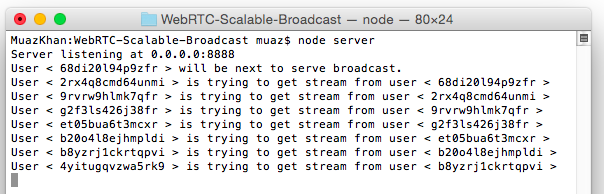
In the image, you can see that each NEW-peer is getting stream from most-recent peer instead of getting stream directly from the moderator.
npm install webrtc-scalable-broadcast
Now, goto node_modules>webrtc-scalable-broadcast:
cd node_modules
cd webrtc-scalable-broadcast

# and run the server.js file
node server.js
Or:
cd ./node_modules/webrtc-scalable-broadcast/
node ./server.js
Or install using WGet:
mkdir webrtc-scalable-broadcast &&cd webrtc-scalable-broadcast
wget http://dl.webrtc-experiment.com/webrtc-scalable-broadcast.tar.gz
tar -zxvf webrtc-scalable-broadcast.tar.gz
ls -a
node server.js
3D printed, scanning laser confocal microscope so I could collect 3D surface topology and profilometry data! The microscope stage is based on an OpenFlexure "Delta" stage, and the confocal optics are constructed with a 3D printed body, some lenses, a 405nm laser, pinhole and photodiode. The microscope is controlled by a Raspberry Pi (which controls an arduino to move the steppers).
It's not beautiful, it takes forever to scan, and the images are of dubious quality... but it works!
OpenFlexure: https://openflexure.org/0:00 Intro
1:56 Confocal vs Widefield Microscopy
3:25 OpenFlexure Motion Platform
4:01 Confocal optical breakdown
8:00 Delta motion stage
8:43 Photodiode amplifier
9:14 Confocal Pinhole demonstration
10:31 Camera vs Photodiode
11:31 Data processing considerations
14:05 Images and results!
18:22 Optimizations
21:37 Discord! Come hang out with us!