Tuesday, February 26, 2013

Fwd: Nu Horizons Electronics Portal - Your Gateway to Today's Leading Technology Products


---------- Forwarded message ----------
From: Nu Horizons Electronics <newsletter@nuhorizons.com>
Date: Tue, Feb 26, 2013 at 7:39 AM
Subject: Nu Horizons Electronics Portal - Your Gateway to Today's Leading Technology Products
To: john


Please click here if you are unable to view this e-mail or if it is improperly formatted.

Let's Stay Connected!

Follow us on twitter!
Become a Fan!
Linkedin
You Tube


Introducing Allegro's Smallest Integrated Current Sensor IC
The Allegro ACS711 consists of a linear Hall sensor circuit with a copper conduction path located near the surface of the die. Applied current flowing through this copper conduction path generates a magnetic field which is sensed by the integrated Hall IC and converted into a proportional voltage.
[more information]

Atmel SAM4L ARM-based Cortex-M4 MCUs Redefine the Power Benchmark
The Atmel® SAM4L family sets new low-power and efficiency standards for ARM®-based Cortex®-M4 microcontrollers (MCUs). Used in hundreds of millions of Atmel AVR® MCUs in the market today, the SAM4L family features ultra-low Atmel picoPower® technology and consumes just one-third the power of current solutions.
[more information]

Atmel CryptoAuthentication™ ATSHA204
The Atmel ATSHA204 is the first CryptoAuthentication product to integrate the SHA-256 hash algorithm with a 4.5Kb EEPROM, providing robust and cost-effective hardware authentication and secure key/data storage. Features such as small outline plastic packages and a single-wire interface make the ATSHA204 ideal for handheld electronic systems or any space-constrained embedded system.
[more information]

Intelligent Digital Signage Applications
Digital Signage is more prevalent and diversified than ever. Digital signage could be seen in supermarkets, restaurants, transportation centers, retail stores, kiosk and more. The interactive kiosk introduces another business - E-Board for meeting in corporate and education in schools. Axiomtek's Digital Signage solution is an excellent platform to manage and broadcast visual and audio content effectively to provide visitors with information, entertainment and a variety of other content.
[more information]

LTC4370 - Two-Supply Diode-ORCurrent Balancing Controller
The LTC®4370 is a two-supply current sharing controller which incorporates MOSFET ideal diodes. The diodes block reverse and shoot-through currents during start-up and fault conditions. Their forward voltage is adjusted to share the load currents between supplies. Unlike other sharing methods, neither a share bus nor trim pins on the supply are required.
[more information]


LTC3626 - 20V, 2.5A Synchronous Monolithic Step-Down Regulator with Current and Temperature Monitoring
The LTC®3626 is a high effi ciency, monolithic synchronous buck regulator using a phase-lockable controlled on-time, current mode architecture capable of supplying up to 2.5A of output current. The operating supply voltage range is 3.6V to 20V, making it suitable for a wide range of power supply applications.
[more information]


P400m Enterprise SATA SSD
Our P400m drive provides enterprise-level performance and reliability with superior data protection that is unmatched by competing products. Built from the ground up using our extended performance and enhanced reliability technology (XPERT) and 25nm MLC NAND, the P400m SSD provides an optimal balance of endurance and speed.
[more information]

Micron M500 SSD
Micron's next-generation M500 solid state drive (SSD) is designed to meet the increasingly demanding needs of the mobile computing market. The M500 delivers strong performance, greatly reduces power consumption, and provides exceptional data protection. It is offered in three thin, ultra-compact form factors in severaldifferent capacities.
[more information]

Ultra small, high efficiency dual-output AC-DC power supply
N2Power leads the power density race with its high efficiency XL330-54 CS AC-DC dual-output power supply. Our advanced technology yields a very small footprint, reduces wasted power, and offers the highest power density in its class. This efficient design means reduced energy costs, a greater return on your investment, greater reliability and longer product life.
[more information]


New Enhanced Brightness 7" Display From the Leader in Low-power, Sunlight Readable LCDs
Pixel Qi's new enhanced brightness 7" display, the PQ070WS02, addresses the widespread need for outdoor-capable, mobile products. Pixel Qi's patented technology combines a highly efficient transmissive optical structure with unique reflective technology to create a display that outperforms conventional sunlight readable displays in power and readability.
[more information]


High Power TVS for Ethernet Interfaces
RailClamp® TVS diodes are speci? cally designed to protect sensitive components which are connected to high-speed data and transmission lines from overvoltage caused by ESD (electrostatic discharge), CDE (cable discharge events), and EFT (electrical fast transients).
[more information]

3-Axis Digital Gyroscopes for Enhanced Motion-Control Realism and Image Stabilization
ST's latest gyroscopes feature excellent accuracy as a result of their unique and patented mechanical structure based on a single driving mass. The L3GD20 and L3G4IS boast superior output stability over time and temperature, removing the need for any further calibration on the customer's side.
[more information]

STM32 F3 Series Mixed-Signal MCUs
The STM32 F3 series of microcontrollers combines a 32-bit ARM® Cortex™-M4 core with DSP and FPU instructions running at 72 MHz with advanced analog peripherals for more flexibility at a competitive cost.
[more information]

Advanced Memory Solutions
Winbond DRAM product portfolio consists of high performance Mobile DRAM and Specialty DRAM. These products are widely used by leaders in the consumer, communication, computer peripheral and automotive markets. Besides discrete parts, Winbond also offers Known-Good-Die (KGD) in wafer format to SiP and MCM customers.
[more information]


Twitter! Facebook  Google+ Linkedin You Tube
 

Join our Newsletter!


Copyright 2012 Nu Horizons Electronics, An Arrow Company
All rights reserved.

Nu Horizons Electronics Corp. respects your online time and privacy.
If for any reason you would prefer not to receive any future emails,
please
CLICK HERE to opt out of future emails.
If you have any questions, please contact us at:
Nu Horizons Electronics Corp.
70 Maxess Road
Melville, NY 11747
Phone: (631) 396-5000
Fax: (631) 396-5050

www.nuhorizons.com


Recent purchase by Yahoo is a video conference broadcast-style cloud App

FROM JM:

It is pitched as "Radio call-in shows for the digital age."

This was noted as one of the first four purchases that Yahoo! has made.
Mentioned fourth paragraph down.
http://www.bizjournals.com/charlotte/blog/morning-edition/2013/02/yahoo-ceo-marissa-mayer-buys-fourth.html


First Look: OnTheAir's Video Call-In Show Platform Makes Hangouts and
Ustream Seem Static
http://techcrunch.com/2012/03/27/ontheair/

Here's how it works. A host sets up an OnTheAir show and selects a
start time. They receive a unique URL that leads to a landing page
with a countdown to their show. OnTheAir lets them schedule tweets for
an hour and a few minutes before the show starts to promote
themselves. When the show starts, the host begins live video streaming
 to the audience.

Friday, February 22, 2013

Google Is Working On A UDP Replacement Called QUIC


FROM: http://techcrunch.com/2013/02/22/looks-like-google-is-working-on-a-udp-replacement-called-quic/


Francois Beaufort had a very good day yesterday. Not only did the leaked video of the Chromebook Pixel he discovered earlier this month turn out to be real, he also noticed that Google started work on a new web protocol in Chrome called QUIC. This protocol, it seems, aims to update the User Datagram Protocol(UDP), a core part of the Internet protocol suite that also includes TCP, for example.
UDP is often used for applications that need real-time connectivity (video conferencing, games etc.). It opens up a direct connection between two machines, which makes it perfect for real-time applications and streaming data where low latency is very important. In return, however, it lacks some of the reliability controls of other Internet protocols like the TCP protocol.
QUIC also focuses on data streams, it seems, but with the extra benefit of adding a built-in encryption layer and some basic reliability controls.
It looks like the project was merged into Chrome just a few days ago, but work on the project seems to have started late last year. And while some people noticed it at the time, the project has mostly gone unnoticed. Now, however, it looks like it is becoming a core part of the Chromium project – the open source initiative behind Google’s Chrome browser.
We contacted Google for a comment about this, but all we got from a spokesperson was the company’s usual non-denial that “the team is continuously testing new features. At this time, we have nothing new to announce.”
With SPDY, of course, Google is currently working on a similar initiative for HTTP, and it looks like a lot of the work on SPDY may flow into the HTTP 2.0 standard. Google probably hopes to achieve something similar for UDP with QUIC. As it aims to make the web faster, more reliable and more secure, the company is clearly not content with just making its applications faster, but it has a vested interest in also pushing forward some of the low-level technologies that make today’s Internet work in the first place.
SPDY
SPDY (pronounced speedy)[1] is an open networking protocol developed primarily at Google for transporting web content.[1] As of July 2012, it is an open de facto standard protocol, the group developing SPDY has stated publicly that it is working toward standardization (available as an Internet Draft).[2] The first draft of HTTP/2 is using SPDY as the working base for its specification draft and editing.[3] Open source reference implementations of SPDY are available in Chromium[4], Mozilla Firefox[5]and Opera[6]. SPDY is similar to HTTP, with particular goals to reduce web page load latency and improve web security. SPDY achieves reduced latency through compression, multiplexing, and prioritization.[1] The name "SPDY" is a trademark of Google, and has no acronym defined.[7]


Thursday, February 21, 2013

MIT researchers build ultrahigh-definition Quad HD (4K) TV chip


At the International Solid-State Circuits Conference this week, MIT researchers unveiled their own Quad HD video chip design.
Quad HD is also known as 4K and ultrahigh-definition (UHD). The new Quad HD video standard enables a fourfold increase in the resolution of TV screens.
At the Consumer Electronics Show (CES) in January, several manufacturers debuted new UHD models.
There is no UHD content yet, but the Japanese government plans to launch the world's first 4K TV broadcast in July 2014, from communications satellites, followed by satellite broadcasting and ground digital broadcasting, NBC News Gadget Box has reported.
Nonetheless, 4K TVs are now on sale by Japanese makers including Sony, Panasonic and Sharp. Other manufacturers include South Korea's LG Electronics.
HEVC
[+]

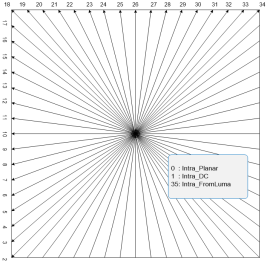
A key to efficient video compression is predicting future video frames on the basis of past ones. This diagram concerns "intra angular prediction."
(Credit: ISO)
UHD also requires a new video-coding standard, known as high-efficiency video coding, or HEVC (aka or H.265).
Although the MIT chip isn't intended for commercial release, its developers believe that the challenge of implementing HEVC algorithms in silicon helps illustrate design principles that could be broadly useful.
Moreover, "because now we have the chip with us, it is now possible for us to figure out ways in which different types of video data actually interact with hardware," says Mehul Tikekar, an MIT graduate student in electrical engineering and computer science and one of the paper's co-authors.
How HEVC works
Like older coding standards, the HEVC standard exploits the fact that in successive frames of video, most of the pixels stay the same. Rather than transmitting entire frames, it's usually enough for broadcasters to transmit just the moving pixels, saving a great deal of bandwidth. The first step in the encoding process is thus to calculate "motion vectors" — mathematical descriptions of the motion of objects in the frame.
On the receiving, end, however, that description will not yield a perfectly faithful image, as the orientation of a moving object and the way it's illuminated can change as it moves. So the next step is to add a little extra information to correct motion estimates that are based solely on the vectors. Finally, to save even more bandwidth, the motion vectors and the corrective information are run through a standard data-compression algorithm, and the results are sent to the receiver.
The new chip performs this process in reverse. It was designed by researchers in the lab of Anantha Chandrakasan, the Joseph F. and Nancy P. Keithley Professor of Electrical Engineering and head of the MIT Department of Electrical Engineering and Computer Science.
The chip's first trick for increasing efficiency is to "pipeline" the decoding process: a chunk of data is decompressed and passed to a motion-compensation circuit, but as soon as the motion compensation begins, the decompression circuit takes in the next chunk of data. After motion compensation is complete, the data passes to a circuit that applies the corrective data and, finally, to a filtering circuit that smooths out whatever rough edges remain.
Fine-tuning
Pipelining is fairly standard in most video chips, but the MIT researchers developed a couple of other tricks to further improve efficiency. The application of the corrective data, for instance, is a single calculation known as matrix multiplication. A matrix is just a big grid of numbers; in matrix multiplication, numbers in the rows of one matrix are multiplied by numbers in the columns of another, and the results are added together to produce entries in a new matrix.
"We observed that the matrix has some patterns in it," Tikekar explains. In the new standard, a 32-by-32 matrix, representing a 32-by-32 block of pixels, is multiplied by another 32-by-32 matrix, containing corrective information. In principle, the corrective matrix could contain 1,024 different values. But the MIT researchers observed that, in practice, "there are only 32 unique numbers," Tikekar says. "So we can efficiently implement one of these [multiplications] and then use the same hardware to do the rest."
Similarly, Chiraag Juvekar, another graduate student in Chandrakasan's group, developed a more efficient way to store video data in memory. The "naive way," he explains, would be to store the values of each row of pixels at successive memory addresses. In that scheme, the values of pixels that are next to each other in a row would also be adjacent in memory, but the value of the pixels below them would be far away.
In video decoding, however, "it is highly likely that if you need the pixel on top, you also need the pixel right below it," Juvekar says. "So we optimize the data into small square blocks that are stored together. When you access something from memory, you not only get the pixels on the right and left, but you also get the pixels on the top and bottom in the same request."
Chandrakasan's group specializes in low-power devices, and in ongoing work, the researchers are trying to reduce the power consumption of the chip even further, to prolong the battery life of quad-HD cell phones or tablet computers.
One design modification they plan to investigate, Tikekar says, is the use of several smaller decoding pipelines that work in parallel. Reducing the computational demands on each group of circuits would also reduce the chip's operating voltage.

Video phone Arduino shield

http://hackaday.com/2013/02/20/video-phone-arduino-shield/#more-94917

Friday, February 01, 2013

Streaming video latency on GoPro Hero3 Black.

We ran a quick test evaluating the GoPro Hero3 Camera for use in Live Video Streaming.

We were seeing around 4.7 Seconds delay while set to 1080P 14 fps.  or basically 66 frames delay. 

Our test was from from the Hero to an iPad3 over Wifi running their app. 

We also tested the HDMI output and found the latency to be impercievably low, we didn't bother  take a measurement.

We where unable to remove the on screen overlay display of the Battery indicator and other messages making in not suitable for a drop in HDMI video source. 

Still have not been able to get the video to stream over USB.

We also were unable to adjust the focus and were impressed with the wide angle lens but because the focus were unable to resolve text smaller then 1/4 inch. The color saturation is beautiful. 

These tests were performed at Anybots Inc. http://www.anybots.com in Santa Clara, Ca. 

John L. Sokol  2/2/2013


Thursday, January 31, 2013

The Vision Gyroscope

Check out this video on YouTube:

http://youtu.be/3g4hBwgGNX0


Sent from my iPad

Thursday, January 24, 2013

Tuesday, January 22, 2013

Fwd: 3D CineCast

---------- Forwarded message ----------
From: "3D CineCast" <olivier.amato@itbroadcastanddigitalcinema.com>
Date: Jan 22, 2013 4:10 AM
Subject: 3D CineCast
To: <john.sokol@gmail.com>

3D CineCast


Trifocal Camera Readied for Live 3D

Posted: 22 Jan 2013 12:40 AM PST

The days of stereo 3D mirror rigs could be numbered if new technology being devised by Arri, the Fraunhofer Institute and Walt Disney Studios comes to fruition.

The trio of companies have just begun a second phase of tests in Berlin on a trifocal camera system that comprises a single Arri M camera sandwiched between two micro HD cameras developed by Fraunhofer, alongside a computer processor.

The dual witness cameras capture enough information on set to be combined into depth maps by Fraunhofer's STAN Stereoscopic Analyzer software (which features in the DVS Clipster post tool), for the post production of live action content in 3D.


The concept would negate the need for cumbersome 3D camera rigs, allow an on-set 3D workflow similar to 2D, and in theory help produce 3D content without the glitches inherent in lens misalignment. Disparity-estimation techniques based on the three captured images should allow a second-eye view to be rendered at a virtual interaxial distance that is defined in post.

"If successful we will go into a third test in April this year and if that is successful it will be used on a major film production," revealed Kathleen Schroeter, executive manager 3D Innovation Centre, Berlin Fraunhofer Institute.

She said this was currently planned to be a 20-minute short film or a 20-minute sequence within a longer feature, both produced by Disney.

"The current trifocal system is for post production, but the next step is to render the data in real time so that we can produce live broadcast programming without rigs," she added.

Curiously the initiative has come from Disney in Hollywood, rather than Disney's own research institute in Zurich, which is also exploring ways of creating 3D content using plenoptic lenses and computational cinematography.

By Adrian Pennington, TVB Europe
You are subscribed to email updates from 3D CineCast
To stop receiving these emails, you may unsubscribe now.
Email delivery powered by Google
Google Inc., 20 West Kinzie, Chicago IL USA 60610

RGBDToolkit - DSLR + DEPTH Filmmaking | Home

http://www.rgbdtoolkit.com/

Thursday, January 17, 2013

Fwd: USB video conference camera makes video conference simple than ever

---------- Forwarded message ----------
From: "marketing@multipixhdtv.com" <marketing@multipixhdtv.com>
Date: Jan 17, 2013 6:25 PM
Subject: USB video conference camera makes video conference simple than ever
To: <john.sokol@gmail.com>


Model No.  MP-
USB 100 


720p30fps;
1/2.5"  CMOS  Image Sensor ;
Universal Serial Bus (USB2.0) Interface;
With IR remote controller ;

Application:
Small and mediumsized conference room; Video conferences; Distance learning;  Group training; Surveillance; 
Sports meeting ; Concert and Internet communications.

Seamlessly integrated into "Polycom,PVX_8.0/Cisco WebEx Series" video conference software and QQ、MSN、SKYPE's video chat;
 

Saturday, January 12, 2013

Vuzix Debuts the M100, an Android Powered Monocular Display - CES 2013

Release Date: 2nd Half, 2013

Price: Under $500

Features: Compatible with Android and iOS, 1080p camera to capture video, onboard processor running android, WiFi and Bluetooth enabled


http://revision3.com/hak5/m100-display


Darren talks with Condition One CEO, Danfung Denis about their vitual imaging technology.


Re: Please can you give me some advice

Hello william,

"While there is no specific meaning for high-definition,"

First lets understand the question.

When I think definition, there is resolution and then is image quality in terms of sharpness, contrast, color saturation and noise level. 

The smallest lens is effectively a pin hole camera.  If you are unsure what that is, it's a fun kids science experiment to google or YouTube search for.

Pixel Resolution is unaffected by the lens size and it purely about the sensor.

Sharpness actually. Increases as a smaller lens can be less accurate and produce a shaper image.  In addition focus is also less of an issue, a pin hole camera is in focus for all distances.
In a larger lens light entering the one side of the lens must match light from the other. The precision of the alignment is determined by the lens quality, focus.  Things like chromatic aberration and many other factors come in to play and become more of an issue the larger the lens.

What does happen with the smaller lens is less light.  What that means is the image sensor is getting less signal.   This means less color resolution, gray scale resolution and sensor noise becomes more of a factor. The classic signal to noise ratio.

To deal with noise longer sample times are needed, meaning longer exposure times and slower frame rates on things like cheap USB web cams. 

In astronomy techniques like cooling the cameras sensors to reduce noise, extremely long exposure times and digital post processing of many successive images to produce a higher contrast low noise image is done. All of which can be applied to even a web cam.

Also high resolution sensors need more light to produce a good image.

So a small lens is a trade off, cheaper lens but less light coming in work with.

There are 1080p cameras with 1mm or smaller lenses.

Here is another extreme example of small lenses.


Sent from my iPad

On Jan 12, 2013, at 6:47 AM, John Sokol <john.sokol@gmail.com> wrote:

---------- Forwarded message ----------
From: W.E.
Date: Jan 12, 2013 5:59 AM
Subject: Please can you give me some advice
To: <john.sokol@gmail.com>

Hell
I wonder if you can help.
I am trying to figure out what is the highest definition i can get from a video camera with a smallest lens.
Can you enlighten me on this at all.
Thank you.
Regards
william

Friday, January 11, 2013

Fwd: Telibrahma press release

---------- Forwarded message ----------
From: "Rita Tennyson" <rita@pulppr.com>
Date: Jan 10, 2013 10:56 AM
Subject: Telibrahma press release
To: <john.sokol@gmail.com>

John:

I saw your blog where you put up my message to you about a CES appointment.  I'm going to paste below the press release as I think it would make a better blog post than my writing :)  Let me know if you can use it or need a photo, etc.

Thanks!

Rita Tennyson

Point Brings Augmented Reality to Your Television Screen

 Telibrahma's Point debuts as first Augmented Reality Second-Screen Experience


January 8, 2013, CES/Las Vegas, Eureka Park #74112 - Telibrahma (www.telibrahma.com), the award-winning leader in

global mobile marketing technology, is breaking the mold by debuting a revolutionary

second-screen experience with Point, their image recognition technology that can

capture point-enabled videos and provide an interactive experience for viewers.

Using Point, consumers can enjoy instant engagement across any mobile device by

simply pointing their phone at a Point-enabled video, movie, commercial or television

program and gain instant access to an augmented experience.


"Point provides a Shazam-like experience for consumers that takes them to the next

level of engagement, and we're thrilled to offer this exciting technology to users," said

Suresh Narasimha, CEO and Founder of Telibrahma.


Point is a 360-degree solution for consumer engagement and provides an innovative

way for brands to communicate with their audience.


In addition to point-enabled videos, Point also works with print ads, editorial content,

brand logos, newspapers, magazines and websites to create "real world" experiences

for consumers on their mobile devices.


Download Point from your mobile device at: www.PointArt.mobi


For more information on Telibrahma visit: www.telibrahma.com.


 About Point

Point, the world's lightest and fastest Augmented Reality, is a visual recognition augmented reality

platform that helps brands engage with consumers by creating "real-world" experiences of products. By

scanning a product or service with their smartphone camera, consumers can gain instant access to

search results that are enhanced by 3D and 2D camera overlays, video overlays, facial recognition and

contextual results. Point allows brands to go beyond the QR code by working with any ad, editorial, brand

logo, newspaper, magazine, website, place or video.


 About Telibrahma

Telibrahma is an Intel-funded company that focuses on consumer engagement through augmented reality

advertising. With Point, the company's new augmented reality platform, Telibrahma helps brands create

"real-life" experiences for consumers, increases engagement and produces higher ROI. Working with

brands like Dove, Nokia, Nike and Toyota, Telibrahma is a leader in contextual mobile solutions.

Telibrahma was established in 2008 and has offices in New York and India. For more information, please

visit the website at www.telibrahma.com.

Thursday, January 03, 2013

Fwd: [CES] Augmented TV (Intel-backed)

---------- Forwarded message ----------
From: "Rita" <lin@pulppr.com>
Date: Jan 3, 2013 8:58 AM
Subject: [CES] Augmented TV (Intel-backed)
To: <john.sokol@gmail.com>

Dear John,

Intel-backed Telibrahma, creators of the Point Augmented Reality platform, will be launching two items at CES:
 
-First augmented TV reality second-screen experience--just point your phone to the TV for a Shazam-like experience with moving image recognition
-Buzz, its new location-based engagement platform that delivers brands and retailers on-demand location-specific media leveraging WiFi and other tech to deliver rich media content with a superior experience
 
Telibrahma can met up on the show floor at Intel's booth. LVCC, Central Hall - 7252 or at its own booth in the Eureka Park section, #74112.  Please contact me with your schedule for CES and we can set up a demo/meeting.  Jessica Hasson will be available on site at 310/739-0344.  Thanks!
 
Rita Tennyson
 
 
Buzz is Available on the Following Mobile Devices:
iPhone, Android, Blackberry, Nokia and Windows 

Company Leadership

Suresh Narasimha, CEO and Founder

Narasimha has over 15 years of experience in entrepreneurship, product creation, mobile innovation and advertising. He has raised several rounds of funding for TELiBrahma while growing employment and earning profit at the same time.

Prior to founding TELiBrahma, Narasimha was the Practice Head of Convergence at Reasoft Inc., where he defined products and solutions while leading convergence and managing delivery organization. Narasimha also worked as a Senior software engineer at Siemens Information Systems Ltd. He has lead mobile advertising efforts at several companies including Nike, HSBC and Mercedes Benz.

Narasimha received his GSM Management degree at ICFAI and a degree at PES Institute of Technology.
 
Telibrahma

Telibrahma is an Intel-funded company that focuses on consumer engagement through augmented reality advertising. Since 2008, TELiBrahma has worked with the advertising, media and retail industries to create innovative ad campaigns that allow consumers to go beyond a print ad to the next level of engagement.

With Point 1.0, the company's new augmented reality advertising platform, Telibrahma creates "real-life" experiences for consumers, increases engagement and produces higher ROI for brands. Working with brands like Dove, Nokia, Nike and Toyota, Telibrahma is a leader in contextual mobile solutions. Telibrahma was established in 2008 and has offices in New York and India. For more information, please visit the website at www.telibrahma.com.