If you own a video projector, be it a module small enough to fit in a mobile phone or one designed for a cinema screen, the chances are it will have a DLP at its heart. An array of microscopic mirrors on an integrated circuit, the current state of the art in video projection technology.
Perhaps you own an older video projector, or maybe a cheaper new one. If so the chances are it’ll have a small LCD screen doing its work, taking the place of the Kodachrome in something very similar to your grandparents’ slide projector or their grandparents’ magic lantern.
LCD technology was invented in the 1970s, while DLP was invented at the end of the 1980s. So how did the video projectors that were such a staple of televised spectaculars in the preceding decades work? For that matter, how did NASA project their status displays on the huge screen at Mission Control? Certainly not with CRT technology, even the brightest CRT projectors weren’t up to filling a cinema-sized screen.
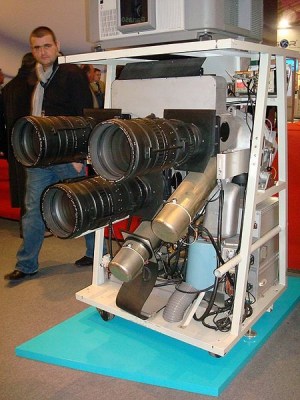
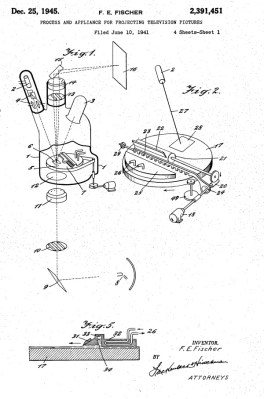
The answer came from the Eidophor (Greek: ‘eido’ and ‘phor’, ‘image’ and ‘bearer’), a device invented in the years before World War II by the Swiss physicist Dr. Fritz Fischerandgranted a US patentin 1945. It featured a complex vacuum device in which an electron gun painted the video frames as a raster on an oil-covered mirror in the light path of a fairly conventional projector. High-voltage electric charges have the effect of deforming the surface of mineral oils, and it was this effect that was exploited to vary the effectiveness of the mirror as the raster was drawn. An unfortunate side-effect of tracing an oil surface with an electron beam is that a charge will build up on the oil surface, so the entire oil-covered mirror assembly had to rotate within its vacuum enclosure and pass under an electrode which removed any charge build-up.
You will probably be unaware of the exact date you last saw an eidophor performance. Quince Imaging tell us their last one was used at the TWA Dome in St Louis in July 2000. Eidophores may have become more compact over the decades but they remained costly to run, and through the 1990s they were suplanted by DLP devices that did substantially the same job with a lot less fuss.
It is not often that a search in the Hackaday archives for a technology returns no results, but the eidophor is one of those cases. Perhaps that is a fitting epitaph for a device that created its own show but never starred in it, that it is only its spectacular performances that live on.
Avegant's Virtual Retinal Display prototype takes Oculus Rift-style immersion to the next level
Avegant's product actually projects two discrete images directly onto the retinas of the wearer -- as is not-so-subtly implied by the name.
Somewhere within the tangled mass, hurriedly yet skillfully wiring this contraption together, is Ed Tang, CEO of a company called Avegant. Avegant has produced this device, a wearable prototype he simply calls the Virtual Retinal Display for now. It could be most closely compared to the Oculus Rift, a full-field wearable display that presents a 3D image to the wearer. However, where the Rift cunningly relies on a single LCD panel and some simple optics to work its magic, Avegant's product actually projects two discrete images directly onto the retinas of the wearer -- as is not-so-subtly implied by the name.
Everything connected, Tang hands over the device and helps get it adjusted. Retinal projection requires precise alignment and optical focusing, a major engineering challenge that has pushed other companies toward simpler technologies when creating wearable displays. (Including Google, which considered retinal projection for Glass.) Avegant seems to have solved that problem in two ways: a frame that expands to accommodate different face widths and high-quality optical elements that can be individually adjusted. Where most wearable displays have crude, fixed optics, Avegant's eyepieces wouldn't look out of place at an ophthalmologist's.
Once properly aligned, the resulting image is compelling. The device offers a separate WXGA (1,280x768-pixel resolution) image for each eye, basically twice the effective resolution of current Oculus Rift developer kits. This means a crisp, clear image and, because of the nature of the projection's micromirror array, there's no screen door effect. Pixels seem to blend together seamlessly, creating an incredibly bright and vibrant image.
With Avegant's prototype there simply is no display. Your eyes completely relax and let the optics do the work of focusing.
Most impressive, however, is how comfortable the device is to wear. Not physically -- it's heavy, and all that weight rests squarely on your nose -- but rather in terms of eye comfort. Traditional wearable displays use optical tricks to provide some degree of eye relief, but you're still trying to focus on a display that's fairly close to your eyes. With Avegant's prototype there simply is no display. Your eyes completely relax and let the optics do the work of focusing. After staring at an LCD for hours, it's actually refreshing to gaze into this prototype.
This was one of the core concepts of the device, which grew out of a military request years ago to create a display that provided thermal imaging in a wearable package like traditional night vision goggles. Allan Evans, Avegant co-founder and CTO, fielded that request. "I was looking around and one day I realized that we don't stare at things that glow, we stare at light. So I started looking at how light actually is perceived, and I connected with an optics researcher and we started building giant boxes to prove the concept. It ended up working and we tried to miniaturize it."
This post doesn’t go into any of the complex mathematics involved with spherical mirror projection. For that information I recommend using the invaluable resources at http://paulbourke.net . This post explains a practical solution for projecting onto complex geometry using spherical mirrors, 3ds Max and 123D Catch.
Please excuse this format, it's a raw copy of my personal notes when search for an inexpensive , LOW LATENCY, small 12V device that could rotate 1080p HDMI video for converting landscape to portrait mode high end video conferencing for a telepresence robot. see: video on my home page.
Ultimately I was able to find a company that could for $15,000 in development be able to use a $300 FPGA board that could be customized to as low as $150. Contact me for more info.
We where also able to use an Intel i5 desktop board and a PCIE HDMI capture board. OMG what a clunky power hungry hassle. The USB HDMI capture devices introduced an unacceptably large delay in the video.
We don’t make a box that will take HD in and rotate or scale it.

Sorry, but thanks for thinking of CSI.

Regards,
Mike

*************************
Michael Fazzi
Western U.S. Regional Manager
CSI (Communications Specialties, Inc.)
2416 NE 18th Ave.
Portland, OR  97212
Tel:503-287-3248
Email:MikeF@CommSpecial.com
Web: CommSpecial.com & ScanDoHD.tv
SCALER PREMIERE VIEW PRO AV are able to reproduce the output, available both with 15-pin analog VGA and with digital DVI-D/HDMI, and to deform, enlarge, reduce, rotate the image as needed. This can be done with a very intuitive interface: a drag and drop matrix is displayed directly on the output directly to grant a simpler configuration.
Sent inquiry, waiting reply.
Aurora Multimedia
Sounds like you would need a dido JR. Please call me to discuss.
Frank Vono
Inside Sales Specialist
fvono@auroramultimedia.com
www.auroramultimedia.com
732-591-5800 x211
The DIDO Pro is an extremely compact and powerful, multipurpose video processor. It is a high resolution, quad image scaler with the ability to rotate the displayed image windows in ninety degree increments.
he ASR-44 has a picture-in-picture (PiP) generator and audio-follow-video capability, and it can rotate, stretch, and crop multiple images at once. $4200
Dear John,

Thank you for your inquiry about rotating video 90 degrees.

Colorado Video’s NVVN424CS will rotate NTSC standard definition video 90, 180 and 270 degrees.  You can view details at http://www.colorado-video.com/rotatevideospecs.html .

Please have a look at this web page contact me again if you need more information or care to place an order.

Sincerely,
Kirk Fowler
COLORADO VIDEO, INC.
sales@colorado-video.com
The CORIOMaster Mini is 1 RU in height. 160W power consumption. It lists for $10995 for the chassis. Input/output cards vary on price.
Hi John,
Thank you for your inquiry. Please provide me with your companies location so I can put you into contact with the appropriate Regional Sales Manager.
Thanks,

Kelly Broderick | Marketing Manager | +1 (859) 282-7303 phone | +1 (513) 490-5629 mobile
kelly.broderick@tvone.com | www.tvone.com | 2791 Circleport Drive, Erlanger, KY  41018


We have our CorioMaster product which can rotate images in 1 degree increments.

http://coriomini.tvone.com/

Let me know how I can help.

Thanks,

Steve

Steve Sherk | Regional Sales Mgr. –Western US | +1 (562) 627-6828 phone | +1 (562) 308-8602 mobile
steve.sherk@tvone.com | www.tvone.com | TV One, 2791 Circleport Drive, Erlanger, KY 41018 |
I have received a response back from engineering.  We currently have a PCIe board that has SDI & HDMI inputs and HDMI output.
We could develop the rotation microcode in the FPGA and deliver the board with a serial link to control it.
The size is small about 4’’x4’’x1’’. The only thing you would need is power supply (5V TBD).
We would have only HDMI output (no VGA and no DVI-a, only DVI-d = HDMI).

Please let me know if this is something you’re interested in pursuing.

Michael Chorpash
Vice President of Sales
VITEC

Office: 650-230-2562
Mobile: 818-324-4658
Email: mikec@optibase.com
 Corporate: www.vitecmm.com


 LCD technology was invented in the 1970s, while DLP was invented at the end of the 1980s. So how did the video projectors that were such a staple of televised spectaculars in the preceding decades work? For that matter, how did NASA project their status displays on the huge screen at Mission Control? Certainly not with CRT technology, even the brightest CRT projectors weren’t up to filling a cinema-sized screen.