
Friday, September 28, 2018

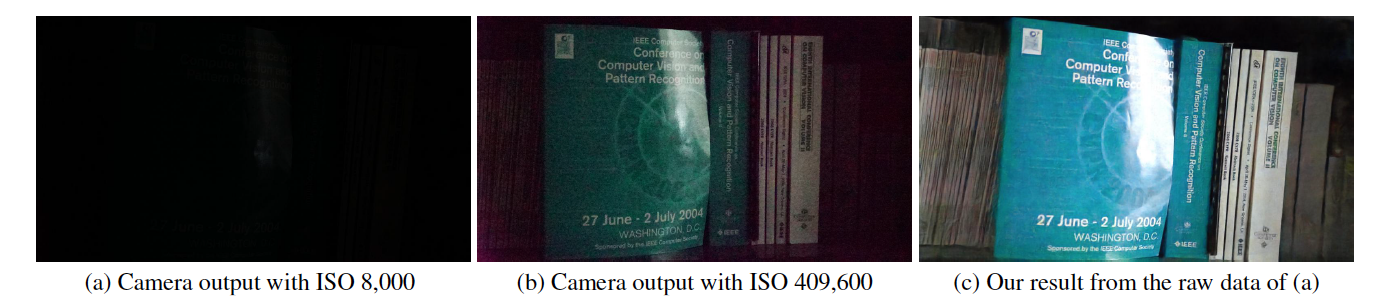
This AI Learned To See In The Dark


The paper "Learning to See in the Dark" and its source code is available here:


Thermal polarimetric imaging.


Researchers demonstrate an example of human identification using conventional and polarimetric thermal cameras. The thermal polarimetric image allows for fine facial details to emerge, researchers said. (U.S. Army Photo)


"Researchers have known for about 30 years that man-made objects emit thermal radiation that is partially polarized, for example, trucks, aircraft, buildings, vehicles, etc., and that natural objects like grass, soil, trees and bushes tend to emit thermal radiation that exhibits very little polarization," Gurton said. "We have been developing, with the help of the private sector, a special type of thermal camera that can record imagery that is based solely on the polarization state of the light rather than the intensity. This additional polarimetric information will allow Soldiers to see hidden objects that were previously not visible when using conventional thermal cameras."

"Prior to our research at ARL, the only way to view humans at night was to use conventional thermal imaging," Gurton said. "Unfortunately, such imagery is plagued by a "ghosting" effect in which detailed facial features required for human identification are lost. However, when polarization information is included in the thermal image, i.e., a thermal polarimetric image, fine facial details emerge, which allows facial recognition algorithms to be applied."

https://www.arl.army.mil/www/default.cfm?article=3292


Monday, September 17, 2018

Fwd: OpenMV News

---------- Forwarded message ----------
From: "OpenMV" <openmv@openmv.io>
Date: Sep 17, 2018 8:41 AM
Subject: OpenMV News
To: "John" <john.sokol@gmail.com>
Cc:

OpenMV Home - https://openmv.io/
View this email in your browser

OpenMV Cam H7 Kickstarter Launched

SEP 17, 2018 POSTED BY: KWABENA AGYEMAN

Hi everyone,

The wait is over! The OpenMV Cam H7 Kickstarter has launched!

OpenMV Cam H7 Kickstarter

Help OpenMV make the OpenMV Cam H7 a reality by backing us on Kickstarter!

Copyright © 2018 OpenMV, LLC, All rights reserved.
You are receiving this email because you provided your email address to OpenMV at some point in time. Please opt out if you do not want to receive communications from OpenMV.

Our mailing address is:
OpenMV, LLC
PO Box 1577 #22900
Atlanta, GA 30301

Add us to your address book


Want to change how you receive these emails?
You can update your preferences or unsubscribe from this list

Email Marketing Powered by MailChimp

Saturday, August 11, 2018

Machine vision camera

http://jevois.org/


About JeVois

Open-source machine vision finally ready for prime-time in all your projects!
JeVois = video sensor + quad-core CPU + USB video + serial port, all in a tiny, self-contained package (28 cc or 1.7 cubic inches, 17 grams or 0.6 oz). Insert a microSD card loaded with the provided open-source computer vision algorithms (including OpenCV 3.4.2, TensorFlow, Caffe, Darknet, and many others), connect to your desktop, laptop, and/or Arduino, and give your projects the sense of sight immediately.


Monday, July 30, 2018

1950 HOW TELEVISION BENEFITS YOUR CHILDREN


Television Newspaper & Intramural Television - Scoops magazine UK (1934/1935)

Television Newspaper:  Can it be Done? syndicated comic, Scoops magazine UK (1934/1935)


Sunday, July 29, 2018

My Notes on TV from 2011, Evolution of Television. Future TV.


The Price of a Television has remained relatively constant


Even High End Televisions are oddly unchanged over a 70 year span!


We have added new capabilities, 3D, 4K, vast improvements in color and image quality


But where are we going ?


Of all the screens we have, we can tolerate much longer viewing times on a TV than any other device.


Below are some thoughts on the Content Ecosystem.


John Sokol shared “Lambert Castle Museum, Passaic County Historical Society Library, Video Related items” with you


Lambert Castle Museum, Passaic County Historical Society Library, Video Related items
4
View album

Monday, April 09, 2018

51 percent of IP cameras are infected with Internet of Things botnet malware


https://en.wikipedia.org/wiki/Mirai_(malware)

https://blog.trendmicro.com/trendlabs-security-intelligence/persirai-new-internet-things-iot-botnet-targets-ip-cameras/

https://www.scmagazine.com/persirai-is-tops-among-four-families-of-iot-camera-botnets/article/667200/

An analysis of roughly 4,400 IP cameras in the U.S. using custom http servers found that just over 51 percent of them are infected by one of four Internet of Things botnet malware families, according to new research.
The majority of these 3,675 compromised cameras, or approximately 64.1 percent, were infected by the IoT botnet Persirai, Trend Micro reported in a blog post on Thursday. Discovered earlier this year, Persirai relies on exploited vulnerabilities to steal credentials and attack other devices.
The remaining affected cameras were found infected by the IoT botnets Mirai (about 27.7 percent), DvrHelper (about 6.8 percent), and TheMoon (about 1.4 percent), the blog post continues. Trend Micro used the Shodan search engine as well as its own research to amass its study sample, though it is not currently clear how recently this analysis took place. (SC Media has contacted Trend Micro for an answer.)


https://motherboard.vice.com/en_us/article/8q8dab/15-million-connected-cameras-ddos-botnet-brian-krebs

Mirai appears to be spreading fast. A security researcher put online six virtual machines designed to look like ADSL routers running Linux operating systems just like the ones targeted by Mirai—in other words, a set of honeypots.
It took only an average of 15 minutes for these to get hit with Mirai malware, the researcher, who asked to be referred to as "Jack B." to protect his real identity, told me in an online chat. (If you didn't just say "holy shit," you probably should have.)

Monday, February 26, 2018

Nicolas Cage as Everyone - Nick Cage DeepFakes Movie Compilation


https://www.youtube.com/watch?v=lNSLf2PNWVg


How to make deep fakes? http://www.fakeapp.org/

FakeApp can easily create robust, diverse datasets of thousands of images in minutes from both image sets and videos.

Screenshots
Get Datasets
Train AIs
Create Faceswaps
FakeApp makes it easy to observe the progress of trained AIs in real time by posting frequent loss values and training previews.

FakeApp reduces the task of converting the face in a video to a single button process by automatically splitting, converting, and stitching video frames.

FakeApp Makes Faceswaps Easy
FakeApp was designed to make the process of creating realistic faceswaps with deep learning as smooth, simple, and quick as possible. It supports all three steps of the basic faceswap workflow—creating datasets, training AI, and converting videos. Here is a brief video tutorial made by a FakeApp user and some screenshots.