from SLASHDOT: Concrete Comparisons of Theora Vs. Mpeg-4
"With the upcoming Firefox 3.5 and HTML5 video, there's natural interest in Theora vs. Mpeg-4, but without much evidence either way. Here's clips encoded at various rates to provide concrete comparison between Theora and Mpeg-4. Theora performs decently, but requires more bandwidth than Mpeg-4 (although this is a 1.1alpha release of Theora and Theora has a much better license than Mpeg-4). The quality comparisons are very subjective, but you can try the clips yourself and see how it breaks down. There was an earlier discussion about this, but it lacked much concrete evidence. (Disclosure: it's my page.)"
Monday, June 22, 2009


Sunday, June 14, 2009
Cute trick video, from Samsung
The tag reads
OUR CHALLENGE: GUESS HOW WE DID THIS. This clip was shot on an I8910 HD phone, a new camera phone just released by Samsung with an 8 megapixel camera that can actually record and output video in HD format. It was shot in one take, with no post production or special effects of any kind. Everything you see here was done "in-camera". Our challenge to you is to figure out how we did it. Hint: it's worth watching in HD...
It's definitely one the better pieces of web marketing.
YouTube HD Camera Trick Challenge
YouTube HD Camera Trick - Revealed!
Cute, right?
OUR CHALLENGE: GUESS HOW WE DID THIS. This clip was shot on an I8910 HD phone, a new camera phone just released by Samsung with an 8 megapixel camera that can actually record and output video in HD format. It was shot in one take, with no post production or special effects of any kind. Everything you see here was done "in-camera". Our challenge to you is to figure out how we did it. Hint: it's worth watching in HD...
It's definitely one the better pieces of web marketing.
YouTube HD Camera Trick Challenge
YouTube HD Camera Trick - Revealed!
Cute, right?
Friday, June 12, 2009
World's Smallest VGA Display
Kopin crafts world's smallest VGA microdisplay, with a planned 2k x 2k postage stamps up next!

You're looking at a full-color LCD with a resolution of 600 x 480 pixels (more than your iPhone's 480 x 320) that measures just over a quarter of an inch, diagonally--the world's smallest. Each individual pixel measures 2.9 x 8.7 µm (that's micro); for reference, the thickness of a human hair is around 100 µm.

You're looking at a full-color LCD with a resolution of 600 x 480 pixels (more than your iPhone's 480 x 320) that measures just over a quarter of an inch, diagonally--the world's smallest. Each individual pixel measures 2.9 x 8.7 µm (that's micro); for reference, the thickness of a human hair is around 100 µm.
But why? Kopin, the company that created the prototype, has the ultimate goal of creating a display with a resolution of 2048 x 2048 (4.2 million dots) that's smaller than a postage stamp--that's more resolution than a typical high-def wide screen monitor or television. They're hoping to use these ultra-high res, tiny displays to make sharp, high-end electronic viewfinders in HD video and still cameras, similar to the one already used in Panasonic's Micro Four Thirds G1 (which uses 1.4 million dots).
See there display products for more info.

Thursday, June 11, 2009
Moon comes out tomorrow.
MOON // A Film by Duncan Jones
In theaters: June 12, 2009
It's almost Stanly Kuberesk
It is the near future. Astronaut Sam Bell is living on the far side of the moon, completing a three-year contract with Lunar Industries to mine Earth’s primary source of energy, Helium-3. It is a lonely job, made harder by a broken satellite that allows no live communications home. Taped messages are all Sam can send and receive. Thankfully, his time on the moon is nearly over, and Sam will be reunited with his wife, Tess, and their three-year-old daughter, Eve, in only a few short weeks. Finally, he will leave the isolation of “Sarang,” the moon base that has been his home for so long, and he will finally have someone to talk to beyond “Gerty,” the base’s well-intentioned, but rather uncomplicated computer.
It doesn't look this movie will be playing in Santa Barbara any time soon. Looks like I will need to drive to LA to see this one. Really crappy distribution on this film.
You know, even the Sony web site for it's hard to find, doesn't even come up in Google till like the 50th link. I would gladly pay $10 to download a copy to watch on my HDTV. If they were smart, they would make a premium download of this available on Netflix, blockbuster or Amazon.
Questions for Duncan Jones, Director of the Film Moon (With Video!)
In theaters: June 12, 2009
It's almost Stanly Kuberesk
It is the near future. Astronaut Sam Bell is living on the far side of the moon, completing a three-year contract with Lunar Industries to mine Earth’s primary source of energy, Helium-3. It is a lonely job, made harder by a broken satellite that allows no live communications home. Taped messages are all Sam can send and receive. Thankfully, his time on the moon is nearly over, and Sam will be reunited with his wife, Tess, and their three-year-old daughter, Eve, in only a few short weeks. Finally, he will leave the isolation of “Sarang,” the moon base that has been his home for so long, and he will finally have someone to talk to beyond “Gerty,” the base’s well-intentioned, but rather uncomplicated computer.
It doesn't look this movie will be playing in Santa Barbara any time soon. Looks like I will need to drive to LA to see this one. Really crappy distribution on this film.
You know, even the Sony web site for it's hard to find, doesn't even come up in Google till like the 50th link. I would gladly pay $10 to download a copy to watch on my HDTV. If they were smart, they would make a premium download of this available on Netflix, blockbuster or Amazon.
Questions for Duncan Jones, Director of the Film Moon (With Video!)
Wednesday, June 10, 2009
Lucasfilm uses Brocade to distribute movies
The artists and engineers behind the Star Wars and Indiana Jones film series rely on Brocade networking solutions to share bandwidth-intensive video files. The power and performance of Brocade solutions streamline file transfers across the entertainment company’s multi-building campus.
Sunday, June 07, 2009
YouTube Video Sends Guatemala Into Crisis
Source:slashdot.org
Slashdot | YouTube Video Sends Guatemala Into Crisis
Several have sent word that a YouTube video of recently assassinated lawyer Rodrigo Rosenberg has sent Guatemala into a tailspin. The video of Rosenberg claims that if you are watching, he has been murdered by President Alvaro Colom with help from presidential secretary Gustavo Alejos.
"The video spread across the Internet after family members handed it out during Rosenberg's funeral on Monday. In the 18-minute tape, a seemingly calm Rosenberg, sitting behind a desk and microphone, alleges that Colom, the First Lady and two associates were involved in murder, corruption and money laundering. The group, he says, filtered public funds through a state-owned bank for personal gain and to finance drug traffickers. Rosenberg then claims that after Khalil Musa, a prominent businessman and bank board member, had learned of the Coloms' scheme, Musa and his daughter were shot to death in front of a shopping center in April. Rosenberg says the President signed off on the killings."
Slashdot | YouTube Video Sends Guatemala Into Crisis
Several have sent word that a YouTube video of recently assassinated lawyer Rodrigo Rosenberg has sent Guatemala into a tailspin. The video of Rosenberg claims that if you are watching, he has been murdered by President Alvaro Colom with help from presidential secretary Gustavo Alejos.
"The video spread across the Internet after family members handed it out during Rosenberg's funeral on Monday. In the 18-minute tape, a seemingly calm Rosenberg, sitting behind a desk and microphone, alleges that Colom, the First Lady and two associates were involved in murder, corruption and money laundering. The group, he says, filtered public funds through a state-owned bank for personal gain and to finance drug traffickers. Rosenberg then claims that after Khalil Musa, a prominent businessman and bank board member, had learned of the Coloms' scheme, Musa and his daughter were shot to death in front of a shopping center in April. Rosenberg says the President signed off on the killings."
Akamai CEO: The Online-Video Tipping point is here
Source: adage.com:
Akamai CEO: The Online-Video Tipping point is here.
How big of a game changer will the online video watching ultimately be for the television industry? And when will those changes really start to happen big time? According to Akamai CEO Paul Sagan, we're watching the tipping point occur right now and sweeping industry upheaval may come sooner and more dramatically then many imagine. Mr. Sagan was Keynote speaker at this week's Streaming Media East conference.
Akamai CEO: The Online-Video Tipping point is here.
How big of a game changer will the online video watching ultimately be for the television industry? And when will those changes really start to happen big time? According to Akamai CEO Paul Sagan, we're watching the tipping point occur right now and sweeping industry upheaval may come sooner and more dramatically then many imagine. Mr. Sagan was Keynote speaker at this week's Streaming Media East conference.
Tru2Way , DVR/DVD - Comcast and Panasonic
I was supposed to have published this back in January, some how it got lost in the bit bucket.
Tru2Way DVR/DVD - Comcast and Panasonic jointly introduced AnyPlay, a portable combo tru2way DVR-DVD. It looks like a regular portable DVD player and also a DVR that works like a Tivo. It sits in your living room by the cable box and then undocks and becomes a portable DVD player with recorded TV shows or other content.
http://www.tru2way.com/
http://en.wikipedia.org/wi
Can Tru2way succeed where CableCard failed?
http://news.cnet.com/8301-
Other things you really should know about.
Open Cable
http://en.wikipedia.org/wi
OCAP
http://en.wikipedia.org/wi
Data Over Cable Service Interface Specification (DOCSIS)
http://en.wikipedia.org/wi
DOCSIS Set-top Gateway (or DSG)
http://en.wikipedia.org/wi
Triple play
http://en.wikipedia.org/wi
Multimedia over Coax Alliance (MoCA)
http://en.wikipedia.org/wi
Tru2Way DVR/DVD - Comcast and Panasonic jointly introduced AnyPlay, a portable combo tru2way DVR-DVD. It looks like a regular portable DVD player and also a DVR that works like a Tivo. It sits in your living room by the cable box and then undocks and becomes a portable DVD player with recorded TV shows or other content.
http://www.tru2way.com/
http://en.wikipedia.org/wi
Can Tru2way succeed where CableCard failed?
http://news.cnet.com/8301-
Other things you really should know about.
Open Cable
http://en.wikipedia.org/wi
OCAP
http://en.wikipedia.org/wi
Data Over Cable Service Interface Specification (DOCSIS)
http://en.wikipedia.org/wi
DOCSIS Set-top Gateway (or DSG)
http://en.wikipedia.org/wi
Triple play
http://en.wikipedia.org/wi
Multimedia over Coax Alliance (MoCA)
http://en.wikipedia.org/wi
Saturday, June 06, 2009
DTV switchover for seniors.
This is a test, I am trying to embedded my own flash video off my web site here.
This is also a really funny clip.
Get the Flash Player to see this player.
This is also a really funny clip.
Get the Flash Player to see this player.
Wednesday, June 03, 2009
Dolby 3D Digital Cinema
Dolby's unique full-spectrum color-filter technology licensed from Infitec, enabled by the passive Dolby 3D Glasses,
The system provides realistic color reproduction and extremely sharp images.

INFITEC 3D is similar to polarised 3D with a few distinct advantages. Firstly, and most importantly, you don't need a silver non-depolarising screen, you can project 3D onto a standard white screen or even straight onto a wall if you want. Infitec is also not affected by viewing angles, so you don't lose 3D if you tilt your head!
According to the press releases the reusable glasses significantly reducing the cost per viewing and are environmentally friendly. The nature of the filters for each eye are much more expensive then plastic polarizers, but deliver a much better result.
They were using a glass or very hard plastic filters that were very high quality but it's not cheap. One theater operator I talk with said he was paying $38 per pair.

The glasses include an anti-theft RF tag.
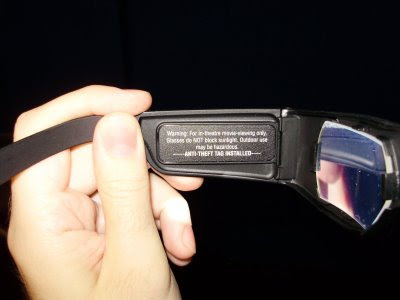
Dolby 3D Digital Cinema technology, in conjunction with digital cinema projectors featuring Texas Instruments Digital Light ProcessingTM (DLP) technology, provides exhibitors with an efficient and flexible solution designed to deliver a superior 3D experience. Dolby 3D utilizes standard white screens, so exhibitors don't have the added cost or the quality compromise associated with the use of silver screens, delivering a consummate 3D experience from every seat in the house.
Infitec's 3-D technology was originally a research project of Daimler Chrysler for automotive design uses. Under the project title "wavelength multiplex visualization system" it was investigate the new approach to improving image quality and to enlarge functionally in Virtual Reality systems.
In July 2006 Infitec teamed up with Dolby Digital to produce 3-D cinemas. Jan 09 Infitec founded a new company for it's new technology Infitec Dualcolor3D.
Infitec uses a technique for channel separation in stereo projections based on interference of filter (In terferenz fi lter tec hnologie).
JDSU is the world's largest producer of optical coatings, developed the 3D filter wheel technology that is used and makes the lenses for the glasses.
Here the pictures for the left and right eye are projected with basic colors of different wavelength (wavelength multiplexing)

The channel separation of the projected images is done with a pair of of glasses that have selective interference filters for each eye.
Each lens filters the suitable wavelength triple with selective interference filters for each eye.
This has some advantages over the other 2 technologies that for 3D, polarization and Shutter goggles.
It has the advantage of the shutter goggle in that it can use a standard white screen rather than a costly silver screen. A white screen cost ~$6000 while a same size silver screen can cost ~$16000.
It also has the advantages over the shutter goggle similar to the polarization systems (RealD and MasterImage) in that it's passive so there is not thing to fail. No batteries, connections or active electronics.
I suspect it's lower cost the the shutter goggles too.
More info:
Dolby Digital 3D vs Real D / Master image systems.
Dolby® 3D Digital Cinema
Infitec - Infitec Dualcolor3D
Disney Digital 3-D™
NAB 3D
Wavelength Multiplexing
JDSU and Dolby Deliver Premium 3D Movie Experience on the Dolby web Site
JDSU and Dolby Deliver Premium 3D Movie Experience On the JDSU web site.
Dolby 3D Glasses Training Video This is a fun video
The system provides realistic color reproduction and extremely sharp images.
INFITEC 3D is similar to polarised 3D with a few distinct advantages. Firstly, and most importantly, you don't need a silver non-depolarising screen, you can project 3D onto a standard white screen or even straight onto a wall if you want. Infitec is also not affected by viewing angles, so you don't lose 3D if you tilt your head!
According to the press releases the reusable glasses significantly reducing the cost per viewing and are environmentally friendly. The nature of the filters for each eye are much more expensive then plastic polarizers, but deliver a much better result.
They were using a glass or very hard plastic filters that were very high quality but it's not cheap. One theater operator I talk with said he was paying $38 per pair.
The glasses include an anti-theft RF tag.

Dolby 3D Digital Cinema technology, in conjunction with digital cinema projectors featuring Texas Instruments Digital Light ProcessingTM (DLP) technology, provides exhibitors with an efficient and flexible solution designed to deliver a superior 3D experience. Dolby 3D utilizes standard white screens, so exhibitors don't have the added cost or the quality compromise associated with the use of silver screens, delivering a consummate 3D experience from every seat in the house.
Infitec's 3-D technology was originally a research project of Daimler Chrysler for automotive design uses. Under the project title "wavelength multiplex visualization system" it was investigate the new approach to improving image quality and to enlarge functionally in Virtual Reality systems.
In July 2006 Infitec teamed up with Dolby Digital to produce 3-D cinemas. Jan 09 Infitec founded a new company for it's new technology Infitec Dualcolor3D.
Infitec uses a technique for channel separation in stereo projections based on interference of filter (In terferenz fi lter tec hnologie).
JDSU is the world's largest producer of optical coatings, developed the 3D filter wheel technology that is used and makes the lenses for the glasses.
Here the pictures for the left and right eye are projected with basic colors of different wavelength (wavelength multiplexing)

- Left eye: Red 629nm, Green 532nm, Blue 446nm
- Right eye: Red 615nm, Green 518nm, Blue 432nm
The channel separation of the projected images is done with a pair of of glasses that have selective interference filters for each eye.
Each lens filters the suitable wavelength triple with selective interference filters for each eye.

This has some advantages over the other 2 technologies that for 3D, polarization and Shutter goggles.
It has the advantage of the shutter goggle in that it can use a standard white screen rather than a costly silver screen. A white screen cost ~$6000 while a same size silver screen can cost ~$16000.
It also has the advantages over the shutter goggle similar to the polarization systems (RealD and MasterImage) in that it's passive so there is not thing to fail. No batteries, connections or active electronics.
I suspect it's lower cost the the shutter goggles too.
More info:
Dolby Digital 3D vs Real D / Master image systems.
Dolby® 3D Digital Cinema
Infitec - Infitec Dualcolor3D
Disney Digital 3-D™
NAB 3D
Wavelength Multiplexing
JDSU and Dolby Deliver Premium 3D Movie Experience on the Dolby web Site
JDSU and Dolby Deliver Premium 3D Movie Experience On the JDSU web site.
Dolby 3D Glasses Training Video This is a fun video
Developers: Money For Nothing and the Codecs For Free
From SlashDot:
"In an in depth discussion on the codec industry, CoreCodec CEO and Matroska Foundation board member Dan Marlin shares his thoughts on the growing popularity of the MKV container, confusion in the marketplace between X.264/MKV and DivXHD and weighs in on a controversial decision by Microsoft to block third party filter support in future versions of Windows media player. His interview offers a behind the scenes look at an important piece of technology that is helping to power the P2P movement. It also raises the prickly question of whether or not Microsoft is abusing their OS monopoly, in order to rein in competition within the codec industry."
"In an in depth discussion on the codec industry, CoreCodec CEO and Matroska Foundation board member Dan Marlin shares his thoughts on the growing popularity of the MKV container, confusion in the marketplace between X.264/MKV and DivXHD and weighs in on a controversial decision by Microsoft to block third party filter support in future versions of Windows media player. His interview offers a behind the scenes look at an important piece of technology that is helping to power the P2P movement. It also raises the prickly question of whether or not Microsoft is abusing their OS monopoly, in order to rein in competition within the codec industry."
Tuesday, June 02, 2009
The Prince's new cloths.
A Hollywood movie producer friend of mine was telling me about some new holographic 3D technology that Prince Charles did a presentation with in Abu Dhabi.
I am always excited to learn about some new holographic or 3D technology, especially since I hadn't heard about this one. I felt I was taken off guard, being that I am working with real holographic stuff, I really should know about this.
A quick google search found this video on youtube.
Prince Charles Speaks in Abu Dhabi Via Hologram
Little more googling, looks like is was done by a UK company called Musion.
http://www.musion.co.uk/Prince_Charles.html Yup, is was done by them.
But further inspection reviled that this is neither 3D or Holographic!
When I read there requirements it didn't add up.
http://www.musion.co.uk/pdf/USPatent5865519.pdf
Plain old simple mono video shot on a standard camera.
There really isn't anything there that I see that is all that exciting!!!
It really wasn't much more then the Arther C. Clarke Events that I did back in 1997.
They do use a 20Mbps MPLS connection, so that mades it really easy for a rock solid international HD video stream to be sent, but there is nothing 3D about it, it's not cheap for that kind of pipe either.
Not that this isn't of some value but it is false advertising and just buzzwords to get the media's attention and the Media is all too mindless and just eat it up.
Now anyone who is doing real 3D and Holographic video has to deal with a fake competitor!
Maybe it doesn't sound all that bad, but when I ran my streaming company back in 96, we found our selves competing against all kinds of insane technological claims from .com start ups scams that just lied. They could never deliver, but it was enough to confuse investors and hold the market back. I had to spend countless hours trying to explain that you can't get full motion, TV quality video over a 36.6K modem and later and 56K.
I am always excited to learn about some new holographic or 3D technology, especially since I hadn't heard about this one. I felt I was taken off guard, being that I am working with real holographic stuff, I really should know about this.
A quick google search found this video on youtube.
Prince Charles Speaks in Abu Dhabi Via Hologram
Little more googling, looks like is was done by a UK company called Musion.
http://www.musion.co.uk/Prince_Charles.html Yup, is was done by them.
But further inspection reviled that this is neither 3D or Holographic!
When I read there requirements it didn't add up.
- A video projector, preferably DLP with an HD card/minimum native resolution of 1280 x 1024 and brightness of 5000+ lumens.
- For smaller cabinet installations, a high quality TFT Plasma or LCD screen can also be used.
- A hard-disc player with 1920 x 1080i HD graphics card, Apple or PC video server, DVD player.
- Musion Eyeliner Foil + 3D set/drapes enclosing 3 sides
- Lighting and audio as required
- Show controller (on site or remote)
http://www.musion.co.uk/pdf/USPatent5865519.pdf
Plain old simple mono video shot on a standard camera.
There really isn't anything there that I see that is all that exciting!!!
It really wasn't much more then the Arther C. Clarke Events that I did back in 1997.
They do use a 20Mbps MPLS connection, so that mades it really easy for a rock solid international HD video stream to be sent, but there is nothing 3D about it, it's not cheap for that kind of pipe either.
Not that this isn't of some value but it is false advertising and just buzzwords to get the media's attention and the Media is all too mindless and just eat it up.
Now anyone who is doing real 3D and Holographic video has to deal with a fake competitor!
Maybe it doesn't sound all that bad, but when I ran my streaming company back in 96, we found our selves competing against all kinds of insane technological claims from .com start ups scams that just lied. They could never deliver, but it was enough to confuse investors and hold the market back. I had to spend countless hours trying to explain that you can't get full motion, TV quality video over a 36.6K modem and later and 56K.
Linux video applications
This isn't really much of an article as a link collection of Linux video apps worth checking out.
This isn't for CCTV or DVR use as much as consumer video.
This isn't for CCTV or DVR use as much as consumer video.
- xine - started as a simple mpeg-2 audio and video decoder, but it since became a full-featured DVD and video media player.
- VLC media player / VideoLAN: a cross-platform video player and streaming solution. Video streaming over an ethernet network, and excellent standalone player.
- MPlayer - another good player, it is also very robust against damaged streams.
- movietime - still quite young, but it looks very promising !
- ffmpeg - a nice audio/video encoder and transcoder. ffmpeg.org
- Ogle - a good DVD player with menu support.
- TCVP - video and music player for unix.
- a52decX - a graphical interface for macintosh OS X.
- bd4go - another graphical interface for macintosh OS X.
- drip - a DVD to DIVX transcoder.
- OMS
- XMPS
- GStreamer - a framework for streaming media (A real beast)
- mpeglib - a video decoding library
- Avidemux
- ELDER
- ffdshow
- GordianKnot
- Handbrake: a multi-platform, multithreaded DVD to MPEG-4 ripper/converter.
- LiVES
- MeGUI
- MEncoder
- pspVideo9
- RealAnime
- StaxRip
- TCVP
Tuesday, May 26, 2009
AMR codec source code and Standards docs.
Adaptive Multi-Rate (AMR) is a patented audio data compression scheme optimized for speech coding. AMR was adopted as the standard speech codec by 3GPP in October 1998 and is now widely used in GSM and UMTS mobile phone standards.
AMR is also a file format for storing spoken audio using the AMR codec. Many modern mobile telephone handsets will allow you to store short recordings in the AMR format, both open source (see the external links) and commercial programs exist to convert between this and other formats such as MP3, although it should be remembered that AMR is a speech format and is unlikely to give ideal results for other audio. The common filename extension is
3GPP - 3rd Generation Partnership Project
Technical Specification Group Services and System Aspects
Performance characterization of the Adaptive Multi-Rate Wideband (AMR-WB) speech codec
Location of Standards Docs and Codec source code:
AMR is also a file format for storing spoken audio using the AMR codec. Many modern mobile telephone handsets will allow you to store short recordings in the AMR format, both open source (see the external links) and commercial programs exist to convert between this and other formats such as MP3, although it should be remembered that AMR is a speech format and is unlikely to give ideal results for other audio. The common filename extension is
.amr.3GPP - 3rd Generation Partnership Project
Technical Specification Group Services and System Aspects
Performance characterization of the Adaptive Multi-Rate Wideband (AMR-WB) speech codec
Location of Standards Docs and Codec source code:
The Foundry Demos Technology to Nuke CMOS Artifacts
FROM: http://www.studiodaily.com/hdstudio/post/10934.html
Rolling-Shutter Skew Can Make Motion Tracking a DragBy Bryant Frazer
May 26, 2009 Source: HD Studio
Rolling-Shutter Skew Can Make Motion Tracking a DragBy Bryant Frazer
May 26, 2009 Source: HD Studio
Digital motion-picture imaging has come so far, so fast, that it’s easy to forget, sometimes, that we still have a long way to go. A case in point is one of the many bits of cool software engineering being showcased at last month’s NAB show in Las Vegas — The Foundry is experimenting with technology that would remove the rolling-shutter artifacts often associated with images captured by CMOS sensors.
Rolling-shutter artifacts occur because CMOS chips don’t update an entire frame at exactly the same time. The image is captured line by line, moving across the sensor in one direction, meaning that the picture may suffer from temporal artifacts. For example, a straight horizontal line may appear skewed as the camera pans past it, since the camera has actually swiveled some distance between the time that the top lines in the frame were captured and the time that the bottom lines are recorded. The effect can be seen to varying degrees on everything from cheap cell phone cameras to footage captured with pro cameras.
It’s a bit of a hassle for the VFX business because the CMOS artifacts can introduce a kind of wobbling effect to elements in the image, making it hard to do good motion tracking. That’s why The Foundry, which makes motion-tracking plug-ins like Furnace and Ocula, has been working on a tool that leverages the company’s understanding of motion to analyze an image and then shift the appropriate portions to correct those artifacts in the course of tracking.
At NAB, the company was showing it as a compelling aspect of its future motion-tracking systems and not necessarily as a standalone technology. But, in the course of running demos during the show, The Foundry found that there is keen interest in using such a system simply to get rid of the Jell-o-like effect that can plague CMOS-acquired footage.
The Foundry isn’t estimating a date when such a tool might be available, but the company is aware that the technology will likely have an expiration date. As in-camera hardware and software improves, manufacturers are getting better at minimizing rolling-shutter artifacts, especially in their high-end gear. As technology marches on, there may be only a two- or three-year window in which filmmakers find it necessary to correct CMOS artifacts before the camera vendors build the fix into their own systems.
Tuesday, May 19, 2009
3-D Video and Cinema

Side-by-side Format 3D HD video signal displayed in normal video mode.
taken at the 3ality Digital booth at NAB, JVC GD-463D10 LCD Monitor
3D was one the the technologies that really stood out at NAB this year.
Sony, JVC, Panasonic, Philips, Samsung and Hyundai all had 3D displays running.
Xpol 3D system
Xpol polarizing filter method of 3D TV with is done by bonding a circular polar filters to each line on the LCD display. With passive polarizing filter glasses it creates a very high quality 3D image. Since both right and left images are displayed on one screen at the same time there is no flicker. The nice part is the polarizing filter glasses could be very inexpensive like the ones made by American Paper Optic, rather then more expensive LCD shutter glasses.
Xpol is from Arisawa an LCD display manufacturer.
Currently, there are only a few broadcasters such as BS11 (a satellite channel in Japan) with available 3D programming; therefore, Asuna Corporation has developed a device called a TriDef DVD player that will convert commercially available 2D content software into 3D video content by simply connecting a 3D monitor and commercial DVD player to it.
DDD
FASE FA System Engineering of Japan 3D Hi-Vision (HD) display manufactured by Asuna Corporation
"naked-eye" and WOW 3D systems
Both developed by Philips Electronics the "naked-eye" 3D system that does not require polarizing glasses but uses a special lenticular lens. The problem is the position of the viewer is critical.
This system inserts black and white depth information (called Depth Map) to conventional 2D images to create 3D images.
For-A Co
Mitomo Co., Ltd. world's largest 3D LCD monitor. The 65-inch monitor was developed by VisuMotion of Germany and like the monitor manufactured by Philips Electronics, it also incorporated a "naked-eye" 3D system. This LCD monitor was released in June 2008, and the company said that it will be able to develop even larger 100-inch+ sized displays using LEDs. The company has also succeeded in developing a commercially viable mobile phone with 3D-image capability and this product is expected to hit the market in the near future.
Shutter Goggle system
To be continued.
Other resources:
3D Consulting from Florian Maier
I put up an excellent paper on 3D Cinema here.
The Stereoscopic Cinema: From Film to Digital Projection
Saturday, May 16, 2009
How Google's High Speed Book Scanner De-Warps Pages
From Slashdot:
"Patent 7,508,978, awarded to Google, shows how the company has already managed to scan more than 7 million books. Google's system uses two cameras and infrared light to automatically correct for the curvature of pages in a book. By constructing a 3D model of each page and then 'de-warping' it afterward, Google can present flat-looking pages online without having to slice books up or mash them onto a flatbed scanner. Stephen Shankland writes that the 'sophistication of the technology illustrates that would-be competitors who want to feature their own digitized libraries won't have a trivial time catching up to Google.' First, a book is placed on a flat surface, while above it, an infrared projector displays a special mazelike pattern onto the pages. Next, two infrared cameras photograph the infrared pattern from different perspectives. 'The images can be stereoscopically combined, using known stereoscopic techniques, to obtain a three-dimensional mapping of the pattern,' according to the patent. 'The pattern falls on the surface of (the) book, causing the three-dimensional mapping of the pattern to correspond to the three-dimensional surface of the page of the book.'"
YouTube Video Sends Guatemala Into Crisis
Several have sent word that a YouTube video of recently assassinated lawyer Rodrigo Rosenberg has sent Guatemala into a tailspin. The video of Rosenberg claims that if you are watching, he has been murdered by President Alvaro Colom with help from presidential secretary Gustavo Alejos. "The video spread across the Internet after family members handed it out during Rosenberg's funeral on Monday. In the 18-minute tape, a seemingly calm Rosenberg, sitting behind a desk and microphone, alleges that Colom, the First Lady and two associates were involved in murder, corruption and money laundering. The group, he says, filtered public funds through a state-owned bank for personal gain and to finance drug traffickers. Rosenberg then claims that after Khalil Musa, a prominent businessman and bank board member, had learned of the Coloms' scheme, Musa and his daughter were shot to death in front of a shopping center in April. Rosenberg says the President signed off on the killings."
Hardware: DisplayLink Releases LGPL USB Graphics Code
from Slashdot:
"USB graphics should be coming to Linux soon: DisplayLink has released an LGPL library that talks to one of its graphics chips over a USB connection. DisplayLink aren't one of the big guys in graphics, but it's always nice to see a hardware manufacturer go the open source route. Now, when can I get one of these touchscreen MIMOs on my Linux HTPC?"
Wednesday, May 13, 2009
Good article links.
I have a video technology group on facebook I have been posting article and links in, here are some of them.
Why TV Lost
Why TV Lost
Source: news.slashdot.org
Akamai CEO: The Online-Video Tipping point is here.
NEW YORK (AdAge.com) -- How big of a game changer will the online video watching ultimately be for the television industry? And when will those changes really start to happen big time? According to Akamai CEO Paul Sagan, we're watching the tipping point occur right now and sweeping industry upheaval may come sooner and more dramatically then many imagine. Mr. Sagan was Keynote speaker at this week's Streaming Media East conference.
SEE VIDEO CLIP
-- my comment --
With Adobe offering TV vendors to incorporate flash for free in to New TV Sets, TV will be able to play web video clips directly from the internet without interference from Cable TV providers and without a special Set Top Box or even a PC, I expect this is really the Tipping point!
SEE VIDEO CLIP
-- my comment --
With Adobe offering TV vendors to incorporate flash for free in to New TV Sets, TV will be able to play web video clips directly from the internet without interference from Cable TV providers and without a special Set Top Box or even a PC, I expect this is really the Tipping point!
Tuesday, May 12, 2009
Hologram video-calling technology could be found in homes ‘within next five years’
FROM : http://www.telegraph.co.uk/
Holograms – the mainstay of science fiction films – could become a regular fixture in our living rooms within the next five years, according to industry experts.
By Claudine Beaumont Last Updated: 6:08PM GMT 06 Feb 2009
Holograms – the mainstay of science fiction films – could become a regular fixture in our living rooms within the next five years, according to industry experts.
By Claudine Beaumont Last Updated: 6:08PM GMT 06 Feb 2009
Soon, entire houses could be designed around the idea of having a ‘viewing room’ with high-speed internet access and a display screen to allow virtual face-to-face conversations between people.
While hologram technology is nothing new, technical constraints have meant that until now, hologram appearances have had to be pre-recorded. But now, thanks to improvements in the speed and stability of broadband internet connections and video compression technology, ‘live’ holograms are able to converse with one another in real time.
“This is cutting-edge stuff,” said Ian O’Connell, director of Musion, a company that is pioneering the use of live hologram technology. “One of the main uses we envisage is celebrity cameos at big conferences or concerts,” he said. “Prince Charles famously appeared by hologram at a conference, pre-recorded. This technology would allow him to appear live, and take questions from the audience.“And a number of musicians we’re talking to want to see this technology used to provide live cameo performances from stars at their concerts.”
Mr O’Connell also said that holograms could be used for distance learning projects, or as part of education programmes in developing nations.
However, hologram technology doesn’t come cheap. Anyone wanting to carry out live hologram broadcasts will need to be connected to a fast, next-generation broadband internet network with a minimum guaranteed constant speed of 20 megabits per second. In addition, people will also need a screening room with compatible lighting and video technology, which costs in the region of £100,000 to install, as well as a display screen for viewing the holograms on, priced at around £150,000.
Nonetheless, Mr O’Connell believes more consumer-focused versions of hologram technology will be a mainstay in homes of the future, perhaps even within the next five years. “It’s going to necessitate a change in architectural design for residential homes for it to be embraced fully,” he said. “It’s going to need a room that can accommodate the screening and delivery technology.
“But I think we’re five years away from holograms being a ubiquitous, affordable tool.”
Monday, May 11, 2009
RED Digital Cinema Update
WEVA NEWS MINUTE: From NAB 09 - Update on RED Scarlet
April 30, 2009 Las Vegas, NV - Just last winter, RED Digital Cinema declared it was rethinking the on-going design of Scarlet (photo from www.red.com). Soon after a countdown clock appeared on the RED website, ticking off the hours and days until the redesign for the camera would be unveiled, the company said. When the clock, stopped RED announced all bets were off until NAB 2009, held this month in Las Vegas, NV.
WEVA NEWS MINUTE producers Sue Lawson and Bruce Himmelblau caught up with RED's Ted Schilowtiz at the NAB show to check on Scarlet's current status, and more. Watch HERE! (Allow for QT download). For more information visit www.red.com.
April 30, 2009
Las Vegas, NV - Just last winter, RED Digital Cinema declared it was rethinking the on-going design of Scarlet (photo from www.red.com). Soon after a countdown clock appeared on the RED website, ticking off the hours and days until the redesign for the camera would be unveiled, the company said. When the clock, stopped RED announced all bets were off until NAB 2009, held this month in Las Vegas, NV.WEVA NEWS MINUTE producers Sue Lawson and Bruce Himmelblau caught up with RED's Ted Schilowtiz at the NAB show to check on Scarlet's current status, and more. Watch HERE! (Allow for QT download). For more information visit www.red.com.
3-D Real-Time Video Display System
I ran across Physical Optics Corporation they have a really interesting 3D display technology.
Holographic Display Screen http://www.poc.com/emerging_products/3d_display/default.asp
Holographic Display Screen http://www.poc.com/emerging_products/3d_display/default.asp
Tuesday, April 28, 2009
HD EXPO
HD EXPO is comming
http://www.hdexpo.net/june/
June 11, 2009 | Navy Pier | Chicago, IL
Hours: 11:00 AM to 7:00 PM
Online registration is FREE and includes all panels, keynotes, exhibit hall, roadshow product demos and Intensive Workshops.
http://www.hdexpo.net/june/
June 11, 2009 | Navy Pier | Chicago, IL
Hours: 11:00 AM to 7:00 PM
Online registration is FREE and includes all panels, keynotes, exhibit hall, roadshow product demos and Intensive Workshops.
Monday, April 20, 2009
Dilithium Promises Better Video Transmission
http://www.wirelessweek.com/article.aspx?id=168660
Dilithium Promises Better Video Transmission
By Monica Alleven
WirelessWeek - April 14, 2009
Dilithium Promises Better Video Transmission
By Monica Alleven
WirelessWeek - April 14, 2009
Dilithium is introducing the Dilithium Video Optimizer (DVO), which, the company says, reduces bandwidth for mobile video transmission by 50 percent without impeding video quality.
The DVO enables network planners to shape video traffic to accommodate more users and save on radio and core network expansions, Dilithium says. For 
Companies that offer mobile TV services, whether it be someone like MobiTV or MediaFLO, might be interested in the product, as well as wireless service providers, says Dilithium CEO Paul Zuber.
Dilithium is now focusing more on the Americas than it had previously. About 90 percent of its business comes from outside the United States, even though it’s now based in Petaluma, Calif. That’s because the company, founded in 2001, decided early on to follow 3G, and the U.S. market then wasn’t as far along as other parts of the world, he explains.
Today, the majority of Dilithium’s solutions are IP based, so they can run on any network, and with the iPhone educating users about services other than voice, demand is increasing for video and multimedia.
The company is not dependent on one product or geography, so that has helped in areas of the world that aren’t seeing high demand. In its last quarter, the company saw quarter bookings go up more than 450 percent.
While Dilithium is profitable and growing, it’s not necessarily prettying itself for sale anytime soon. “We always run the company as if we’re independent,” Zuber says. At some point down the line, the company could go public or combine with another, but for now, “we will continue to run it that way.”
In multimedia gateways, Dilithium has about 60 percent market share, with its main single competitor being Ericsson.
Free TV for cell phones and mobile devices
FROM : http://news.cnet.com/8301-1035_3-10223478-94.html
Free TV service could soon be coming to a cell phone near you.
Broadcasters announced Today Monday April 20th, at the NAB conference that a new pilot program is launching in the Baltimore-Washington, D.C. area that will allow people to watch free mobile digital television on cell phones and other mobile devices.
Local affiliate stations for CBS, NBC, PBS, Ion, and Fox will broadcast their programs beginning in late summer for mobile devices, which includes cell phones, laptops and car entertainment systems.
Broadcasters throughout the country are switching to all-digital transmission in June as part of a government mandate. And as part of the switch, some broadcasters will also broadcast their over-the-air TV signals on a digital sub-channel for mobile devices. The standard that will be used to transmit the signal is called ATSC Mobile DTV. And the hope is that consumer electronics makers, like cell phone manufacturers, will include the technology in their products so that they can receive the signals.
The trial in the Baltimore-Washington area is expected to kick off later this summer. But it's only the first step toward offering free mobile DTV. Broadcasters in 28 markets, including New York, Chicago, Philadelphia, San Francisco, Boston and Atlanta, said they will be broadcasting their signals in mobile DTV.
The biggest hurdle for the new mobile TV service is building a viable ecosystem of products and services around the technology. For example, right now there are no devices that even support mobile DTV. But some companies have built prototypes. LG and Samsung have already been showing off mobile DTV handsets. Dell is showing off an Inspiron Mini10 Netbook PC with a built-in Mobile TV tuner at the NAB show. And other consumer electronics products have also been shown off at the Consumer Electronics Show and CTIA, both of which took place earlier this year.
But devices won't likely get into the hands of consumers, unless U.S. carriers subsidize and sell them. And that might be harder to achieve than actually building the devices. In the U.S., wireless operators control the cell phone market. They subsidize handsets and determine which features are available on which devices.
Today, three of the four major wireless operators already offer their own mobile TV services. AT&T, Sprint Nextel, and Verizon Wireless each sell TV packages for around $10 to $15 per month. These services include a mix of live TV as well as on-demand programming and specialized mobile-only content.
MobiTV, which supplies the back-end for many of these mobile TV services, says a hybrid approach is needed to get operators on board.
"The biggest problem with Mobile DTV is getting the ecosystem in place," said Kay Johansson, CTO of MobiTV. "Right now the service bypasses the carrier. And if there is nothing in it for them, there isn't an incentive for them to offer it."
On Monday, MobiTV announced that it's partnering with Sinclair and PBS to create a hybrid mobile TV service it is calling, MixTV. The MixTV business model combines free mobile DTV with a subscription based seven-day window of on-demand programming. MobiTV is demonstrating how this service would look at the NAB conference this week. The company is also showing off how a hybrid approach could allow broadcasters, mobile operators, and content providers more interactive and personal ways to advertise to consumers.
While MobiTV has grown its mobile TV viewership by at least 100 percent in the last year, the number of people subscribing to such services is still relatively small. At the end of 2008, MobiTV had about 6 million subscribers. But analysts predict that mobile TV market could grow to 50 million users in the next few years. Johansson believes that a hybrid service that offers free local TV shows with premium cable programming, on-demand programming, and made for mobile content will grow the market the fastest.
"I don't think you could reach the 50 million subscriber mark with free-to-air mobile TV alone," he said. "I think you could with a subscription service. But the MixTV model combined with personalized and interactive advertising could accelerate adoption."
Free TV service could soon be coming to a cell phone near you.
Broadcasters announced Today Monday April 20th, at the NAB conference that a new pilot program is launching in the Baltimore-Washington, D.C. area that will allow people to watch free mobile digital television on cell phones and other mobile devices.
Local affiliate stations for CBS, NBC, PBS, Ion, and Fox will broadcast their programs beginning in late summer for mobile devices, which includes cell phones, laptops and car entertainment systems.
Broadcasters throughout the country are switching to all-digital transmission in June as part of a government mandate. And as part of the switch, some broadcasters will also broadcast their over-the-air TV signals on a digital sub-channel for mobile devices. The standard that will be used to transmit the signal is called ATSC Mobile DTV. And the hope is that consumer electronics makers, like cell phone manufacturers, will include the technology in their products so that they can receive the signals.
The trial in the Baltimore-Washington area is expected to kick off later this summer. But it's only the first step toward offering free mobile DTV. Broadcasters in 28 markets, including New York, Chicago, Philadelphia, San Francisco, Boston and Atlanta, said they will be broadcasting their signals in mobile DTV.
The biggest hurdle for the new mobile TV service is building a viable ecosystem of products and services around the technology. For example, right now there are no devices that even support mobile DTV. But some companies have built prototypes. LG and Samsung have already been showing off mobile DTV handsets. Dell is showing off an Inspiron Mini10 Netbook PC with a built-in Mobile TV tuner at the NAB show. And other consumer electronics products have also been shown off at the Consumer Electronics Show and CTIA, both of which took place earlier this year.
But devices won't likely get into the hands of consumers, unless U.S. carriers subsidize and sell them. And that might be harder to achieve than actually building the devices. In the U.S., wireless operators control the cell phone market. They subsidize handsets and determine which features are available on which devices.
Today, three of the four major wireless operators already offer their own mobile TV services. AT&T, Sprint Nextel, and Verizon Wireless each sell TV packages for around $10 to $15 per month. These services include a mix of live TV as well as on-demand programming and specialized mobile-only content.
MobiTV, which supplies the back-end for many of these mobile TV services, says a hybrid approach is needed to get operators on board.
"The biggest problem with Mobile DTV is getting the ecosystem in place," said Kay Johansson, CTO of MobiTV. "Right now the service bypasses the carrier. And if there is nothing in it for them, there isn't an incentive for them to offer it."
On Monday, MobiTV announced that it's partnering with Sinclair and PBS to create a hybrid mobile TV service it is calling, MixTV. The MixTV business model combines free mobile DTV with a subscription based seven-day window of on-demand programming. MobiTV is demonstrating how this service would look at the NAB conference this week. The company is also showing off how a hybrid approach could allow broadcasters, mobile operators, and content providers more interactive and personal ways to advertise to consumers.
While MobiTV has grown its mobile TV viewership by at least 100 percent in the last year, the number of people subscribing to such services is still relatively small. At the end of 2008, MobiTV had about 6 million subscribers. But analysts predict that mobile TV market could grow to 50 million users in the next few years. Johansson believes that a hybrid service that offers free local TV shows with premium cable programming, on-demand programming, and made for mobile content will grow the market the fastest.
"I don't think you could reach the 50 million subscriber mark with free-to-air mobile TV alone," he said. "I think you could with a subscription service. But the MixTV model combined with personalized and interactive advertising could accelerate adoption."
International Symposium on Mixed and Augmented Reality (ISMAR)
http://www.ismar09.org/
http://www.ismar-conf.org/
Sponsored by the IEEE and ACM.
Orlando Florida from October 19-23, 2009 for ISMAR 2009. Contribute, volunteer or become a sponsor to help mount the most comprehensive program for Mixed and Augmented Reality ever created.
http://www.ismar-conf.org/
Sponsored by the IEEE and ACM.
(ISMAR) International Symposium on Mixed and Augmented Reality.
Orlando Florida from October 19-23, 2009 for ISMAR 2009. Contribute, volunteer or become a sponsor to help mount the most comprehensive program for Mixed and Augmented Reality ever created.
Join the ISMAR 2009 LinkedIn Group http://www.linkedin.com/groups?about=&gid=1809289 to join in on the discussions about the conference
Linksys IP cam hacking
from Hack a day:
filed under: digital cameras hacks, wireless hacks
Linksys IP cam hacking
posted Apr 20th 2009 12:34pm by Caleb Kraftfiled under: digital cameras hacks, wireless hacks

GNUCITIZEN has posted information on linksys wireless IP camera hacking. It turns out that some models send the administrator user name and password to the computer when the setup wizard requests a connection. In theory, someone could send the request and harvest your passwords wirelessly. This seems like a pretty careless oversight. We would think that linksys will probably remedy this before too long.
Flash TV
TV is dead, long live TV.
Youtube is the new Television. It's been long overdue, it makes no sense to use a PVR since it's mostly record content being broadcast it's just a colossal waste of bandwidth at this point.
There is no reason why we can't see all programs any time we want, without pre-planning ahead to record and making sure we are home when it's being broadcast.
I have been pitching this for years with a variety of STB solutions to investors and no one get's it!
Well it seems Adobe will have completely re-invented themselves from a postscript printing company to the next media power house.
Flash video slipped in stealthily under Microsoft and Real video's radar and has completely dominated the streaming video market since there announcement several years ago.
Now it seems that they aren't going to wait for Set top Boxes to make the next step but just IP enabled TV's with Flash that can allow a TV viewer to surf youtube and other flash video networks!
Best of all they are avoiding the whole content and copyright issues.
With Hulu, Youtube, Google Video, yahoo video and every one else jumping on the content side all using Adobe's flash technology soon broadcast TV (and all the fuss of the DTV switchover) and CATV will all become irrelivant as streaming flash video will take it all over.
The rest of the players will just be data carriers or content providers.
Press Release: Adobe Extends Flash Platform to Digital Home
From Slashdot
Youtube is the new Television. It's been long overdue, it makes no sense to use a PVR since it's mostly record content being broadcast it's just a colossal waste of bandwidth at this point.
There is no reason why we can't see all programs any time we want, without pre-planning ahead to record and making sure we are home when it's being broadcast.
I have been pitching this for years with a variety of STB solutions to investors and no one get's it!
Well it seems Adobe will have completely re-invented themselves from a postscript printing company to the next media power house.
Flash video slipped in stealthily under Microsoft and Real video's radar and has completely dominated the streaming video market since there announcement several years ago.
Now it seems that they aren't going to wait for Set top Boxes to make the next step but just IP enabled TV's with Flash that can allow a TV viewer to surf youtube and other flash video networks!
Best of all they are avoiding the whole content and copyright issues.
With Hulu, Youtube, Google Video, yahoo video and every one else jumping on the content side all using Adobe's flash technology soon broadcast TV (and all the fuss of the DTV switchover) and CATV will all become irrelivant as streaming flash video will take it all over.
The rest of the players will just be data carriers or content providers.
Press Release: Adobe Extends Flash Platform to Digital Home
From Slashdot
"In a move that should make cable companies nervous, Adobe announces they are going to push a Flash that runs directly on TVs. 'Adobe Systems, which owns the technology and sells the tools to create and distribute it, wants to extend Flash's reach even further. On Monday, Adobe's chief executive, Shantanu Narayen, will announce at the annual National Association of Broadcasters convention in Las Vegas that Adobe is extending Flash to the television screen. He expects TVs and set-top boxes that support the Flash format to start selling later this year.' With the ability to run Hulu, YouTube and others, the question of dropping your cable becomes a little bit more reasonable."
High speed book scanner from trash
High speed book scanner from trash

[Daniel] sent us his entry to the Epilog laser cutter challenge on instructables. He made a book scanner, mainly out of found parts. The bulk of the project was salvaged from dumpsters, though if you’re not comfortable with that, the free section of craigslist might be able to do the job. The cameras are loaded with CHDK, using StereoData maker, and custom software to compile the images into PDFs. They did a fantastic job of documenting every step of the construction, including helpful tips for some of the more complicated parts. There are several videos in the instructable, so be sure to check them out. We’re particularly amused by the extra step of making the photo captions visually interesting. At 79 steps, it’s a long read, but well worth it.
[Daniel] sent us his entry to the Epilog laser cutter challenge on instructables. He made a book scanner, mainly out of found parts. The bulk of the project was salvaged from dumpsters, though if you’re not comfortable with that, the free section of craigslist might be able to do the job. The cameras are loaded with CHDK, using StereoData maker, and custom software to compile the images into PDFs. They did a fantastic job of documenting every step of the construction, including helpful tips for some of the more complicated parts. There are several videos in the instructable, so be sure to check them out. We’re particularly amused by the extra step of making the photo captions visually interesting. At 79 steps, it’s a long read, but well worth it.
NAB is this week
I plan to be there Wednesday, if anyone want's to meet up with me give me a call 916-704-7676.
Panasonic To Develop Professional 3D Full HD Production System
 http://www.weva.com/cgi-bin/newsreader.pl?op=render&type=i&storyid=4079
Panasonic To Develop Professional 3D Full HD Production System
April 19, 2009 Las Vegas, NV - Panasonic Corporation today announced it will start developing a professional 3D Full HD production system. The system, expected to be the first of its kind in the industry, consists of a twin-lens P2 professional camera recorder and a 3D-compatible High Definition Plasma display. Panasonic will display concept models of the 3D system starting tomorrow at NAB 2009.
With Hollywood studios moving towards creation of more 3D entertainment content, Panasonic debuted the world's first 3D Full HD Plasma Home Theater System based on Plasma display and Blu-ray Disc technologies at the CEATEC trade show in Japan in September 2008. More recently, Panasonic established the Advanced Authoring Center within Panasonic Hollywood Laboratory in February 2009 to support Hollywood studios in developing 3D Full HD Blu-ray Disc titles.
Production of 3D movies requires a great deal of time and effort, However, with the new 3D production system, which can enable an easier and more efficient 3D production process and environment, Panasonic will contribute to accelerating the realization of easier high-quality 3D content production.
At present, 3D content producers have to hand-build their own 3D production systems by physically connecting multiple 2D production devices. Panasonic is now starting to work on developing a twin-lens, 3D camera system. Also, Panasonic’s Plasma displays have been used in many post-production facilities in Hollywood, thanks to their high-quality imaging performance, which has been endorsed by leading Hollywood professionals.
Technologies and expertise obtained from their use in post-production has enabled Panasonic to further develop high-quality 3D viewing performance in its Plasma technologies. As a result of this process, Panasonic’s 3D Plasma display system will help 3D content producers to quickly and easily evaluate the image quality of 3D content.
Each component of Panasonic’s innovative 3D Full HD production system has unique features. The twin-lens P2 camera recorder enables the capturing of natural and high-quality live 3D images. Thanks to the non-mechanical solid-state construction of the P2 system, the camera recorder will be compact enough to allow more flexible 3D shooting, thereby maximizing the creativity of the filmmakers by eliminating the stress factor from the use of the equipment.
3D Full HD recording using Panasonic’s proprietary P2 system also enables recording of two channels of Full HD images on the P2 card. P2’s non-mechanical construction and compactness will also be incorporated into the company’s 3D image recording and editing equipment to make production in the field highly flexible and efficient.
Panasonic’s 3D Drive System enables the display of Full HD moving pictures for the left and the right eyes, so large screen 3D viewing will become possible. The excellent moving picture performance and accurate color reproduction characteristics achieved by Plasma’s self-illuminating technology enables the realization of high-quality 3D image evaluation capabilities required in the professional content production field.
“Panasonic is continuing its efforts to enable consumers to enjoy 3D movies in the comfort of their own living rooms with its 3D Full HD Plasma Home Theater System, which incorporates a Plasma HDTV and a Blu-ray Disc player,” said Dr. Paul Liao, Chief Technology Officer of Panasonic Corporation of North America. “The professional 3D Full HD image production system we are going to develop will improve the 3D production environment and accelerate creation of 3D titles.” For more information visit www.panasonic.com
Tuesday, April 14, 2009
Flash streaming
Joshua: Hey John!
Sent at 3:47 PM on Tuesday
me: hi
Sent at 3:54 PM on Tuesday
Joshua: you going to go revolutionize the video streaming business and get rich? :)
Sent at 4:01 PM on Tuesday
me: It's a nice thought, but since flash and youtube are now doing almost everything that I had in 1996 there is probably little chance of that.
I am working on a Head Mounted display
Something like http://www.lumusvision.com/
Joshua: nice!
me: Not sure how far it will get, still in research phase
I also had an incredible idea for super caps as in the end of battery technology as we know it
Joshua: dang!
Sent at 4:05 PM on Tuesday
Joshua: That would be amazing too. I still think you can improve on the CDN side of video streaming though.
Sent at 4:06 PM on Tuesday
me: I am sure I can by using P2P or cooperation from the prodiders I had a live p2p streaming system at one point up for demo's a long long time ago.
Sent at 4:09 PM on Tuesday
Joshua: could a site like youtube use something like that?
Sent at 4:12 PM on Tuesday
me: They are limited to what Adobe's macromedia flash platform can operate with
I was thinking of selling a flash server since adobe want's $4000 for one that only works on windows server but for recorded video a web server is fine
Joshua: what can a flash server do that a normal one can't?
me: So this would be for live flash video streaming encode and stream at the same time it's like web server, but the file never ends. so a normal web server can't do it the livecam server can already do this.
Sent at 4:17 PM on Tuesday
Joshua: whats the difference between your server and the livecam one?
me: Mine is the livecam one
I wrote it
Joshua: lol. thats really cool.
me: Sorry I thought you knew this.
Joshua: nope. it's really impressive though.
me: we made a web server version of it called afterburner, it's on sourceforge
Joshua: would it be able to save a company like google money?
Sent at 4:21 PM on Tuesday
me: Well they are already using litehttp similar to afterburner from what I can tell, haven't read the source code yet.
and no one is doing live flash streaming but 2 small web sites
Joshua: you said that most content is recorded though.
me: ustream.tv and justin.tv but any web server will work for recorded because it just serving up large files some throttling would help them not waste bandwidth by not serving more of the file then the viewer is going to need right now someone on a fast connection will download the who video as fast as they can even if they will just flip to another video and not watch , so there is a lot of data sent that it just tossed out later and never used. Increasing bandwidth costs.
Sent at 4:26 PM on Tuesday
Joshua: Great point. Hey John, I gotta jet. It's always good talking to you and I'll catch up with you later. Have a great one!
Sent at 4:29 PM on Tuesday
me: ok l8r
Sent at 4:31 PM on Tuesday
Sent at 3:47 PM on Tuesday
me: hi
Sent at 3:54 PM on Tuesday
Joshua: you going to go revolutionize the video streaming business and get rich? :)
Sent at 4:01 PM on Tuesday
me: It's a nice thought, but since flash and youtube are now doing almost everything that I had in 1996 there is probably little chance of that.
I am working on a Head Mounted display
Something like http://www.lumusvision.com/
Joshua: nice!
me: Not sure how far it will get, still in research phase
I also had an incredible idea for super caps as in the end of battery technology as we know it
Joshua: dang!
Sent at 4:05 PM on Tuesday
Joshua: That would be amazing too. I still think you can improve on the CDN side of video streaming though.
Sent at 4:06 PM on Tuesday
me: I am sure I can by using P2P or cooperation from the prodiders I had a live p2p streaming system at one point up for demo's a long long time ago.
Sent at 4:09 PM on Tuesday
Joshua: could a site like youtube use something like that?
Sent at 4:12 PM on Tuesday
me: They are limited to what Adobe's macromedia flash platform can operate with
I was thinking of selling a flash server since adobe want's $4000 for one that only works on windows server but for recorded video a web server is fine
Joshua: what can a flash server do that a normal one can't?
me: So this would be for live flash video streaming encode and stream at the same time it's like web server, but the file never ends. so a normal web server can't do it the livecam server can already do this.
Sent at 4:17 PM on Tuesday
Joshua: whats the difference between your server and the livecam one?
me: Mine is the livecam one
I wrote it
Joshua: lol. thats really cool.
me: Sorry I thought you knew this.
Joshua: nope. it's really impressive though.
me: we made a web server version of it called afterburner, it's on sourceforge
Joshua: would it be able to save a company like google money?
Sent at 4:21 PM on Tuesday
me: Well they are already using litehttp similar to afterburner from what I can tell, haven't read the source code yet.
and no one is doing live flash streaming but 2 small web sites
Joshua: you said that most content is recorded though.
me: ustream.tv and justin.tv but any web server will work for recorded because it just serving up large files some throttling would help them not waste bandwidth by not serving more of the file then the viewer is going to need right now someone on a fast connection will download the who video as fast as they can even if they will just flip to another video and not watch , so there is a lot of data sent that it just tossed out later and never used. Increasing bandwidth costs.
Sent at 4:26 PM on Tuesday
Joshua: Great point. Hey John, I gotta jet. It's always good talking to you and I'll catch up with you later. Have a great one!
Sent at 4:29 PM on Tuesday
me: ok l8r
Sent at 4:31 PM on Tuesday
NAB Coming and pirate HDTV Station.
NAB 2009 is coming up next week.
NABShow
April 17–23, 2009 • Las Vegas, Nev.
www.nabshow.com
Lumantek of South Korea 2009 NAB Show, Booth: C2243
Makes the VENTUS a new DTV/Mobile TV modulator based on small USB 2.0 platform have ability to stream an MPEG stream from hard disk and output an industry-standard 50-870MHz (VHF + UHF) RF signal and S/L band.
The on-board synthesizer can generate a stable and accurate symbol clock and tuning frequency. The Transport Stream can be supplied via an external USB2.0 interface, and full customer-selectable modulation.
Basically it's a pirate HDTV Station. You can broadcast your own HDVT ATSC signals, and with amplifiers have a fully functioning TV station!
NABShow
April 17–23, 2009 • Las Vegas, Nev.
www.nabshow.com
Lumantek of South Korea 2009 NAB Show, Booth: C2243
Makes the VENTUS a new DTV/Mobile TV modulator based on small USB 2.0 platform have ability to stream an MPEG stream from hard disk and output an industry-standard 50-870MHz (VHF + UHF) RF signal and S/L band.
The on-board synthesizer can generate a stable and accurate symbol clock and tuning frequency. The Transport Stream can be supplied via an external USB2.0 interface, and full customer-selectable modulation.
Basically it's a pirate HDTV Station. You can broadcast your own HDVT ATSC signals, and with amplifiers have a fully functioning TV station!
Subscribe to:
Posts (Atom)

Welcome to the new LiveVideo--the web's ultimate social networking and video hosting site! Forget multiple usernames and passwords for your blog, photos, videos and networking sites.
With one account on LiveVideo, you can:
Create your own LiveTV show, and broadcast yourself to the world!
Watch LIVE shows streaming from all over the world!
Upload videos up to 200MB with Stereo sound!
Upload photos and arrange them into professional-quality slideshows for family and friends!
Create and manage a blog!
Make new friends from around the world!
Video chat with up to 10 other people at once!
Give your friends fun virtual gifts!
Check out the hottest videos on the internet in our Superchannels!
Embed widgets directly into your profile!
Create groups or join one and meet people with similar interests!
Get discovered!
Meet your future significant other!
And more!
Or put up adds, to get more play.