Thursday, February 21, 2013

MIT researchers build ultrahigh-definition Quad HD (4K) TV chip


At the International Solid-State Circuits Conference this week, MIT researchers unveiled their own Quad HD video chip design.
Quad HD is also known as 4K and ultrahigh-definition (UHD). The new Quad HD video standard enables a fourfold increase in the resolution of TV screens.
At the Consumer Electronics Show (CES) in January, several manufacturers debuted new UHD models.
There is no UHD content yet, but the Japanese government plans to launch the world's first 4K TV broadcast in July 2014, from communications satellites, followed by satellite broadcasting and ground digital broadcasting, NBC News Gadget Box has reported.
Nonetheless, 4K TVs are now on sale by Japanese makers including Sony, Panasonic and Sharp. Other manufacturers include South Korea's LG Electronics.
HEVC
[+]

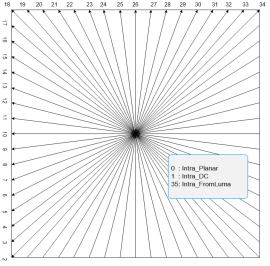
A key to efficient video compression is predicting future video frames on the basis of past ones. This diagram concerns "intra angular prediction."
(Credit: ISO)
UHD also requires a new video-coding standard, known as high-efficiency video coding, or HEVC (aka or H.265).
Although the MIT chip isn't intended for commercial release, its developers believe that the challenge of implementing HEVC algorithms in silicon helps illustrate design principles that could be broadly useful.
Moreover, "because now we have the chip with us, it is now possible for us to figure out ways in which different types of video data actually interact with hardware," says Mehul Tikekar, an MIT graduate student in electrical engineering and computer science and one of the paper's co-authors.
How HEVC works
Like older coding standards, the HEVC standard exploits the fact that in successive frames of video, most of the pixels stay the same. Rather than transmitting entire frames, it's usually enough for broadcasters to transmit just the moving pixels, saving a great deal of bandwidth. The first step in the encoding process is thus to calculate "motion vectors" — mathematical descriptions of the motion of objects in the frame.
On the receiving, end, however, that description will not yield a perfectly faithful image, as the orientation of a moving object and the way it's illuminated can change as it moves. So the next step is to add a little extra information to correct motion estimates that are based solely on the vectors. Finally, to save even more bandwidth, the motion vectors and the corrective information are run through a standard data-compression algorithm, and the results are sent to the receiver.
The new chip performs this process in reverse. It was designed by researchers in the lab of Anantha Chandrakasan, the Joseph F. and Nancy P. Keithley Professor of Electrical Engineering and head of the MIT Department of Electrical Engineering and Computer Science.
The chip's first trick for increasing efficiency is to "pipeline" the decoding process: a chunk of data is decompressed and passed to a motion-compensation circuit, but as soon as the motion compensation begins, the decompression circuit takes in the next chunk of data. After motion compensation is complete, the data passes to a circuit that applies the corrective data and, finally, to a filtering circuit that smooths out whatever rough edges remain.
Fine-tuning
Pipelining is fairly standard in most video chips, but the MIT researchers developed a couple of other tricks to further improve efficiency. The application of the corrective data, for instance, is a single calculation known as matrix multiplication. A matrix is just a big grid of numbers; in matrix multiplication, numbers in the rows of one matrix are multiplied by numbers in the columns of another, and the results are added together to produce entries in a new matrix.
"We observed that the matrix has some patterns in it," Tikekar explains. In the new standard, a 32-by-32 matrix, representing a 32-by-32 block of pixels, is multiplied by another 32-by-32 matrix, containing corrective information. In principle, the corrective matrix could contain 1,024 different values. But the MIT researchers observed that, in practice, "there are only 32 unique numbers," Tikekar says. "So we can efficiently implement one of these [multiplications] and then use the same hardware to do the rest."
Similarly, Chiraag Juvekar, another graduate student in Chandrakasan's group, developed a more efficient way to store video data in memory. The "naive way," he explains, would be to store the values of each row of pixels at successive memory addresses. In that scheme, the values of pixels that are next to each other in a row would also be adjacent in memory, but the value of the pixels below them would be far away.
In video decoding, however, "it is highly likely that if you need the pixel on top, you also need the pixel right below it," Juvekar says. "So we optimize the data into small square blocks that are stored together. When you access something from memory, you not only get the pixels on the right and left, but you also get the pixels on the top and bottom in the same request."
Chandrakasan's group specializes in low-power devices, and in ongoing work, the researchers are trying to reduce the power consumption of the chip even further, to prolong the battery life of quad-HD cell phones or tablet computers.
One design modification they plan to investigate, Tikekar says, is the use of several smaller decoding pipelines that work in parallel. Reducing the computational demands on each group of circuits would also reduce the chip's operating voltage.

Video phone Arduino shield

http://hackaday.com/2013/02/20/video-phone-arduino-shield/#more-94917

Friday, February 01, 2013

Streaming video latency on GoPro Hero3 Black.

We ran a quick test evaluating the GoPro Hero3 Camera for use in Live Video Streaming.

We were seeing around 4.7 Seconds delay while set to 1080P 14 fps.  or basically 66 frames delay. 

Our test was from from the Hero to an iPad3 over Wifi running their app. 

We also tested the HDMI output and found the latency to be impercievably low, we didn't bother  take a measurement.

We where unable to remove the on screen overlay display of the Battery indicator and other messages making in not suitable for a drop in HDMI video source. 

Still have not been able to get the video to stream over USB.

We also were unable to adjust the focus and were impressed with the wide angle lens but because the focus were unable to resolve text smaller then 1/4 inch. The color saturation is beautiful. 

These tests were performed at Anybots Inc. http://www.anybots.com in Santa Clara, Ca. 

John L. Sokol  2/2/2013


Thursday, January 31, 2013

The Vision Gyroscope

Check out this video on YouTube:

http://youtu.be/3g4hBwgGNX0


Sent from my iPad

Thursday, January 24, 2013

Tuesday, January 22, 2013

Fwd: 3D CineCast

---------- Forwarded message ----------
From: "3D CineCast" <olivier.amato@itbroadcastanddigitalcinema.com>
Date: Jan 22, 2013 4:10 AM
Subject: 3D CineCast
To: <john.sokol@gmail.com>

3D CineCast


Trifocal Camera Readied for Live 3D

Posted: 22 Jan 2013 12:40 AM PST

The days of stereo 3D mirror rigs could be numbered if new technology being devised by Arri, the Fraunhofer Institute and Walt Disney Studios comes to fruition.

The trio of companies have just begun a second phase of tests in Berlin on a trifocal camera system that comprises a single Arri M camera sandwiched between two micro HD cameras developed by Fraunhofer, alongside a computer processor.

The dual witness cameras capture enough information on set to be combined into depth maps by Fraunhofer's STAN Stereoscopic Analyzer software (which features in the DVS Clipster post tool), for the post production of live action content in 3D.


The concept would negate the need for cumbersome 3D camera rigs, allow an on-set 3D workflow similar to 2D, and in theory help produce 3D content without the glitches inherent in lens misalignment. Disparity-estimation techniques based on the three captured images should allow a second-eye view to be rendered at a virtual interaxial distance that is defined in post.

"If successful we will go into a third test in April this year and if that is successful it will be used on a major film production," revealed Kathleen Schroeter, executive manager 3D Innovation Centre, Berlin Fraunhofer Institute.

She said this was currently planned to be a 20-minute short film or a 20-minute sequence within a longer feature, both produced by Disney.

"The current trifocal system is for post production, but the next step is to render the data in real time so that we can produce live broadcast programming without rigs," she added.

Curiously the initiative has come from Disney in Hollywood, rather than Disney's own research institute in Zurich, which is also exploring ways of creating 3D content using plenoptic lenses and computational cinematography.

By Adrian Pennington, TVB Europe
You are subscribed to email updates from 3D CineCast
To stop receiving these emails, you may unsubscribe now.
Email delivery powered by Google
Google Inc., 20 West Kinzie, Chicago IL USA 60610

RGBDToolkit - DSLR + DEPTH Filmmaking | Home

http://www.rgbdtoolkit.com/

Thursday, January 17, 2013

Fwd: USB video conference camera makes video conference simple than ever

---------- Forwarded message ----------
From: "marketing@multipixhdtv.com" <marketing@multipixhdtv.com>
Date: Jan 17, 2013 6:25 PM
Subject: USB video conference camera makes video conference simple than ever
To: <john.sokol@gmail.com>


Model No.  MP-
USB 100 


720p30fps;
1/2.5"  CMOS  Image Sensor ;
Universal Serial Bus (USB2.0) Interface;
With IR remote controller ;

Application:
Small and mediumsized conference room; Video conferencesDistance learning;  Group training; Surveillance
Sports meeting ; Concert and Internet communications.

Seamlessly integrated into "Polycom,PVX_8.0/Cisco WebEx Series" video conference software and QQMSNSKYPE's video chat;
 

Saturday, January 12, 2013

Vuzix Debuts the M100, an Android Powered Monocular Display - CES 2013

Release Date: 2nd Half, 2013

Price: Under $500

Features: Compatible with Android and iOS, 1080p camera to capture video, onboard processor running android, WiFi and Bluetooth enabled


http://revision3.com/hak5/m100-display


Darren talks with Condition One CEO, Danfung Denis about their vitual imaging technology.


Re: Please can you give me some advice

Hello william,

"While there is no specific meaning for high-definition,"

First lets understand the question.

When I think definition, there is resolution and then is image quality in terms of sharpness, contrast, color saturation and noise level. 

The smallest lens is effectively a pin hole camera.  If you are unsure what that is, it's a fun kids science experiment to google or YouTube search for.

Pixel Resolution is unaffected by the lens size and it purely about the sensor.

Sharpness actually. Increases as a smaller lens can be less accurate and produce a shaper image.  In addition focus is also less of an issue, a pin hole camera is in focus for all distances.
In a larger lens light entering the one side of the lens must match light from the other. The precision of the alignment is determined by the lens quality, focus.  Things like chromatic aberration and many other factors come in to play and become more of an issue the larger the lens.

What does happen with the smaller lens is less light.  What that means is the image sensor is getting less signal.   This means less color resolution, gray scale resolution and sensor noise becomes more of a factor. The classic signal to noise ratio.

To deal with noise longer sample times are needed, meaning longer exposure times and slower frame rates on things like cheap USB web cams. 

In astronomy techniques like cooling the cameras sensors to reduce noise, extremely long exposure times and digital post processing of many successive images to produce a higher contrast low noise image is done. All of which can be applied to even a web cam.

Also high resolution sensors need more light to produce a good image.

So a small lens is a trade off, cheaper lens but less light coming in work with.

There are 1080p cameras with 1mm or smaller lenses.

Here is another extreme example of small lenses.


Sent from my iPad

On Jan 12, 2013, at 6:47 AM, John Sokol <john.sokol@gmail.com> wrote:

---------- Forwarded message ----------
From: W.E.
Date: Jan 12, 2013 5:59 AM
Subject: Please can you give me some advice
To: <john.sokol@gmail.com>

Hell
I wonder if you can help.
I am trying to figure out what is the highest definition i can get from a video camera with a smallest lens.
Can you enlighten me on this at all.
Thank you.
Regards
william

Friday, January 11, 2013

Fwd: Telibrahma press release

---------- Forwarded message ----------
From: "Rita Tennyson" <rita@pulppr.com>
Date: Jan 10, 2013 10:56 AM
Subject: Telibrahma press release
To: <john.sokol@gmail.com>

John:

I saw your blog where you put up my message to you about a CES appointment.  I'm going to paste below the press release as I think it would make a better blog post than my writing :)  Let me know if you can use it or need a photo, etc.

Thanks!

Rita Tennyson

Point Brings Augmented Reality to Your Television Screen

 Telibrahma's Point debuts as first Augmented Reality Second-Screen Experience


January 8, 2013, CES/Las Vegas, Eureka Park #74112 - Telibrahma (www.telibrahma.com), the award-winning leader in

global mobile marketing technology, is breaking the mold by debuting a revolutionary

second-screen experience with Point, their image recognition technology that can

capture point-enabled videos and provide an interactive experience for viewers.

Using Point, consumers can enjoy instant engagement across any mobile device by

simply pointing their phone at a Point-enabled video, movie, commercial or television

program and gain instant access to an augmented experience.


"Point provides a Shazam-like experience for consumers that takes them to the next

level of engagement, and we're thrilled to offer this exciting technology to users," said

Suresh Narasimha, CEO and Founder of Telibrahma.


Point is a 360-degree solution for consumer engagement and provides an innovative

way for brands to communicate with their audience.


In addition to point-enabled videos, Point also works with print ads, editorial content,

brand logos, newspapers, magazines and websites to create "real world" experiences

for consumers on their mobile devices.


Download Point from your mobile device at: www.PointArt.mobi


For more information on Telibrahma visit: www.telibrahma.com.


 About Point

Point, the world's lightest and fastest Augmented Reality, is a visual recognition augmented reality

platform that helps brands engage with consumers by creating "real-world" experiences of products. By

scanning a product or service with their smartphone camera, consumers can gain instant access to

search results that are enhanced by 3D and 2D camera overlays, video overlays, facial recognition and

contextual results. Point allows brands to go beyond the QR code by working with any ad, editorial, brand

logo, newspaper, magazine, website, place or video.


 About Telibrahma

Telibrahma is an Intel-funded company that focuses on consumer engagement through augmented reality

advertising. With Point, the company's new augmented reality platform, Telibrahma helps brands create

"real-life" experiences for consumers, increases engagement and produces higher ROI. Working with

brands like Dove, Nokia, Nike and Toyota, Telibrahma is a leader in contextual mobile solutions.

Telibrahma was established in 2008 and has offices in New York and India. For more information, please

visit the website at www.telibrahma.com.

Thursday, January 03, 2013

Fwd: [CES] Augmented TV (Intel-backed)

---------- Forwarded message ----------
From: "Rita" <lin@pulppr.com>
Date: Jan 3, 2013 8:58 AM
Subject: [CES] Augmented TV (Intel-backed)
To: <john.sokol@gmail.com>

Dear John,

Intel-backed Telibrahma, creators of the Point Augmented Reality platform, will be launching two items at CES:
 
-First augmented TV reality second-screen experience--just point your phone to the TV for a Shazam-like experience with moving image recognition
-Buzz, its new location-based engagement platform that delivers brands and retailers on-demand location-specific media leveraging WiFi and other tech to deliver rich media content with a superior experience
 
Telibrahma can met up on the show floor at Intel's booth. LVCC, Central Hall - 7252 or at its own booth in the Eureka Park section, #74112.  Please contact me with your schedule for CES and we can set up a demo/meeting.  Jessica Hasson will be available on site at 310/739-0344.  Thanks!
 
Rita Tennyson
 
 
Buzz is Available on the Following Mobile Devices:
iPhone, Android, Blackberry, Nokia and Windows 

Company Leadership

Suresh Narasimha, CEO and Founder

Narasimha has over 15 years of experience in entrepreneurship, product creation, mobile innovation and advertising. He has raised several rounds of funding for TELiBrahma while growing employment and earning profit at the same time.

Prior to founding TELiBrahma, Narasimha was the Practice Head of Convergence at Reasoft Inc., where he defined products and solutions while leading convergence and managing delivery organization. Narasimha also worked as a Senior software engineer at Siemens Information Systems Ltd. He has lead mobile advertising efforts at several companies including Nike, HSBC and Mercedes Benz.

Narasimha received his GSM Management degree at ICFAI and a degree at PES Institute of Technology.
 
Telibrahma

Telibrahma is an Intel-funded company that focuses on consumer engagement through augmented reality advertising. Since 2008, TELiBrahma has worked with the advertising, media and retail industries to create innovative ad campaigns that allow consumers to go beyond a print ad to the next level of engagement.

With Point 1.0, the company's new augmented reality advertising platform, Telibrahma creates "real-life" experiences for consumers, increases engagement and produces higher ROI for brands. Working with brands like Dove, Nokia, Nike and Toyota, Telibrahma is a leader in contextual mobile solutions. Telibrahma was established in 2008 and has offices in New York and India. For more information, please visit the website at www.telibrahma.com.


Saturday, December 29, 2012

Fwd: 3D CineCast

---------- Forwarded message ----------
From: "3D CineCast" <olivier.amato@itbroadcastanddigitalcinema.com>
Date: Dec 29, 2012 4:04 AM
Subject: 3D CineCast
To: <john.sokol@gmail.com>

3D CineCast


Google's New VP9 Video Technology Reaches Public View

Posted: 29 Dec 2012 01:05 AM PST

VP9, the successor to Google's VP8 video compression technology at the center of a techno-political controversy, has made its first appearance outside Google's walls.

Google has built VP9 support into Chrome, though only in an early-stage version of the browser for developers. In another change, it also added support for the new Opus audio compression technology that's got the potential to improve voice communications and music streaming on the Internet.

VP9 and Opus are codecs, technology used to encode streams of data into compressed form then decode them later, enabling efficient use of limited network or storage capacity. Peter Beverloo, a developer on Google's Chrome team, pointed out the new codec support in a blog post earlier this month.

Releasing VP9 gives Google a chance to improve the video-streaming performance and improve other aspects of VP8. That's important in competing with today's prevailing video compression technology, H.264, and with a successor called H.265 or HEVC that also has the potential to be attract broad support across the electronics and computing industry with better compression performance.

Codecs might seem an uninteresting nuts-and-bolts aspect of computing, but they actually ignite fierce debates that pit those who like H.264's convenience and quality against those who like that Google offers VP for free use.

H.264 is used in videocameras, Blu-Ray discs, YouTube, and more. But most organizations using it must pay patent royalties to a group called MPEG LA that licenses H.264-related patents on behalf of their many owners.

Google has tried to spur adoption of VP8 instead, which it's released for royalty-free use. One major area: online video built into Web pages through the HTML5 standard.

However, VP8 hasn't dented H.264's dominance, and VP8 allies failed in an attempt to specify VP8 as the way to handle online video. As a result, HTML5 video can be invoked in a standard way, but Web developers can't easily be assured that a browser can properly decode the video in question. Internet Explorer and Safari support H.264 video, Firefox and Opera support VP8 video, and Chrome supports both codecs.

Google had tried to encourage VP8 adoption by pledging in 2011 to remove H.264 support from Chrome, but it reversed course and left the support in. Mozilla, several of whose members were bitter about Google's reversal, has since begun adapting Firefox so it can use H.264 when the operating system supports it. Windows 7 and 8, Apple's OS X and iOS, and Google's Android all have H.264 support built in.

One cloud that's hung over VP8 is the possibility that others besides Google would demand royalty payments for patented technology it uses. Indeed, MPEG LA requested such organizations come forth as it considered adding VP8 licensing program, and it said last year that 12 organizations have said they have patents essential to VP8 use.

But it's been nearly two years since MPEG LA issued started seeking VP8-related patents, and the organization still hasn't offered a license.

The VP8 and VP9 codecs have their origins at On2 Technologies, a company Google acquired for $123 million. Google and assorted allies combined VP8 with the freely usable Vorbis audio codec to form a streaming-video technology called WebM.

By Stephen Shankland, CNET
You are subscribed to email updates from 3D CineCast
To stop receiving these emails, you may unsubscribe now.
Email delivery powered by Google
Google Inc., 20 West Kinzie, Chicago IL USA 60610

Thursday, December 06, 2012

Fwd: Revolve Robotics' debut robotic telepresence iPad stand Kubi is NOW LIVE on Indiegogo!


Begin forwarded message:

From: Marcus Rosenthal <marcus@revolverobotics.com>
Date: December 6, 2012, 5:03:47 AM PST
To: undisclosed-recipients:;
Subject: Revolve Robotics' debut robotic telepresence iPad stand Kubi is NOW LIVE on Indiegogo!

Hi friends,

We're excited to announce that our Kubi project is now live on Indiegogo! 

Kubi is the easy-to-use robotic platform we designed to enhance the video calling experience and other telepresence applications on tablets like the iPad.  A web-controlled, robotic iPad stand, Kubi means "neck" in Japanese and lets you look around and interact with remote environments during video calls.  We have created intuitive controls that operate effortlessly with Skype, FaceTime and other video calling applications so you can control your Kubi from across the globe, elevating video calls to a more natural, interactive experience.

Kubis are available for pre-order through our Indiegogo project from December 6 until January 16. Visit our project page and watch a video of Kubi in action, learn more about our product design, development and company! 

For those of you who have been waiting, we have a limited release of Kubis available for pre-order with a special early bird offer of $199 ($50 discount!).

We are so grateful for all your support during development stages and are thrilled for the opportunity to take Kubi from prototype to product in your home and beyond!

Please help spread the word by sharing with your friends and colleagues.

Thanks you for your support,

Marcus Rosenthal & Ilya Polyakov
Co-founders
Revolve Robotics
415-735-5502


Wednesday, December 05, 2012

Drivers file lawsuit over NYC red-light cameras - WSJ.com

It is worth noting similar cases have been brought on the West Coast. It had been blogged here.

http://online.wsj.com/article/AP1431c98f812642ea9bc8a330898e23a9.html

Thursday, November 29, 2012

Friday, November 23, 2012

The Vision Gyroscope

http://www.youtube.com/watch?v=3g4hBwgGNX0

Estimates angular velocities solely by means of image processing. Operates under a large variety of conditions and matches or even outperforms current MEMS gyroscopes in terms of accuracy, responsiveness and resource consumption.


Monday, November 12, 2012

3D-Bee Diamond

---------- Forwarded message ----------
From: "VEFXi - Creator of the 3D-Bee" <media@vefxi.com>
Date: Nov 12, 2012 6:22 PM
Subject: One Day Sale: 3D-Bee Diamond only $249!
To: <john.sokol@gmail.com>

Having trouble viewing this email? Click here

One Day Sale: 3D-Bee Diamond Only $249!

This is hot! 3D-Bee Diamonds are 50% off for one day only, Nov. 13, 2012 in tandem with the game release Call of Duty, Black Ops II. Take advantage today!

50% off 3D-Bee Diamond

About VEFXi:

VEFXi is the leading developer of the highest quality realtime 2D to 3D converters in ten hardware market segments and six service markets. VEFXi products are also utilized by several movie studios as the technology of choice for 3D conversion. VEFXi is uniquely positioned to advance 3D technologies with its current and future product lines. VEFXi is headquartered in Portland, Oregon. To learn more visit http://www.vefxi.com .

Learn more about VEFXi's cutting edge technology.

Forward email

This email was sent to john.sokol@gmail.com by media@vefxi.com |  

VEFXi - Creator of the 3D-Bee | PO Box 860 | North Plains | OR | 97133

Fwd: Optrix Expands Video Capturing Capabilities with New Accessories for XD Sports Case

---------- Forwarded message ----------
From: "Pedro Chen" <pedrochen@maxborgesagency.com>
Date: Nov 12, 2012 11:18 AM
Subject: Optrix Expands Video Capturing Capabilities with New Accessories for XD Sports Case
To: <john.sokol@gmail.com>

Optrix Expands Video Capturing Capabilities with New Accessories for XD Sports Case
Selection by iStabilizer includes the Glidepro video stabilizer, rugged Dolly, extendable Monopod and Tripod Flex

Marin, CA – November 12, 2012 – Optrix, designer of action sports video cases for smartphones, in partnership with iStabilizer, announces the availability of accessories customized for the acclaimed XD Sport Wide-Angle action case.  Designed to transform the iPhone 4, 4S and iPod Touch into an extreme wide-lens camera, the XD Sport adds the Glidepro handheld video stabilizer, rugged flexible Dolly, extendable Monopod and Flex Tripod to it's stable of accessories and mounts.

"Although the XD Sports Case is military grade and rugged enough to withstand almost any condition, it is also the perfect iPhone case for photography enthusiasts," said John Willenborg, founder of Optrix.  "Our new line of accessories gives both photography novices and professionals even more options to capture their memories while keeping their device safe."

Product Highlights:

Glidepro – Hand Stabilizer
-    Ideal to capture smooth and steady videos anywhere
-    Eliminates the shakes typically associated with hand-held filming
-    Utilizes same technology found in professional filmmaking equipment

Dolly – Flexible Roller
-    Ideal for tracking shots, time lapse, artistic work and capturing travel videos
-    Large wheels provide smooth movement
-    11" adjustable arm allows for unique angles and positions

Monopod
– Extendable Arm
-    Ideal for self-portraits, high/low angles, self-videos and POV shots
-    Extendable arm provides access to hard to reach camera angles and positions
-    Lightweight portable design extends up to 3 ft

Flex
– Flexible Tripod
-    Ideal for usage from unique angles, including poles, tree branches and more
-    Flexible legs secure your XD Sport to virtually any surface
-    Compact size makes it a perfect travel companion

Optrix's new accessories are available individually or in bundles at www.optrix.com.  The Optrix XD Sport action sports case can be found at select Apple, Best Buy and Target stores; and online at Apple.com, Bestbuy.com and www.optrix.com

For additional information about Optrix, visit our website or contact PR representative Pedro Chen at 305-374-4404 x139, PedroChen@maxborgesagency.com.

About Optrix
Optrix is a designer of military grade action sports video cases for iPhone 4, 4S and iPod Touch that enables capturing in all environments while taking advantage of the iPhone 4S interface and advanced video capabilities.  Optrix's team of extreme sports athletes includes race car drivers, skateboarders, mountain bikers and surfers, and is committed to becoming the leading provider of extreme filming smartphone cases.

About iStabilizer:
Based in Park City, Utah, iStabilizer designs universal smartphone mounts that allow users to create professional, high quality photos and videos. With their lightweight and compact tripods, dollies, steady cams and mounts, iStabilizer helps amateurs and professionals alike, turn ordinary camera work into extraordinary works of art. iStabilizer's team of highly motivated creative individuals are committed to providing the highest level of product performance and service, for many years to come.

Media Contact
Pedro Chen
Sr. Account Manager
Max Borges Agency
(305) 374-4404 x139
PedroChen@maxborgesagency.com

###
 
Sent to:john.sokol@gmail.com
If you prefer not to receive
future e-mails of this type,
click here
Sent By:
Max Borges Agency
3550 Biscayne Blvd
Suite 501
Miami FL 33137
U.S.A.
 
To view as a web page click here.

Sunday, November 11, 2012

Jury says journalist arrested while videotaping police is not guilty


Jury says journalist arrested while videotaping police is not guilty

Police Major Nancy Perez, moments before she arrested Miller on January 31, 2012.

A jury acquitted a Florida photojournalist who was arrested on January 31while documenting the eviction of Occupy Miami protesters. The police accused Carlos Miller, author of a popular blog about the rights of photojournalists, of disobeying a lawful police order to clear the area. But another journalist testified he had been standing nearby without incident.

After Miller's January arrest, the police confiscated his camera and deleted some of his footage, including video documenting his encounter with the police. That may prove to be an expensive mistake. Miller was able to recover the footage, which proved helpful in winning his acquittal. He says his next step will be to file a lawsuit charging that the deletion of the footage violated his constitutional rights.

"I was questioning their orders. That's what I do"

The one-day trial occurred on Wednesday. In a Thursday interview, Miller told us that the prosecution accused him of "being antagonistic to police because I was questioning their orders." However, he said, "that's what I do. I know my rights. I know the law."

During the trial, Miller's attorney, Santiago Lavandera, admitted that Miller used some coarse language with the police officers at one point during the evening. But he stressed that it wasn't the job of a journalist to meekly obey police orders.

"When you're a journalist, your job is to investigate," Lavandera told the jury. "Not to be led by your hand where the police want you to see, so they can hide what they don't want you to see. As long as you are acting within the law, as Mr. Miller was, you have the right to demand and say, 'no, I'm not moving, I have the right to be here. This is a public sidewalk, I have the right to be here.'"

Miller told us the jury deliberated for only about half an hour before returning a verdict of "not guilty." He said his case was helped by the footage he recovered from his camera. That footage, he told us, clearly showed that there were other journalists nearby when he was arrested.

One of them was Miami Herald reporter Glenn Garvin, who testified in Wednesday's trial. According to Miller, when Garvin saw Miller being arrested by Officer Nancy Perez, "he immediately thought he was going to get arrested, so he asked Nancy Perez if it was alright for him to be standing there and she said, yes, he was under no threat of getting arrested."

Enlarge / Perez is cross-examined by Miller attorney Arnold Trevilla.

There's a history of confrontations between Miller and the police, and Miller said the police had singled him out for that reason. An e-mail disclosed during the trial showed the police had been monitoring Miller's Facebook page and had sent out a notice warning officers in charge of evicting the Occupy Miami protestors that Miller was planning to cover the process.

Constitutional challenge

Now that Miller doesn't have a jail sentence hanging over his head, he's planning to turn the tables on the Miami-Dade Police Department. He plans to file a lawsuit arguing the deletion of his footage by the police violated his constitutional rights.

According to Miller, such incidents are disturbingly common around the country. As camera-equipped cell phones have proliferated, ordinary Americans have increasingly used the devices to document how police officers do their jobs. And he said he heard of numerous incidents in which the police confiscate these devices and delete potentially embarrassing footage.

Miller told us most victims don't stand up for their rights in court. In many cases, people are happy simply to have the police drop the charges against them. But Miller isn't so easily cowed.

If Miller files his lawsuit, he will join a handful of other plaintiffs who have gone to court to vindicate their rights to record the activities of police officers. Judges in Massachusetts and Illinois have held it unconstitutional to arrest people for recording the activities of police. A Baltimore man hassued the police for deleting his footage from his cell phone. The Obama administration filed a brief in the case arguing that deleting such footage violates the Fourth Amendment.

Miller points out that if an ordinary citizen deleted footage relevant to an alleged crime, he could be charged with destruction of evidence, a felony. He believes that police officers should also be held accountable when they seize cameras and delete footage.

Wednesday, November 07, 2012

Apple Told to Pay $368.2 Million to VirnetX in Trial- Bloomberg

> From: JM
>
> http://mobile.bloomberg.com/news/2012-11-07/apple-told-to-pay-368-2-million-to-virnetx-in-patent-trial-1-.html

A federal jury in Tyler, Texas, said Apple's FaceTime function, used on the iPhone, iPod Touch and iPad as well as Mac computers, infringed four VirnetX patents. VirnetX had won a $200 million settlement from Microsoft Corp. in 2010 over the same technology.

"This victory further establishes the importance of our patent portfolio," VirnetX Chief Executive Officer Kendall Larsen said in a statement.

The VirnetX patents cover the use of a domain-name service to set up virtual private networks, through which a website owner can interact with customers in a secure way or an employee can work at home and get access to a company's electronic files.

Microsoft Files Patent to use Kinect to Detect Audience Size for Licensing Content

http://www.hackingnetflix.com/2012/11/microsoft-files-patent-to-use-kinect-to-detect-audience-size-for-licensing-content.html

Friday, November 02, 2012

H.264 Decoder in JavaScript Running at 30fps

I must admit, I missed this one when it happened.

A friend of mine was telling me they were streaming live H.264 video off an AR Drone Copter using  Broadway.js

Some 15 years ago I did an H.263 decoder in Java, but it was miserable and only had enough cpu to
do 176x144 postage stamp size video.

Source code available here:
https://github.com/mbebenita/Broadway

Native JavaScript H.264 decoder offers compelling demo of JS performance
Mozilla has released "Broadway," a native JavaScript-based H.264 decoder that …
http://arstechnica.com/information-technology/2011/10/native-javascript-h264-decoder-offers-compelling-demo-of-js-performance/

Broadway: An H.264 Decoder in JavaScript Running at 30fps
JS Challange: Build an H.264 decoder in JavaScript for Firefox and Chrome. If we can do PDFs and MP3s, we can do H.264!
http://badassjs.com/post/12035631618/broadway-an-h-264-decoder-in-javascript-running-at


Similar project but for WebM video:
Route9.js: A VP8/WebM decoder in JavaScript
http://badassjs.com/post/13551173773/route9-js-a-vp8-webm-decoder-in-javascript

Thursday, October 18, 2012

Inter-Continental 8K Media Streaming Demonstrated at the GLIF Global LambdaGrid Workshop

---------- Forwarded message ----------
From: BC
Date: Thu, Oct 18, 2012 at 8:50 AM
Subject: Inter-Continental 8K Media Streaming Demonstrated at the GLIF Global LambdaGrid Workshop
To: John Sokol 
http://www.ces.net/doc/press/2012/pr121017.html

Tuesday, October 16, 2012

Hasselblad aims for luxury camera market, not just pros - CNET Mobile

http://m.cnet.com/news/hasselblad-aims-for-luxury-camera-market-not-just-pros/57514888

Fwd: IEEE CES - Oct 23, Quantum Dots / Nanosys

---------- Forwarded message ----------
From: "Gary Sasaki" <gary.sasaki@digdia.com>
Date: Oct 16, 2012 8:54 AM
Subject: IEEE CES - Oct 23, Quantum Dots / Nanosys
To: <ieee-scvce@listserv.ieee.org>

Note: NVIDIA has been a great venue for our meetings, but sometime in 2013 we will need to move to a new venue. 
If you know of a venue that we can use that can hold about 150 people or more, please let us know.  Thank you.


October 23 Meeting Notice

Subject:

Quantum Dots, The Future of LED Display Technology

Speaker(s):

Jason Hartlove, President and CEO of Nanosys

Venue

NVIDIA - 2800 Scott Blvd, Building E

Date and Time:

October 23, 2012
6:30 - 7:00 Pizza + Drinks, Networking
7:00 - 8:30 Talk and Questions

Register Online

Click to Register

Abstract

Consumers want a lifelike experience in a handheld device and color performance is the one area where large gains can be made immediately to greatly enhance that experience. Color performance, the next major differentiator in the mobile market, will bring a stunning new visual experience to the consumer and a great new value proposition to the manufacturer.

Current mobile devices are only capable of displaying 20 to 30 percent of the visual color spectrum. This means the user is missing a large component of the visual experience.

Designed as a diffuser sheet replacement, Nanosys' QDEF creates an ideal white backlight for LCD displays. The result is stunning color and a more lifelike user experience. High-color displays allow consumers to enjoy more visceral, more impactful, and truer to life content from photos to movies to videogames.

Speaker

Jason Hartlove joined Nanosys in 2008 with a proven track record of turning emerging technologies into successful commercial products. Prior to joining Nanosys, he was president of the Imaging Solutions Division of MagnaChip Semiconductor in Seoul, South Korea, where he turned an internally focused semiconductor group into a multinational company. Mr. Hartlove is the author of more than 20 patents, including the winner of the Hewlett Award in 2004 for best patent. Mr. Hartlove holds a B.S. in electrical engineering from UCLA and has completed graduate work at the Anderson School of Management at UCLA.

Meeting Place
NVIDIA, 2800 Scott Blvd., Building E, Santa Clara
Click to see overhead photo of campus

Admission Fee: Open to all - to attend -
(Please register in advance. If you cannot register in advance, you can still show up at the door, but please allow extra time for NVIDIA security signin.)

IEEE CES members - free
IEEE Student members - free
IEEE members - $5 (pay at door)
non-members - $10 (pay at door)
You do not need to be an IEEE member to attend!
(If you wish to be a member of IEEE, click here)

To see our upcoming events - click here


Best Regards,

Gary Sasaki

DIGDIA

twitter: @digdia


This message being sent to you on behalf of the IEEE Santa Clara Valley Consumer Electronics Society
Click here to be added or removed from this mailing list

IEEE Santa Clara Valley, Consumer Electronics Society
www.ieee.org/scvce

Founders of Leap Motion: Our Amazing 3D Tracking Will Be Everywhere | Singularity Hub

http://singularityhub.com/2012/06/13/founders-of-leap-motion-our-amazing-3d-tracking-will-be-everywhere/