Friday, December 17, 2010

3 reasons why MasterImage may win the 3D Cinema wars.

1.) Low cost recyclable / disposable Glasses

Glasses need to be sterilized before handing then out a second time to customers.
This is a laborious process that will significantly increase the cost of man power to operate a theater. It this cost that I think will limit the Dolby system to only the most high end theaters.

One of the more successful business strategies is "Give away the razors..sell the blades" It's taught at every business school in the country.

Well with the MasterImage glasses this seems to be the case, where they recycle the glasses over and over can keep reselling sterilized and sealed packaged glasses to theater operators. It's a brilliant strategy with glasses being the blades


The plastic glasses to cost under 0.50 a pair new.  With cleaning and reuse it's totally down to cleaning, packaging and shipping costs. What this means is even buying new glasses from China for each viewing isn't competitive with recycling.


Packaging on MasterImage recyclable plastic Glasses

2.) RealD uses a perpetual licensing agreement while MasterImage sells systems to theater chains, allowing them to own the 3-D technology outright.

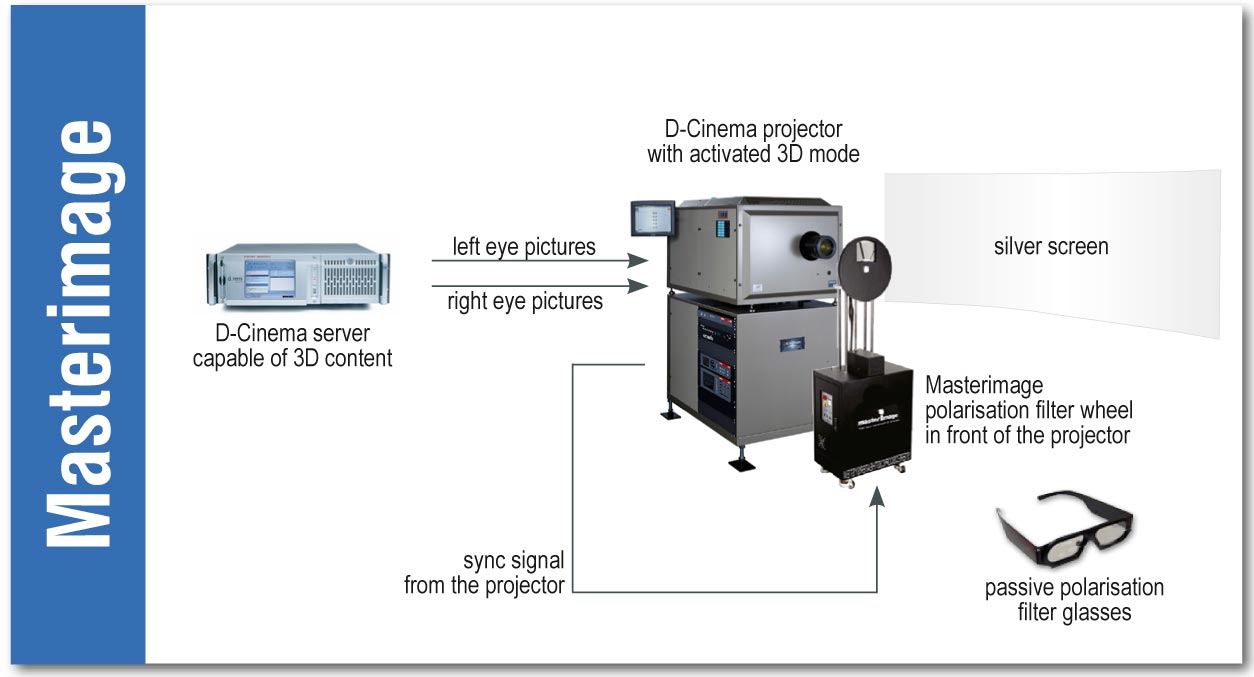
3.) Low tech light polarizer on the projector. These are the razors. This is used to turn each film/video frame from clockwise and counterclockwise polarization. Real-D uses a transparent LCD panel, which is high tech with no moving parts while the master image uses a synchronized rotating wheel with low cost plastic filters.  I suspect it is much lower cost to produce then the Real-D system.

The custom Polarizing LCD panel called is Z-Screen that Real-D depends on can only be produced by a few companies at best, and maybe only one.   The MasterImage system is something that someone who can repair a projector could probably fix.

The Dolby system uses the most advanced filter system that filters out narrow bands of light. This filter is made of very thing vacuum deposited metal layers to form an Interference filter. These are only made by one company JDSU is the world's largest producer of optical coatings. It must be built in to the projector itself and placed between the light source and the DLP or LCOS light valves.


Thursday, December 16, 2010

Freeviewpoint

What's next beyond 3D? Free viewpoint video is the ultimate 3DTV.

This will be the next hottest technology.

Free viewpoint video offers the same functionality that is known from 3D computer graphics. The user can choose an own viewpoint and viewing direction within a live scene. They are free to move around and interactive navigate as if they could control the camera.

What's different from your 3D video-game Virtual environment is, Free viewpoint video targets real world scenes as captured by real cameras. This could be live, streaming or recorded.

This is interesting for consumers where you could now where the viewer could freely chose the viewpoint as well as for professional production and post.

Tools for post-production are already being used (e.g. for sports, movies, EyeVision, Matrix-effects).

I have seen this described as Virtual Cameras, and Synthetic views.

The secret is setting up a many cameras around the "event" and taking video from all angles, then compiling them together to form the virtual space.

With sufficient video coverage off all surfaces and enough data to construct accurate 3D models this data can then be used to drive a standard PC graphics card to renders it in full 3D from any position and angle.

This would allow a user to zoom around like it were a virtual room in a video game.

One things about this technology is it could render better quality images then the source cameras by fulling pixels from one camera with pixels from other cameras.

Not all cameras would need to be identical, so some could be SD and other HD and even low frame rate very high def like digital still cameras. All of this image data can be integrated together and use to refine the texture maps in the 3D Model.

The applications of this live sports could change everything. We could see the game from the perspective of any player on the field, from the referees or even the the ball.

New cameras would not be needed to produce high quality 3D content, the saving to studios would be incredible. In addition post production techniques could be used to correct for eye separation and perspectives making 3D content easier on the eyes and helping to eliminate headaches and fatigue.

In CCTV and surveillance also it would allow an operate to do far more then just zoom in. Cameras could be strung like Christmas lights and placement and reliability of a single camera wouldn't be as critical.

In Military, AUV and fixed cameras could be integrated to provide total battle field awareness.

By tracking an objects position with several cameras and determining it's 3D position with sub pixel accuracy it becomes possible to integrate video from several cameras across many video frames to produce super resolution images and 3D models of faces and objects.

When this technology is applied to Head Mounted Displays (HMD) in a VR / AR type headgear you would literally be able to walk around in a live action scene like the
Star Trek Holodeck or Matrix construct as a ghost. You could see them, but they will not see you unless they are wearing AR Goggles too. A fly on the wall.

VR / AR = Virtual Reality / Augmented Reality

Free viewpoint television - Wikipedia

Viewpoint - Technologies - Viewpoint Media Player

3D VIDEO AND FREE VIEWPOINT VIDEO – TECHNOLOGIES, APPLICATIONS AND

FIFA World Cup in Full Court 3-D Vision

Free-Viewpoint TV (FTV) System

FIFA World Cup in Full Court 3-D Vision : Update

Holographic TV dreams in Japan 2022 World Cup bid


Forget 3D TV, Japan was promoting the idea of ultra-realistic holographic broadcasts and the ability to zoom a virtual camera in behind players on the pitch if it was given the 2022 World Cup. Japan proposed expanding the World Cup to all 208 FIFA member nations through fan-fest events that will feature live, holographic coverage of the games. Fans will gather in stadiums thousands of kilometers from the action and watch the games as if they are taking place in front of their eyes.


For more info see original Article: FIFA World Cup in Full Court 3-D Vision

Wednesday, December 15, 2010

Dolby Digital 3D vs Real D / Master image systems.

It's interesting to watch this evolutionary battle play out.

Dolby 3D Digital Cinema / INFITEC Glasses

VS.

Real-D / Master Image Circular Polarized Glasses

Dolby's 3D is clearly superior, I mean just breathtaking 3D, but in the end it's the costs and not just the image quality that may end up determining the winners in this game.

Glasses

I am told the Dolby glasses are $38 a pair, which is an amazing deal for 2 precision interference filters.

The Real D / Masterimage system using inexpensive plastic polarizers. This make them almost disposable.  But this lower cost in glasses comes at a cost.

 
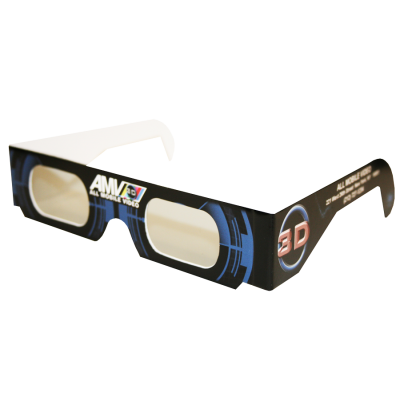
American Paper Optics Even make disposable paper glasses for 3D movies that I am sure the theaters really have consider deeply.  I think they went for the recyclable plastic just because the paper seemed too cheap.

I wonder if they ask their customers, "Would you like that in paper or plastic?"


There is also a shutter goggle system that nearly identical to what they are now pushing with 3D HDTV's. These are my least favorite as they require batteries, and are bulky and don't work 1/2 the time.  I have not seen these use in a normal theater setting ever, only in amusement parts, older IMAX system and trade show demos.

It's getting push with HDTV's only because it required no changed to existing TV designs and they can charge more.   Just the addition of an IR LED to provide a sync signal to the glasses and a sticker and double the price. I will discuss shutter goggle technology in more depth in a later article.


Screen

3D projection using polarization requires non-depolarizing screens. What this means in that the screen must be coated with a special polarization preserving material, usually silver or aluminum metals in paint.

Regular white matte theater screens cost normally around $6000 for an ordinary screen which the Dolby system and shutter glasses can use.

But not just any screen will work with polarized light it cost $13000 or more for an old fashion silver screen or specialized 3D Polarization preserving screen.

Da-Lite 3D Silver Matte or Virtual Grey front projection material

Silver screen in general don't give as good of an image as the high reflectivity white matte plastic screens.  You can see an almost metallic luster and they have more of a Grey appearance.


Maintenance

But there is a hidden cost with the Dolby system, with the increased cost of the glasses this brings about several other problems.

The need to keep to employees by the theater doors when the film ends to collect the glasses even with the anti-theft RF tag.

Also the cost of washing and sterilizing the glasses and the manpower needed to do this.

When they recycle the polarizing glasses the issues are the same they can order many pair of glasses and eat the cost of the ones that aren't returned.

The glasses can be sterilized in one of two ways.
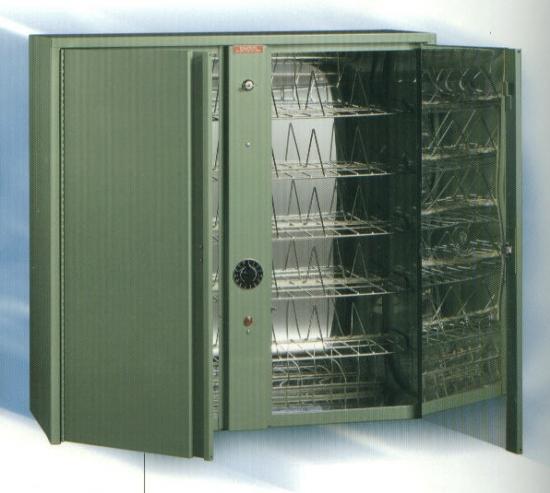
1.) UV sterilization system but most UV sterilizers are only small capacity and usually used for laboratory safety goggles.

2.) A commercial washer that uses a special disinfectant detergent.

Both take about 1 hour and some man power to load and unload the glasses.

 UV sterilizer

Projectors & Filter Wheels.

Both systems use synchronized wheels in front of a digital projector.

In the Dolby system they provide now is a sealed Barco SUPERKONTRAST projector system with the filter wheel inside. The Theater operators can not open it and if they do an Alarm system prevents the projector from running till a technician comes out and resets it.

Dolby 3D filter wheel


JDSU is the world's largest producer of optical coatings, developed the 3D filter wheel technology for use in an exclusive partnership deal with Dolby.

I just can't tell you how cool this technology is. Some of the most impressive optical interference filters to split the RGB into and upper and lower spectrum for each eye. 


Master Image also has a rotating wheel system, with alternating Clockwise and Counterclockwise circular polarizers.

I see is both of these as some sort of throwback to the film days with all the the clockwork and moving parts.


The Real D system uses "Z Screen" basically an electronic polarizing filter but for the most part is 100% compatible with the Master Image system.


Summary


$38 Glasses, expensive to clean
Uses existing screens
Special Projector, cost unknown.
Needs special digital cinema server.


Glasses almost disposable. They are recycled, meaning washed and repackaged.
Needs special screen at 2x the cost.
Can use any standard projector and digital cinema server.


Glasses almost disposable. They are recycled, meaning washed and repackaged.
Needs special screen at 2x the cost.
Can use any standard projector and digital cinema server.


$50+ Glasses, expensive & difficult to clean, (can't get electronics wet),
The glasses are also prone to malfunction, with batteries dying, contact failing etc.
Uses existing screens
Can use any standard projector and digital cinema server.


OPINION

It's my opinion that even though the Dolby system is superior, the circular polarized systems will win, the glasses are lighter, cheaper and disposable. (really important with small kids)

I think in the end they will also win the battle on the HDTV front also for this very same reason.


More Reading:

I explain in some depth how the Dolby system work here.
Dolby 3D Digital Cinema
MasterImage site
Chinese source for Circular Polarized glasses

Eye Wear

Through the 3D looking glass

http://www.avsforum.com/avs-vb/showthread.php?t=953978&page=5


http://www.reald.com/

3D projection in cinemas

Digital 3D-Systems

American Paper Optics

Dolby 3D Glasses Training Video

Sunday, December 12, 2010

Rear Window Captioning

Rear-window captioning system displays reversed captions on a light-emitting diode (LED) text display screen that could be fastened to the back of a theater seat. The plexiglass device looks like a rear-view mirror that fits into a viewer's cup holder and reflects words from a display board in the back of the theater so that they appear superimposed on the movie screen. The reflective panels are portable and adjustable, enabling the caption user to sit anywhere in the theater. The 'rear-window' reflectors are made available at the theater's customer service desk.

Theater can be outfitted for this 'rear-window' captioning system for around $10,000.


Rear Window Captioning System

http://ncam.wgbh.org/mopix/

http://www.designboom.com/portrait/rufus_rear.html

Cinemark Sued Over Closed Captions

Descriptive Video Service (DVS)

Monday, December 06, 2010

Camera implanted in the back of the head


The camera, which will be stuck to the NYU photo professor Wafaa Bilal's head via a "piercing-like attachment" when he goes through surgery in the next couple of weeks according to the WSJ, will take photos every 60 seconds and beam them to monitors at the Mathaf: Arab Museum of Modern Art in Qatar.


This is quite mild compared to the one in this other story from last year.
A one-eyed filmmaker get a camera eye

More info on
This Professor Is Surgically Implanting a Camera in the Back of His Head
NYU art professor to take photos with camera implanted in the back of his head

The official Web site: http://www.3rdi.me/

LG Display, Chi Mei, others face EU fines

LG Display, Chi Mei, others face EU fines: source

Mon, Dec 06 10:44 AM EST

By Foo Yun Chee

BRUSSELS (Reuters) - EU regulators are set to fine LG Display, Chi Mei Optoelectronics Corp and three other firms up to 700 million euros ($928 million) in total for fixing prices of display panels used in consumer devices, a source close to the case said on Monday.

The European Commission, the EU antitrust watchdog, charged the companies in July last year with breaching EU laws on restrictive business practices, while other regulators around the world have also investigated the sector.

"The total fine will be between 600 and 700 million euros," the source told Reuters.

The EU executive will levy the biggest fine on Taiwan's Chi Mei, the source said, declining to provide details of the individual fines.

Chi Mei paid $220 million in fines last year after pleading guilty to U.S. charges of price-fixing. The company later merged to form Chi Mei Innolux, a combination which now comprises Taiwan's largest maker of LCD panels.

The Commission is expected to announce its decision on Wednesday, sources told Reuters previously.

The Commission can penalize companies up to 10 percent of their global turnover for infringing EU laws.

The watchdog did not identify the companies at the time, but LG Display, 3 AU Optronics and Chi Mei confirmed the charges.

Taiwanese firms Chunghwa Picture Tubes and HannStar Display Corp were also named in a Commission document obtained by Reuters.

World No.1 LCD maker Samsung Electronics will not be fined as it alerted the Commission to the cartel.

Dutch company Philips received a copy of the charge sheet as a former shareholder of LG Display, but said it was not directly involved. It sold the rest of its shares in the joint venture with LG Electronics in March 2009.

The EU Commission's case had centered on thin-film liquid crystal display panels used in computers, mobile phones, televisions, digital watches, pocket calculators and MP3 players.

In the U.S. Department of Justice investigation, eight companies, including LG Display, Chi Mei, Chunghwa, Japanese company Sharp Corp and Hitachi Displays, paid more than $890 million in criminal fines for price-fixing.

Japan's Fair Trade Commission slapped fines on Sharp Corp and Hitachi Ltd in 2008 for price fixing in the market for LCD panels.


I have written about them previously. 

Chimei Innolux Corporation (CMI)   奇美电子


Chi Mei

Friday, December 03, 2010

What's been happening with Barbie Video Girl!

Barbie Video Girl Doll (Mattel, $45 at Toys “R” Us) seems like clever idea — put a video camera inside a doll — until you try to find the tiny Phillips screwdriver needed to fit the AAA batteries into Barbie’s legs. Your child soon will discover that Barbie has no speakers, so all the videos are silent until the doll is tethered to the computer.


Canon 7D vs. Barbie Video Girl from Brandon Bloch on Vimeo.

Canon 7D vs. Video Barbie.


Wire Magazine: Video Barbie in FBI Cross Hairs

Image deblurring using inertial measurement sensors

Make Magazine:  Image deblurring using inertial measurement sensors


Also see an older article from August 2010: Image Deblurring using Inertial Measurement Sensors

Thursday, December 02, 2010

Video display clothing.

Fans of an artist can walk around with a video of there favorite musician or movies playing on there backpack. (audio on or off)

This can be a whole new revenue stream for the industry.

The idea is to make a clear plastic pocket in shirts, jackets and backpacks designed for these displays to be held.  Make standardized pocket sizes.
Clothing is sold with cardboard inserts with photos in it, but you can buy your digital players separately preloaded with videos, images & music.


O-Led
http://www.youtube.com/watch?v=f8S8tbQMp2k

http://www.youtube.com/watch?v=NcAm3KihFho


E-ink

http://www.videotechnology.com/old11-03.html  Second article down on the right.

http://www.youtube.com/watch?v=P8u3OfKG3tI

http://www.youtube.com/watch?v=oq_2LiTxhls

Shooting in 3D: Very Early Days

Shooting in 3D: Very Early Days

Good video related facebook groups

http://3dtvshop.tv/
http://www.facebook.com/pages/3DTV/167813426584547


www.videomaker.com
http://www.facebook.com/pages/Videomaker/39881894777


Video Technology


www.WEVA.com
WEVA - Wedding & Event Videographers Association International

Add an comment if you know of any others. 

FIFA World Cup in Full Court 3-D Vision

Japan pledged a technologically mind-blowing experience for the 2022 FIFA World Cup Soccer.

It said by 2022 it could beam games to iconic stadiums around the planet using revolutionary 3-D technology to make it seem as though players are rising out of the ground.

The action in Japan would be filmed using hundreds of cameras and broadcast to screens laid flat on the pitches of iconic locations.

Sony chairman and chief executive Howard Stringer said the so-called Full Court 3-D Vision would work.

"This is not science fiction," he said. "In 2022, this will be science fact."


Sony is planning to released a full soccer field-sized 3D holographics real-time soccer match for the coming Japan 2022 FIFA World Cup. Japan is talking about to setting up 400 stadiums around the world with 3D flat screens to show live size matches thousands of miles away.

Japanese officials dubbed the technology "Full Court 3D Vision," with hundreds of "Freeviewpoint" cameras designed to document the action. The 3D and Freeview rights would be completely separate from the global TV broadcast rights, Japanese officials said.


Concept video


Concept video


I already know how I could do this today, in 12 years it will not only be possible but cheap.

If anyone wants to develop this type of technology please contact me


To get some understanding how this would have to work read:
NHK Japan is Promising Functional Holographic TV by 2016 and Will Work With Korea to Present 2022 World Cup With 3D Holography

Wednesday, December 01, 2010

Apple Wins Patent for Glasses-Free 3-D TV


Read article on PatentlyApple & fastcompany.com

Apple credits Christopher Krah as the sole inventor of Granted Patent 7,843,449 originally filed in Q3 2006. 

Augmented Reality 3D Digital Graffiti


Graffiti artist DAIM "sprays" digital graffiti into empty space

Augmented Reality will change everything in the future, where we will live in a mixed world.

1/2 in the real world and 1/2 in a digital virtual world.

Using Head Mounted displays similar to sun glasses or the 3D glassed need to watch 3D TV now, we can add Interactive video and computer graphics over the real world.

QR Code


QR codes are a 2D barcode format, mostly used by cell phone cameras.


QR Code has the advantage of large information capacity and is similar to an AR marker  in appearance. (AR is Augmented reality) Thus, more interesting and useful applications can be developed by combining the QR Code with the traditional AR system.

AR systems often use a particularly designed pattern (the marker) to recover the 3D scene structure and identify the object to be displayed on the scene. In these systems, the marker is used only for tracking and identification.

A QR Code is pasted on the package of a product and then a 3D virtual object is displayed on the QR Code. This system allows the customer to visualize the product via a more direct and interactive way.

I believe that in the future using QR Code as the AR marker will become common place.


Wikipedia Article on QR Codes
AR Toolkit

Virtual Fashion Show


www.demoslam.com | Some trendsetting Japanese girls try on clothes using nothing but a projector.

Now imagine adding 3D position data using something like the Microsoft Kinect , and you could do real time video mapping on to a live person.

By this I mean as the person in front of the projector moves, so could the virtual dress image with her. If she were to turn around the image of the dress could turn around with her giving a much more realistic image of her wearing a dress.

DVD video rental Prototype.

What can I say, It's breaks my heart. Another venture that didn't quite make it.

DVD Rental Machine Bar codes and storage bins.

Below is a variety of different Barcodes designed to go around the DVD spindles.

Also the storage cases designed to allow the bar codes to be read while inside and handle by the robotic pick and place systems.


Inside a Video Rental Machine there is a Robotic pick and place system.

Some of these can handle both VHS tapes and DVD's.


RFID and Barcodes for DVD's and DVD Video Rental Machines.

This is mostly just a collection on Photo's from when I was working on this stuff.


These are different RFID tags to go around a DVD hub that will not interfere with DVD playback.  Some of these are prototypes and initial samples.  Feb 2005


Circular Bar-codes for DVD rental Machines.


This is the RDID reader and reader board.


Video based Automotive Wheel Alignment System

The John Bean Visualiner 3D system use 2 camera with Red LED lights around then very similar to the IR Night vision CCTV cameras.

These are aimed at targets that have an image pattern that's black and retro-reflective film.

See article Retroreflective Materials for more info on that.


Many years ago I helped a friend work on a computer based automotive wheel alignment system/ Autobody measurement system.

This was back in the mid 80's and was based on a Commodore 64 computer with Rotary optical encoders with fishing line.

The accuracy requirements were very high and it's a very difficult environment that's hot and cold, dusty, greasy and dirty.

So it's even more impressive to me that the video system can get the needed measurement accuracy, be able to tolerate the dirty environment and be simple enough for no computer people to operate.

It's one thing to make something like this work in the lab, but out in the Auto Mechanics garage is impressive.

These days these targets are very similar to the Augmented reality markers that the AR Toolkit and other video tracking systems can key on.

Product information at:

Visualiner 3D2

Wheel Aligners


Video Targets